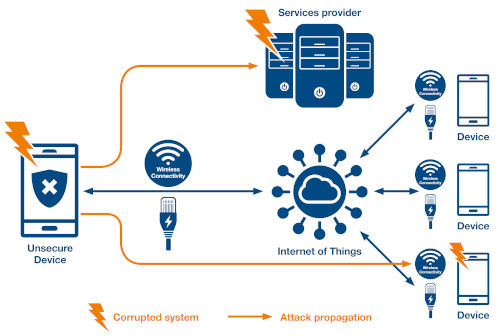

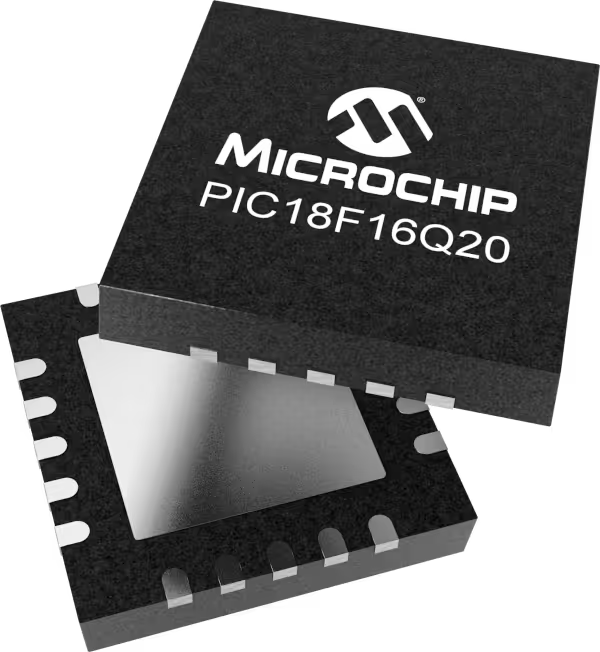
This increased connectivity effectively turns these devices into peripheral IoT nodes, but that comes at the cost of increased processing requirements and larger memory subsystems.
System Challenges:
Most embedded systems are also “connected” to their immediate environment, meaning they offer facilities for some form of environmental sensing, mechanical actuation, or human interface. For example, smart thermostats are connected to local networks of temperature and humidity sensors, as well as housing a series of buttons or capacitive sensors for human input. And, of course, the primary goal of a connected kitchen appliance is to understand your preferences regarding food temperature and translate them into precisely applied amounts of heat. These primarily “analog” systems are making their way into the increasingly fast-paced world of cloud communication, which poses a unique problem: Does the system adapt to the slow input of the analog world, or is analog fidelity compromised for the sake of speed and increased overall functionality? To explore this problem in depth, we will look at a ubiquitous and simple example of this type of application: the IoT edge sensor node.
Analog Subsystems:
IoT edge sensor nodes require an analog subsystem to measure and monitor environmental conditions such as temperature, humidity, motion, and more. Analog subsystems include a microcontroller (MCU) that reads sensor data, processes it, and communicates it over a network. Environmental data typically changes slowly, so most edge nodes don't need to process a continuous, uninterrupted stream of data. Because an edge node often runs on the same small battery for several years, it spends most of its time in a low-power "sleep" mode and only wakes up periodically to detect changes in its environment. During this wake-up period, the node collects data and transmits it over a network. It then returns to sleep until it needs to take the next measurement. As the number of edge nodes and collected data increases in our hyperconnected world, energy efficiency and low-power operation are a vital design consideration for extending battery life in analog subsystems.
Embedded System Segmentation:
For embedded systems to be efficient, it is best to segment the system into different "speed domains" using a bridge to connect the fast main processor to the analog subsystems. Partitioning allows the analog subsystem to focus on handling slow-switching tasks, while ultra-fast, intensive processing tasks are handled by a fast main processor, thus maximizing the functional strength of each processor type. With the growing trend toward more connected devices, I3C® is the next-generation serial communication interface that supports high-speed inter-chip communication. As the successor to I2C, it is better suited for future applications with a faster, smarter interface and sophisticated control capabilities. I3C maintains backward compatibility with I2C devices, which is essential for facilitating I3C adoption on existing hardware platforms. Furthermore, I2C devices can coexist with I3C controllers operating at 12.5 MHz, enabling the migration of existing I2C bus designs to the I3C specification. For example, a microcontroller that supports both I3C and a legacy communication interface such as I2C, SPI, or UART can serve as a bridging device. This bridge connects a fast processor to a sensor via the microcontroller. The microcontroller measures the sensor input, calculates the results, and efficiently transfers the data. This configuration maintains the integrity and speed of the I3C bus while enabling communication between the I3C controller and I2C/SPI devices through the microcontroller. By partitioning embedded systems and leveraging I3C, it is possible to implement robust and successful system designs.
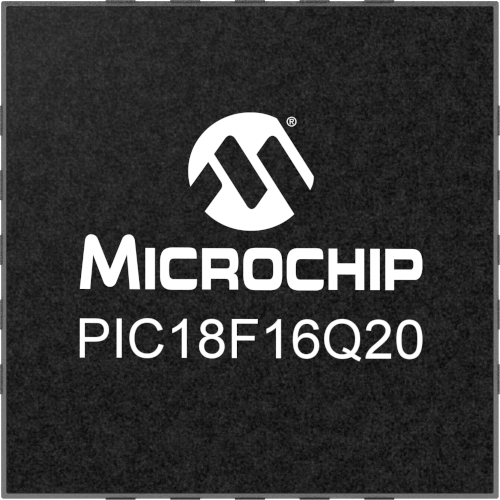
PIC18-Q20
product family specifically for modern distributed processor embedded systems. These MCUs offer advanced serial communication interfaces, including up to two I3C peripherals, for high-speed connectivity to multiple buses, enhancing flexibility. They also come equipped with built-in legacy communication protocols such as UART, SPI, I2C, and SMBus, enabling seamless integration as a bridge device and isolating I2C/SPI client devices from a pure I3C bus. This configuration maintains the speed of the I3C bus while allowing an I3C controller to communicate with I2C/SPI devices through the microcontroller. Furthermore, the PIC18-Q20 supports multiple voltage domains, so it can easily connect to various components with different operating voltage levels. This eliminates the need for level shifters, reducing the bill of materials cost and simplifying system design. The PIC18-Q20 MCUs also include on-chip core-independent peripherals (CIPs) that can operate without constant CPU interaction and communicate directly with other peripherals. These hardware-based peripherals consume minimal power, require little to no code, and use less RAM and Flash memory than software to implement the same functions. Furthermore, many functions can be enabled simultaneously on a single MCU. Designers can easily customize combinations of CIPs, including the I3C peripheral, using the MPLAB® Code Configurator (MCC), a user-friendly graphical user interface (GUI) environment, to generate application code without having to read datasheets. With CIPs, engineers can divide each system task to simplify function management, reducing the number of components, code size, development time, and power consumption.
Conclusion:
In our ever-changing world, innovations and technological advancements demand faster processing speeds, quicker connectivity, and miniaturization. While modern electronics are increasingly connected to the outside world, small-scale, energy-efficient analog subsystems are needed to sense and measure the "real world" within connected systems. Because changes in environmental data often occur gradually, design goals tend to diverge.
Efficient embedded systems are achieved by dividing the system into different speed domains, using a bridge to connect the fast processor to the surrounding parts of the system where analog subsystems exist. As I3C becomes the de facto interface for high-speed inter-chip communication, it is important for engineers to select advanced MCUs equipped to fully support the growing high-performance requirements in the digital realm while maintaining high analog accuracy for next-generation designs.
More information about the PIC18-Q20 microcontroller family
About the author

Greg Robinson is the corporate vice president of the 8-bit MCU business unit and has over 30 years of experience in the semiconductor industry. He joined Microchip Technology in 1995 and, during this time, Robinson has held several different roles within the company. He began his career as a product/test engineer and then spent several years focusing on operations, automotive application engineering, sales management, and marketing, which gave him a unique perspective on the different functional areas within Microchip. Robinson holds a bachelor's degree in electrical engineering from Washington State University and an MBA in Technology Management.