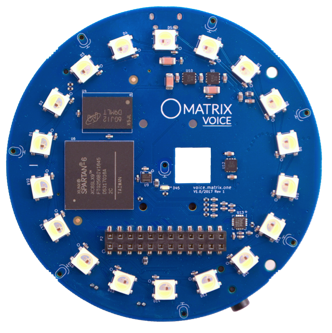
MATRIX Voice aims to remove barriers to the creation and deployment of IoT voice applications.
Matrix Voice can be run on a Raspberry Pi or used as a standalone device with an ESP32 and is specifically designed for voice recognition and detection projects. It allows users to utilize existing platforms such as Google Assistant or Amazon Alexa, or any other voice recognition API. The platform offers users the ability to integrate custom voice capabilities and hardware-based machine learning into their applications. Beamforming, noise cancellation, far-field speech recognition, and derverberation capabilities ensure high-quality performance for all voice applications.
Hari Kalyanaraman, Global Head of Emerging Businesses at Premier Farnell and Farnell element14, said: “As the distributor of choice, we want to offer customers the latest technologies to help them bring their products to market. Platforms like MATRIX Voice truly put makers and entrepreneurs at the forefront, enabling them to shorten product development cycles and accelerate time to market.”.
Rodolfo Saccoman, CEO and Co-Founder of MATRIX Labs, said: “At MATRIX Labs, we want to democratize the intersection of hardware, artificial intelligence, and software. We have created hardware and accompanying operating systems to enable solutions, creations, and the success of startups. Instead of trying to build their own board, companies can encapsulate our MATRIX Voice, manufacture any type of enclosure, and quickly bring their product to market.”.
The MATRIX Voice board, measuring 7.97 cm in diameter, includes a Xilinx Spartan-6 FPGA, 64 Mbit SDRAM, an 8-microphone MEMS array, and 18 LEDs, among other features, including an optional Wi-Fi adapter. The 64 GPIO expansion pins (40 of which are used to connect a Raspberry Pi) allow for greater customization.