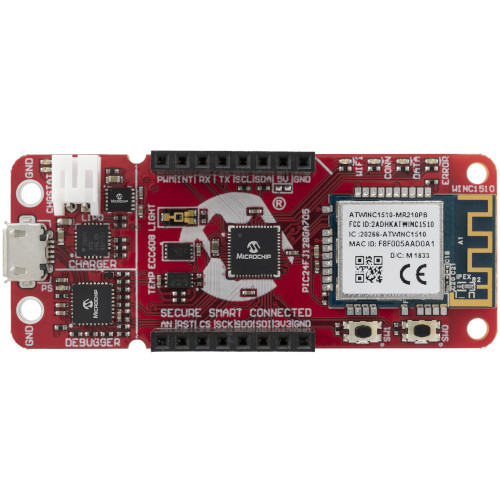
Therefore, during laboratory work and the design phase, development platforms prepared by the system manufacturers themselves remain the safest solution. It's worth noting that they haven't overlooked the advantages of popular consumer-segment solutions: their ease of adaptation and affordability. Today, the market offers user-friendly development boards prepared by leading microcontroller manufacturers, primarily Microchip, whose portfolio includes systems from the PIC® and AVR® families. Below, we present one of this manufacturer's prototype solutions, from the Curiosity Nano series.
Curiosity Nano Series Products
: The Curiosity Nano (or MC Nano) is a commissioning platform primarily dedicated to 8-bit PIC® and AVR® microcontrollers. It can also be used to develop applications equipped with some 32-bit products from the PIC32 and SAM families, based on ARM® Cortex® architecture. TME's offering includes 15 development boards and 2 motherboards within this platform. Regardless of the system used, the Curiosity Nano platform is designed to maximize the speed of new application development and, consequently, shorten the time between prototyping and mass production. The following video presents an example of using MC Nano solutions in the dynamic project development process.
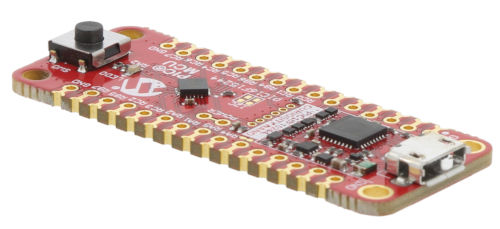
 Example of an MC Nano board that uses a 32-bit PIC32CM series chip.
Key Features of the MC Nano Platform:
The development boards included in the platform come in a variety of sizes (lengths), depending on the size of the microcontroller used. The smallest boards are dedicated to circuits with 20 pins (including 16 GPIO pins), while the largest contain an MCU in a 48-pin package, resulting in 40 input/output pins. Regardless of length, the products included in the platform share key physical characteristics (including board width, pin pitch, and the presence of a MicroUSB connector for power, communication, and programming) and technical features, enabling seamless migration between individual models. Furthermore, the manufacturer announces that the platform will be developed in conjunction with its microcontroller offerings. You can expect recently introduced Microchip chips to appear in the Curiosity Nano family, giving designers the convenience of working with the latest solutions in a proven and familiar environment.
 The carefully designed holes eliminate the need for soldering the connectors.
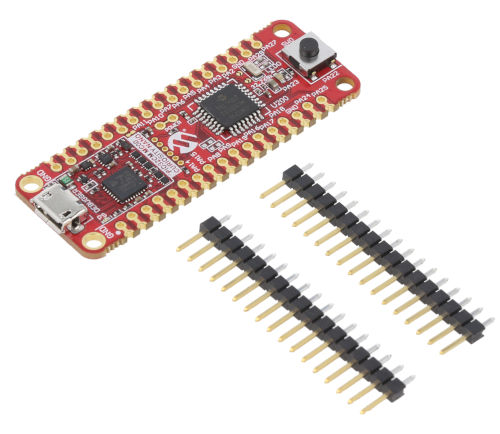
Two pin connectors are included with the MC Nano. At first glance, you can see the clever design solution employed by Microchip. The GPIO fields, arranged on the PCB with a 2.54mm pitch, contain both edge connectors and holes. In both cases, these are metallized grommets, designed for mounting pin connectors. Due to the minimal offset of the holes relative to each other, a perfect fit for the pin connectors and optimal connection parameters are ensured, virtually eliminating the need for soldering (although it is recommended). After installation, the PCB can be mounted on a larger breadboard, a dedicated motherboard, or an adapter (available and compatible products are described later in this article).
 Systems on the PCB Circuit:
The Microchip Curiosity Nano platform has a number of general features shared by all models in the series. In the center of the board is a microcontroller (C), whose pins are connected to the fields at the edges of the PCB (F), and a quartz resonator (D). For simple prototyping, a button (A) and an LED (B) were installed on the board. Unlike the Arduino platform, the switch does not have a reset function; it is connected to the microcontroller's input/output pin (the address of the dedicated output is marked on the PCB and varies between models in the series). The Micro USB connector (G) is used for system communication and power.
Data transmission between the MC Nano and a computer (system, IDE software, communication terminal, etc.) is performed via a virtual COM port. Most of these boards, when connected to a PC, will be recognized by the operating system as an external drive labeled "CURIOSITY". Simply copy the .hex file to this device, and the microcontroller will be programmed automatically. This functionality is possible because MC Nano boards have a built-in nEDBG chip, i.e., a debugger/programmer (E). Its presence allows the products to be operated without additional devices. Furthermore, thanks to this chip, the microcontroller is not burdened with the bootloader support, which speeds up program execution and frees up memory. Additionally
, MC Nano circuits utilize a programmable voltage regulator, allowing the microcontroller's operating voltage and power range to be defined within the range of 1.8V to 5V DC.
 Standardization of Outputs:
One of the advantages of the Microchip platform is the standardization of its pinouts. Regardless of the selected board model and the microcontroller installed on it, the pins along the PCB edges are connected to the programmer, debugger, and central system pins, all with the same functionality. Therefore, the order of the connectors on the board does not correspond to the microcontroller pin numbering; however, it is the same for the entire MC Nano series. This standard applies to the first 28 pins (on the USB connector side).
The pins are divided into several sections. The first is designated as DEBUG (system connection group). These pins are used to communicate with the nEDBG circuit. There are also power inputs (VBUS, adjustable VTG), ground (GND), and the VOFF pin, which controls the operation of the built-in voltage regulator. You can even turn it off if needed. The user also has access to the following serial communication lines (Virtual COM Port): CDC RX/TX. The next four pins, DBG1-DBG4, belong to the debugger interface. The interface compatible with a given board model depends on the type of microcontroller. For PIC, it will be the ICSP™ and MCLR interfaces; for AVR, the UPDI interface; and for ARM®, the SWD interface.
The remaining outputs are the communication (COM) and analog (ANALOG) sections. These are also a common feature of the MC Nano series. The COM section groups the pins used for communication via UART, I2C bus, and SPI. On the opposite edge of the PCB are the analog inputs, which are the outputs of the analog-to-digital converters integrated into the microcontroller. In most cases, these can also be used as outputs for counters (timers) and PWM signal generators. Of course, these outputs cannot be programmed onto any pin of the microcontroller (as is the case with digital inputs/outputs). Standardizing their position on the board results in ease of use and migration between different development board models. If the microcontroller installed on the board has more ADC inputs or PWM outputs, these are available in the next section: GPIO. Here, the mapping is more arbitrary, as the number and capabilities of the I/O ports depend strictly on the functionality of the core system. Consult the documentation for exact information on which physical pin is assigned to which connector. This information is available after connecting the NC Nano board to the computer's USB port. The mass storage device (which will be detected by the system and presented as a drive labeled "CURIOSITY") contains the file KIT-INFO.HTM, which provides detailed information about the function of each pin on the specific board model. Integrated Debugger Functionality:
Integrated on the board, the Microchip Curiosity Nano debugger (also known as PKOB nano, nEDBG onano debugger) has the following basic functions: controlling the program execution flow (start, stop, step activation, reset); reading and writing the contents of the microcontroller's non-volatile memory; and handling breakpoints, the number of which depends on the system type.
The built-in debugger's firmware can be updated via the MPLAB® IDE or Microchip Studio development environment. The PKOB nano is slightly slower than similar solutions, such as the PICkit™4 programmer. It also has some limitations, such as the inability to write to certain areas of the microcontroller's flash memory. On the other hand, it protects against accidental overwriting of memory areas responsible for the debugging process itself or unwanted changes to the fuse bit values in the case of AVR® microcontrollers. Another advantage is that, thanks to the presence of PKOB nano, the board is automatically recognized in the MPLAB IDE and Microchip Studio development environments. After connecting the board, the user gains immediate access to sample programs, documentation, electrical diagrams, pinout diagrams, microcontroller catalog cards, and more. At the end of this article, you will find example videos and basic concepts for programming the Curiosity Nano.
Compatible Motherboards and Modules:
TME's offering also includes a range of accessories and complementary products that will facilitate getting started with the MC Nano platform, as well as enhance the prototyping process itself. The standardization of outputs across the Microchip product series described above allows for the use of adapters, expansion cards, and digital modules: sensors, controllers, interfaces, etc.
 Development boards and adapters:
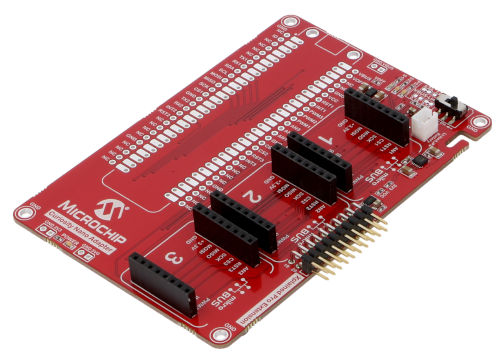
Using pin connectors, each MC Nano model can be inserted into the motherboard. TME offers two models of these products: the AC164162, equipped with connectors compatible with modules from Mikroelektronika and Microchip, among others. The second solution is the AC80T88A evaluation kit, to which components from the Xplained Pro family can be connected. In both cases, the user has a separate power switch and independent pins for all ports—also providing a convenient and stable base that improves working comfort. A key advantage of the AC164162 model is its built-in battery charge controller. This facilitates the prototyping of mobile devices, applications for which many Microchip microcontrollers are designed.
Click® Series Modules:
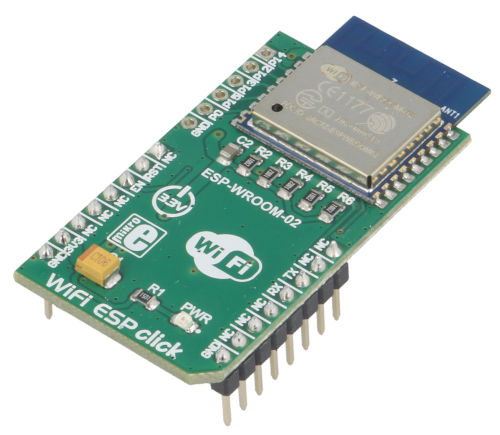
Thanks to the standardization of communication pins within the MC Nano series, these products can be quickly connected to many standardized modules, especially the Click® series from the microelectronics manufacturer. It is currently the largest family of universal extensions for microcontrollers. For data transmission, it uses the MikroBUS standard (which combines several communication methods). TME's current offering includes more than 1,000 products in the Click® Board family. These include numerous communication systems (RF, WiFi, Bluetooth, ZigBee, GSM), sensors, meters (ammeters, voltmeters), useful accessories such as memory card and RFID readers, GPS receivers, as well as interface elements (buttons, keypads, controls) and numerous less typical circuits, for example, hybrid circuits (FM and AM tuners) and audio amplifiers.
MC Nano Product Comparison:
One of the biggest advantages of the MC Nano series is the wide range of microcontrollers installed on this platform. The following table shows the systems currently available directly from the TME catalog, but the offering is sure to expand.
The current product range showcases the broad spectrum of prototype boards in the Microchip Curiosity Nano family. For simple mobile applications where energy efficiency is key, boards with ATTINY microcontrollers (the DM080104 kit is a perfect example) are the best choice. These boards are well-suited for low-power projects and are ideal as controllers for applications such as household appliances or the automotive industry. Extremely low-power (eXtreme Low-Power) microcontrollers utilize PIC16 microcontrollers, which feature Core Independent Peripherals (CIPs). These integrated circuits can operate independently of the core and even wake the microcontroller from sleep mode, generating an interrupt triggered by a programmable parameter (for example, exceeding the set voltage at the AC converter input).
For more complex applications requiring real-time calculations and responses, as well as integration with numerous sensors, PIC18 products, such as the EV26Q64A kit, are worth considering. The microcontrollers in this product group are equipped with numerous interfaces, A/C converters, as well as AC/A converters (i.e., DACs), a built-in operational amplifier, 16-bit PWM signal generators, and memory adapted for fast and reliable data acquisition.
Application and Programming Examples:
For users taking their first steps in MPLAB IDE or Microchip Studio environments, the manufacturer has prepared a wealth of supporting materials. These can be found both on the Microchip website and on YouTube. With their help, creating your first project and operating the IDE will be easy.
A convenient way to learn about other features of the Microchip Curiosity Nano platform is to participate in classes within the Microchip University program.
Content produced by Transfer Multisort Elektronik Sp. z o.o.
The original source of text: https://www.tme.eu/es/news/library-articles/page/45286/plataforma-de-desarrollo-curiosity-nano-de-microchip/