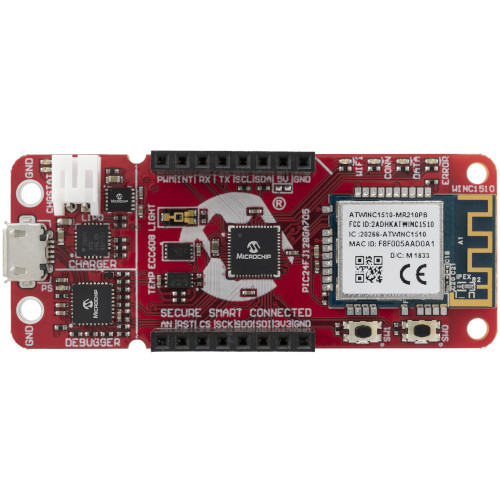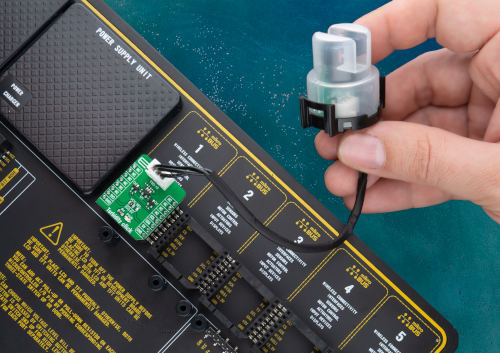
Click boards are based on the open-source 16-pin mikroBUS™ standard for connection to a development board developed by MIKROE. They allow design engineers to easily change peripherals, reducing development time by months. The Turbidity Click is a Click board™ adapter used to interface a compatible turbidity sensor with the host MCU. The board features a 2.5 mm x 3 connector suitable for connecting the sensor via a 15 cm male-to-male 3-wire cable, allowing users to upgrade and test different sensors. The sensors can also measure temperature and turbidity.
The analog output voltage from the turbidity sensor can be converted to a digital value using the MCP3221, a 12-bit successive approximation A/D converter from Microchip, via a 2-wire I2C-compatible interface. Turbidity Click comes with a library containing user-friendly functions and sample code that can be used as a reference for further development.
According to Nebojsa Matic, Managing Director of MIKROE, "Water quality is, of course, essential for good health, so accelerating the development of instruments that measure turbidity is an important step toward improving living conditions worldwide."
MIKROE releases a new Click board almost every day at 10 a.m., and many leading microcontroller companies, including Microchip, NXP, Infineon, Dialog, STM, Analog Devices Renesas, and Toshiba, now include the mikroBUS socket on their development boards. Turbidity Click is available separately or as part of a bundle for only $19.50.