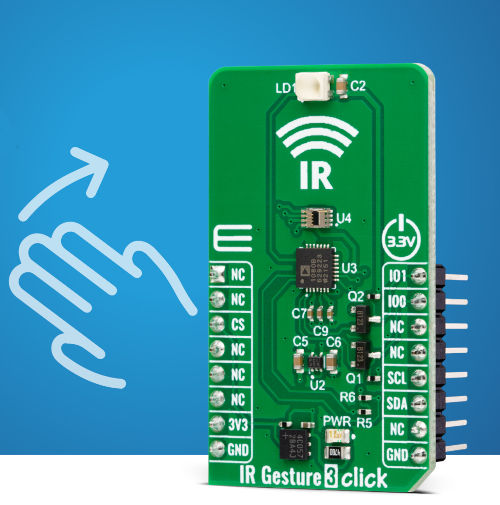
The first is the ability to detect the beginning and end of a gesture, thus identifying which part of the gesture constitutes a command. Tracking the hand's movement during the gesture is the second part; the third function is identifying the gesture based on the complete hand movement.
This Click™ board is based on the ADPD1080, a multifunction photometric front-end from Analog Devices that features a fully integrated AFE, ADC, LED drivers, and timing core, enabling ambient light rejection without photodiode optical filters. The drivers can supply 370 mA of peak LED current, with flexible, multiple, and short LED pulses per optical sample. Its 14-bit ADC and 20-bit burst accumulator allow up to 20 bits per sampling period, with a sampling frequency ranging from 0.122 Hz to 2700 Hz.
The ADPD1080 functions as a complete optical transceiver, driving the SFH4249, a high-power infrared emitter from ams OSRAM, which acts as a 940 nm light source with a short switching time. The front-end IC then measures the return signal in the analog block via independent current inputs, storing the results in discrete data locations. This data can then be read by the host MCU. The ADPD1080 has a 1.8 V analog/digital core; for this purpose, IR Gesture 3 Click uses the BH18PB1WHFV, a CMOS LDO regulator from Rohm Semiconductor.
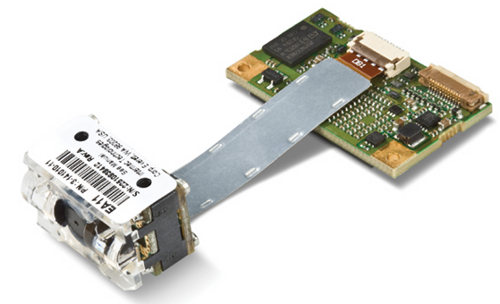
The ADPD1080 uses the ADPD2140, an infrared angle sensor from Analog Devices, as its current inputs. It consists of an intrinsically type N-type P-type silicon photodiode that provides a linear measurement of the incident infrared light angle on four separate channels. Two-axis angle measurements are available in the x and y directions, where the resulting quantities are coefficients related to the angles through a constant term. The ADPD1080 front-end connects to the ADPD2140 angle sensor via its four photodiode current inputs and a common photodiode cathode bias. The photodiode current inputs receive analog data through the ADPD2140's analog outputs.
While functioning as a state machine, the ADPD1080 can operate in standby, program, and normal modes. Normal mode follows a specific pattern established by the state machine. This pattern consists of LED pulse and sample, average between samples, data read, and repeat. The LED pulse and sample pattern allows each data sample to be constructed from a user-configurable sum of pulses (1-255). The average between samples reports an average of 2 to 128 samples in powers of 2. Click
boards follow mikroBUS™, a modular standard for prototyping add-on boards invented by MIKROE, which allows design engineers to easily swap peripherals, cutting months of development time. Any Click board can be connected to the microcontroller or microprocessor of a main board. Many of the leading microcontroller companies, such as Microchip, NXP, Infineon, Dialog, STM, Analog Devices, Renesas, and Toshiba, now include the mikroBUS socket on their development boards.