including robotics, security, contactless control, autonomous vehicles, and smart commerce. For example, these advanced capabilities eliminate the need for costly lidar implementations for robotics and other services.
“The collaboration between Blaize and eYs3D demonstrates the power of Blaize’s programmable GSP architecture and software productivity suite to process both RGB camera and depth data in a highly efficient manner, delivering both high accuracy and high performance for 3D edge sensor fusion applications,” said Rajesh Anantharaman, Director of Products at Blaize. “The integration of Blaize and eYs3D accelerates time to market for systems incorporating simultaneous visual localization and mapping (VSLAM), facial feature depth recognition, and gesture-based commands.”
Leveraging Blaize's Graph Streaming Processor (GSP) architecture, the combined design offers improved depth and distance sensing through the application of the camera's 3D sensor, including a sensor fusion function that combines two datasets: the camera's RGB data and depth data. Processing efficiency and ease of programming for the entire end-to-end application enable a reduction in system performance per watt (RPW). Furthermore, the Blaize P1600 can convert the depth camera's USB output to high-speed Ethernet connectivity for enhanced video processing. Software development kits for the reference design are compatible with a wide range of operating systems, programming languages, and development tools.
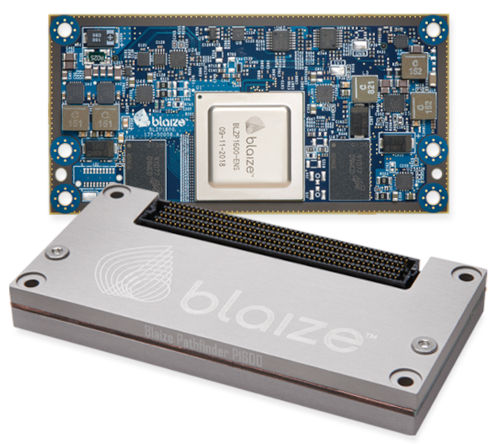
Blaize's embedded and accelerator platforms are based on the Blaize Graph Streaming Processor (GSP) architecture, designed for the demands of edge computing. Blaize's Pathfinder P1600 embedded systems SoM brings the programmability and efficiency benefits of GSP to embedded AI applications at the sensor or network edge. Blaize's AI software suite, comprising Blaize Picasso and AI Studio, leads the industry with open standards and ease of access, reducing time to production for edge applications from months to days.