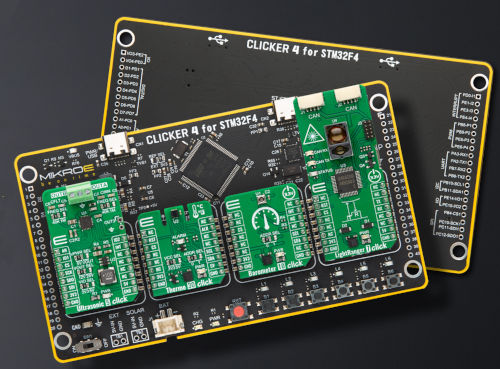
Currently, the company offers more complementary Click plates than any other company in the world, and estimates that 188,544,549,285 unique combinations can be made from the 1460 plates available.
Equipped with the popular STM32F4 MCU, Clicker 4 is a perfect solution for accelerating prototyping, but it can also be deployed directly into a fully functional custom design. Key features include: a 32-bit Arm® Cortex®-M4 STM32F4 MCU running at up to 168 MHz; 1 MB of Flash memory; a floating-point unit (FPU); a full DSP instruction set; and a memory protection unit (MPU).
Nebojsa Matic, CEO of MIKROE, explains: "To make the prototyping experience as seamless as possible, Clicker 4 is equipped with an integrated debugging unit, MIKROE's advanced CODEGRIP programmed debugger, which meets the CMSIS-DAP embedded emulator standard. This allows designers to fully use, test, and debug the target device right out of the box."
Also included is a JTAG/SWD header for interfacing with external electronic components, USB Type-C connectors, six LEDs, six pushbuttons, and a reset button. Furthermore, Clicker 4 is equipped with five different power inputs, offering all the flexibility development requires, and a reliable and safe battery charging circuit that allows charging a single-cell Li-Po/Li-Ion battery.
Click boards follow mikroBUS™, a modular standard for add-on prototyping boards invented by MIKROE, which allows design engineers to easily swap peripherals, cutting months of development time. Any Click board can connect to the microcontroller or microprocessor of a main board. Many leading microcontroller companies, such as Microchip, NXP, Infineon, Dialog, STM, Analog Devices, Renesas, and Toshiba, now include the mikroBUS socket on their development boards.