





The entire computer fits on a rectangular PCB measuring 85.6 mm by 56.5 mm. This small size allows AAEON units to be used in a number of unusual applications and reduces production costs for various household and industrial devices (by eliminating the design, prototyping, and manufacturing of complex control circuits). Below, we present the specifications for the entire product series – detailing their differences, as well as the characteristics of the Intel® processors used.
In this article, we cover the following topics:
• Compatibility with Windows and Linux systems
• Information on the Intel® processors used
• Overview and parameters of the built-in connectors and interfaces
• Capacity and format of the integrated memory chips
• Typical and less common applications
UP 4000 Computer Specifications
Most single-board small form factor PCs are equipped with ARM processors. This solution has its advantages, but to some extent, it limits the compatibility of such PCs with "desktop" software, i.e., software developed for desktop computers. In most cases, the team responsible for adapting the device to a specific application will need to rely on one of the Linux (Android) or FreeBSD distributions. The situation is different for AAEON's UP 4000 series PCs, as their motherboards are integrated with Intel® processors (Atom®, Celeron®, or Pentium®). These units are based on the x64 architecture, which allows them to run, for example, Microsoft Windows. Thanks to this, users gain the ability to use standard PC software, as well as services provided by Microsoft (devices are Azure certified). However, there is a need to use Linux-based systems, so AAEON computers can also be operated by such software, for example, the Ubuntu distribution (18.04) or a custom operating system built using the Yocto Project platform. An attractive alternative is the compatibility of UP 4000 products with a minimalist and compact version of Windows known as IoT Core.
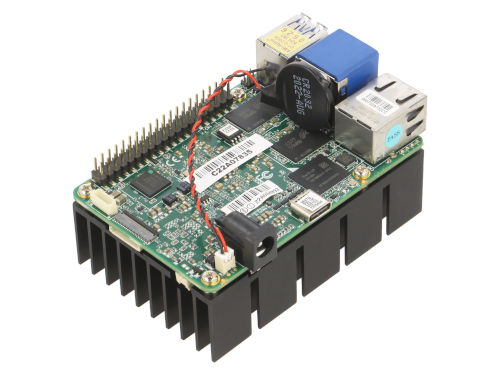
UPAPL03X7F-A100464
Intel® Atom® Models
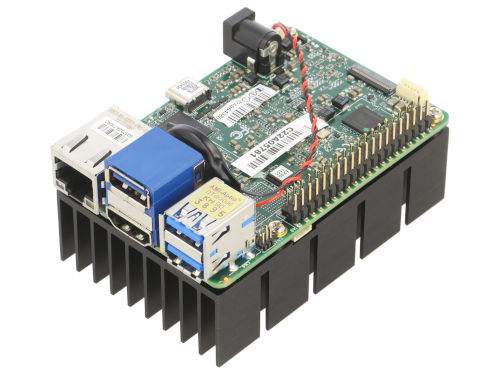
UPAPL03C2F-A100216
Intel® Celeron® Models
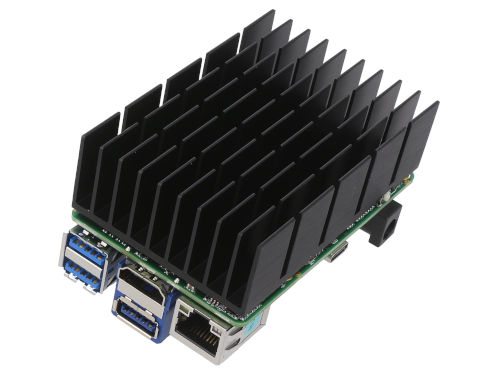
UPAPL03P4F-A100864
Intel® Pentium®
Processor Models and Their Capabilities
UP 4000 motherboards are available with three Intel® processor models: Celeron® N3350 (2.4 GHz), Pentium® N4200 (2.5 GHz), or Atom® x7-E3950 (2 GHz). A key feature shared by these chips is the integrated graphics: Intel® HD Graphics 500 or 505. In both cases, the coprocessor provides support for DirectX or OpenGL, enabling the creation of extensive graphical interfaces and facilitating the rendering of three-dimensional objects (however, it should be noted that the system shares the operating memory with the central processing unit). It is also worth highlighting that UP 4000 computers can be connected to two monitors simultaneously, displaying an image with a resolution of up to 4K and a refresh rate of 30Hz. CPU cooling can be achieved passively (using a heatsink), but for prolonged and demanding operation, forced air cooling is recommended.
The following video shows a performance comparison (benchmarks) of the UP 4000 with competing products:
Interfaces and Connectors.
A significant advantage of AAEON computers is their wide selection of interfaces. First, it's worth mentioning three USB 3.2 ports, one USB Type-C port (with DP1.2 support, i.e., graphics output), and a 10-pin connector for connecting two additional external USB 2.0 ports. This allows, for example, routing the connection of this popular interface to the target device's panel. Graphics output is provided via HDMI 1.4 and a full-size HDMI connector. Furthermore, the board also features a standard network port (RJ45) supporting a gigabit (max. 1Gb/s) Ethernet interface.
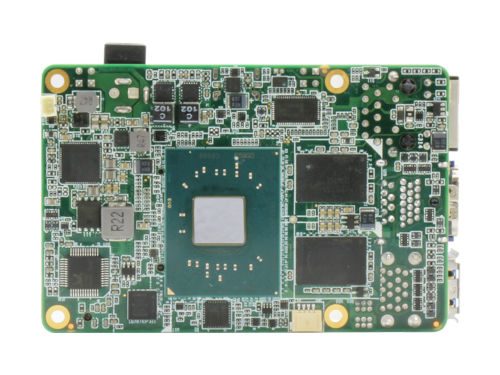
UPAPL03P4F-A100432
The underside of the UP 4000 motherboard without a heatsink.
The computer requires a 12V DC power supply capable of delivering 5A (connected via a coaxial connector). It's also worth noting that, unlike many competing solutions, this motherboard has a power button (which can also be used to force the computer to shut down). Additionally, there's a connector on the edge of the board that allows this functionality to be controlled with an external monostable switch. AAEON also provided the option to power the fan (forcing airflow through the heatsink) directly from the motherboard using the dedicated connector. Analog audio inputs and outputs are implemented in the same way. There's also a 40-pin GPIO header on the board, made using a double-row male connector ("gold pin") with a 2.54mm pitch. This type of connection for overlays and other electronic devices is slowly becoming a global standard. In the case of the UP 4000 series, the GPIO lines, in addition to the zero-to-one states, can be configured to handle UART, SPI, I2C, PWM, ADC, and I2S. The selected pins supply 3.3V or 5V DC (up to 0.5A) to the connected components.
Operating and System Memory:
Depending on the selected model, the computer is equipped with 2GB, 4GB, or 8GB of RAM implemented using LPDDR4 technology (LP stands for low power, as this type of system is characterized by relatively low power consumption). The non-volatile system memory has a capacity of 16GB, 32GB, or 64GB and is based on the integration of Flash (eMMC) storage with the motherboard.
Possibilities and Applications:
The combination of a wide range of interfaces, significant computing power, and the capabilities offered by powerful systems like Windows or Ubuntu makes UP 4000 computers ideal for many applications. First, they can be used as a central control unit in public-use machines (food dispensers, ticket vending machines, parcel machines, etc.). These boards are also perfect as a foundation for building IoT (Internet of Things) and home automation devices, alarm systems, lighting controllers, and more. Thanks to their competitive price, they are an attractive option for building industrial controllers and monitors, enabling deep automation of production or transport processes while simplifying programming and providing a user-friendly interface.
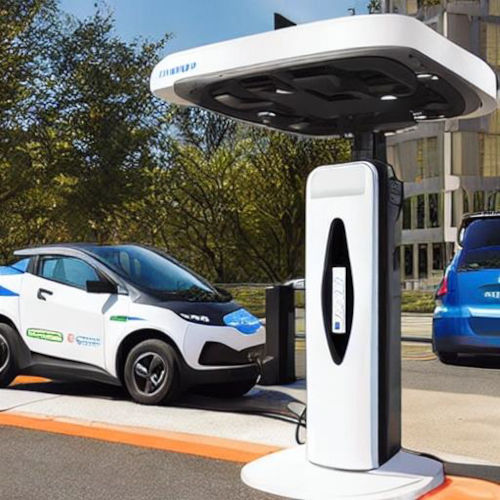
Application Story_Empowering Electric Vehicle Charging with UP 4000
As an example of an application for which the UP 4000 series is perfectly suited, the manufacturer cites a network of electric vehicle (EV) charging stations. First, the AAEON computer can communicate with various components within such infrastructure units (current sensors, charge controller, interface elements, and download data on the status of connected vehicles via the communication pin in the charging connector). Furthermore, the Intel® processors provide hardware support for AES encryption instructions, as well as Identity Protection Technology (IPT), which ensures efficient and effective protection of personal data. This allows the UP 4000 products to be used for electronic payments for energy drawn from the station. In such a scenario, virtually the entire device is managed by a single integrated computer.
Of course, AAEON products can be used in many other ways, not only in mass-produced devices or machines, but also in prototyping processes and the efficient development of industrial, student, and hobby projects.
Content produced by Transfer Multisort Elektronik Sp. z oo
https://www.tme.eu/es/news/library-articles/page/54289/miniordenadores-aaeon-equipados-con-procesadores-intel/



