




• How an LED display is built
• Character display method in 7-segment displays
• Displays with more segments
• Microcontrollers in display control
In this article, we will discuss 7-segment LED displays in detail, examining their construction, applications, control methods, and importance in the modern world of electronics. From simple indicators to advanced devices, these small but versatile components play a key role in our lives, helping us understand and interpret the information generated by devices in digital form. Get ready to travel the world with LED displays and discover how they influence our daily lives and evolve with technological progress.
Construction and operation of LED screens.

segment description
7-segment LED displays are an integral part of many electronic devices and ensure clear display of numbers, letters, and alphanumeric characters. Their relatively simple construction makes them extremely efficient and reliable. 7-segment displays are based (as the name suggests) on seven segments, which are actually LEDs with a specific shape and color. Each of these segments is usually labeled with a letter from "a" to "g". These segments are arranged to form a figure eight, with three horizontal segments (top, middle, and bottom) and four vertical segments forming the sides. You may also find a segment labeled "dp" on the display, which is interpreted as a period or comma.
Each LED "segment" display is made up of semiconductor elements that emit light as a result of the electric current flowing through them. The segments are made of a light-diffusing material (usually milky in color) to ensure uniform illumination. These diodes are connected in two configurations: common anode or common cathode. In common anode displays, all the positive pins of the LED segments are connected to a single point; similarly, common cathode displays have a single pin for all the negative legs.
The operation of 7-segment displays is quite simple and involves lighting the appropriate segments to create the desired characters. A controller, such as a microcontroller or embedded system, controls the current flowing through the individual LEDs, depending on the digit or character to be displayed. For example, to display the number "1," segments "b" and "c" are activated, and the remaining segments are deactivated.
Thanks to their simple structure and control, 7-segment displays are extremely popular in devices such as calculators, clocks, meters, thermometers, and many others that require displaying numbers or basic characters. These displays are not only efficient and reliable, but also perfectly visible in both well-lit rooms and complete darkness, making them indispensable in everyday electronics. TME offers displays of this type in a wide range of sizes, from miniatures used in small electronic devices to enormous models used in sports stadiums. The displays can also be selected in terms of color and brightness.
Character Encoding:
Character encoding on 7-segment displays is a key aspect of displaying information effectively and legibly. Several encoding methods exist; the two most popular are Latin encoding (also known as Binary Coded Decimal (BCD)) and hexadecimal encoding. Furthermore, the meaning of the dot on 7-segment displays is an important additional element for accurate data display.

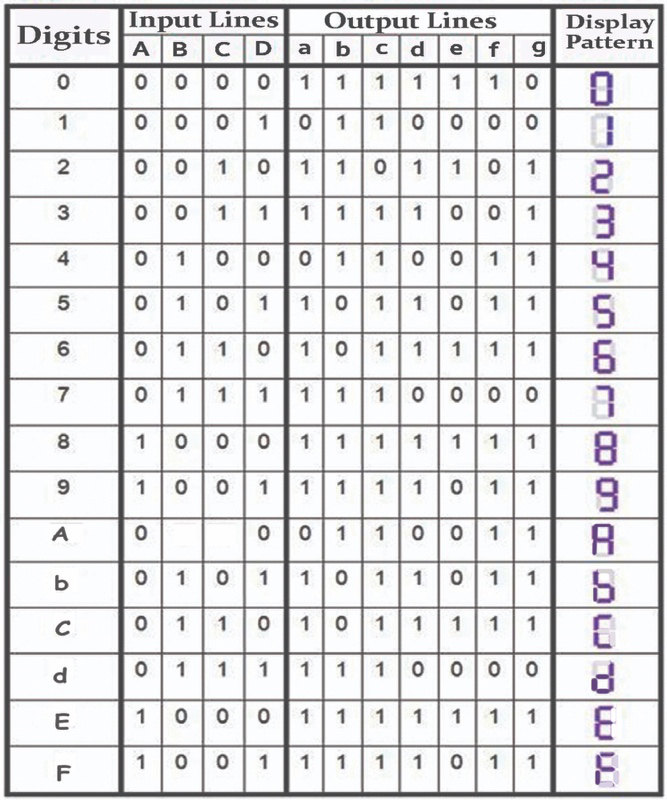
BCD Encoding Table (https://www.electrical4u.com/bcd-to-seven-segment-decoder/)
Latin encoding, also known as BCD, is one of the most common ways to encode digits on 7-segment displays. It involves assigning a unique binary code (usually 4 bits) to each digit from 0 to 9 and some alphanumeric characters, such as the letters A through F. Each binary code is associated with a specific set of LED segments that must light up to display a specific number or character.
HEX Encoding Table (https://bcisnotes.com/secondsemester/digital-systems/hexadecimal-to-seven-segment/)
Hexadecimal encoding, also called hexadecimal coding, is used to display alphanumeric characters in the hexadecimal system (the digits 0-9 and the letters A-F). In this case, each digit or letter is assigned a unique hexadecimal code (4-bit or 8-bit), which corresponds to the activation of the corresponding LED segments. This encoding is particularly useful in applications where data is represented in hexadecimal, such as programming microcontrollers or devices operating in diagnostic mode.
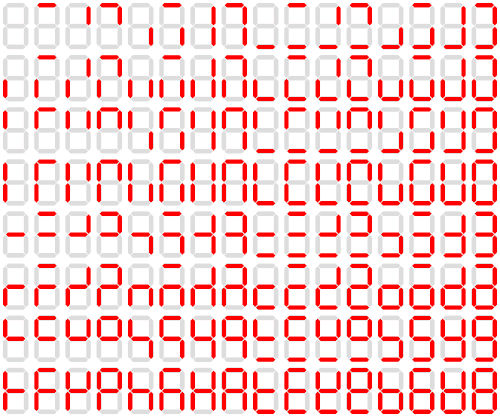
All possible states of a 7-segment display (https://pl.wikipedia.org/wiki/Wyświetlacz_siedmiosegmentowy)
The dot on a 7-segment display plays an important role in showing specific and precise data, especially fractional parts. Enabling the "dp" segment next to a given digit allows it to be displayed as a fractional value. For example, to display the number 3.14, the "dp" segment will be included next to the number 3, although it's worth noting that there are designs where the dot is placed before the character. In this case, the "dp" segment will start at the digit 1.
Character encoding and precise control of the segments, including the dot, on 7-segment displays are crucial for displaying diverse information and data in a clear and intuitive way, making these displays irreplaceable in many electronic applications.
More segments – more possibilities

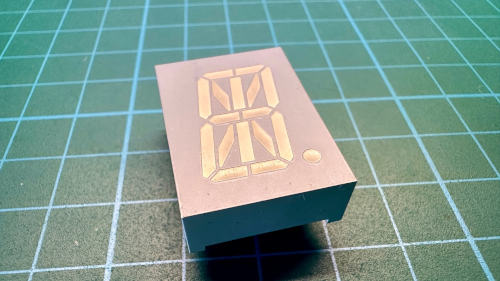
In addition to the popular 7-segment displays, there are also displays with a higher number of segments, such as 8-segment, 9-segment, 14-segment, 16-segment, and even 22-segment displays. These more advanced designs introduce new character display capabilities and are used in specific applications where greater flexibility and precision are required. Even greater possibilities are achieved by using LED matrices, which allow for the display of simple graphics. 8-segment and 9-segment displays add extra segments compared to traditional 7-segment displays, allowing for the display of more alphanumeric characters and special symbols. They are often used in control panels and measuring devices where more extensive information needs to be displayed. 14-segment, 16-segment, and 22-segment displays are even more advanced designs that can display more complex characters, including many letters, numbers, and special characters. Thanks to the increased number of segments, these displays are used in illuminated signs, information panels, musical instruments, and medical devices, where the precise display of diverse content is key.
Larger displays with more light segments increase the capacity to show more diverse and complex information, which is important in today's world where audiences expect increasingly advanced and interactive displays. Their applications cover fields such as consumer electronics, industry, medicine, advertising, and many others. Another solution that offers greater possibilities is the use of 7-segment displays connected in pairs, threes, or even fours. Thanks to the shared housing, the rear signals are perfectly integrated.
LED Display Control:
Controlling segment displays is a key element in the information display process. There are several ways to control 7-segment displays, depending on the complexity of the application and the precision of the displayed data. The traditional solution is to control the display using digital circuits/digital logic in BCD code. In this approach, each digit or character is controlled by an appropriate decoder. These types of systems are combinational structures, whose input is the BCD code of the character, and based on this, specific outputs of the system connected to the display are activated. This is an effective method, but it is time-consuming and its implementation is quite complex compared to more modern microcontroller-based solutions.
Today, a common solution is to control 7-segment displays using microcontrollers. They offer much greater flexibility and precision in data display. The programmable circuit passes data to the display and decides which segments to activate to show numbers, letters, or special characters. This approach allows for dynamic display control, enabling smooth changes in the displayed content. In microcontroller-based systems, multiplexing is a common technique, especially in designs that include more than one 7-segment display. This involves switching between successive displays very quickly (often imperceptibly to the human eye), so that each display is active for only a short period. In other words, only one display is on at a time; the others turn off simultaneously. This allows the same set of microcontroller pins to be used to control segments of all the displays. This is an efficient solution that saves CPU resources.
Controlling 7-segment displays is a key aspect of the design of many electronic devices, and the selection of the appropriate method depends on the application's needs and available resources. Regardless of the technology chosen, 7-segment displays remain indispensable in many areas of the technological world.



