




- Details
- Category: Industrial Computing
Q3D Lamp and 3D Printer (Kit)
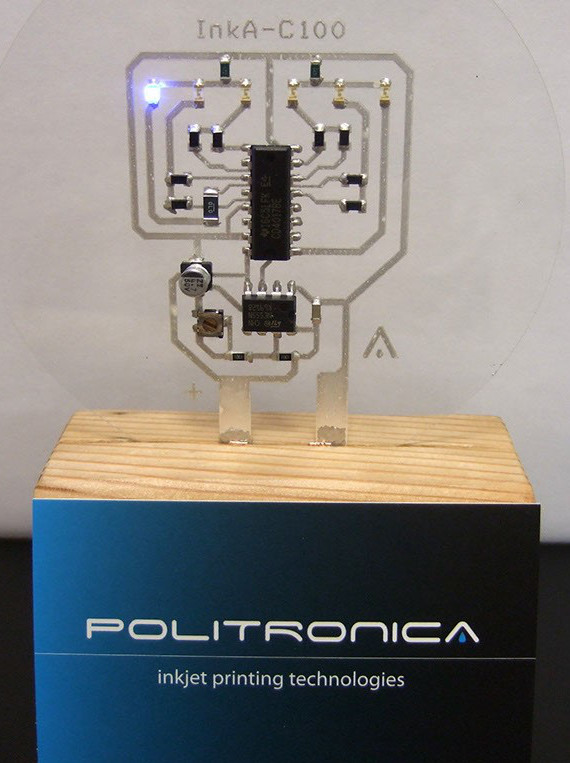 The commercial collaboration agreement between Politrónica, a spin-off company of the Polytechnic University of Turin, and Fadisel, a Spanish company based in Barcelona and active for almost 40 years, has been signed for the supply and verification of electronic material.
The agreement is part of Operation Q3D, a project Politrónica has been working on for several months, which involves a collaboration with the well-known Danish retail chain Tiger to bring a low-cost 3D printer to the public. The Q3D is, in fact, a unique printer of its kind. Entirely 3D printed and inspired by the design of the popular Luxo lamp, the Q3D is both a lamp and a 3D printer that uses a special resin capable of solidifying under the lamp's white light.
Politrónica, which has been working in the field of functional printing with conductive inks since 2008, has also been involved in 3D printing for a couple of years, particularly FDM technology, namely the melting and storage of plastic material. However, to complete the q3d project, it was necessary to identify a partner capable of guaranteeing the supply, verification, and preparation of the printer's electronic components.
An investigation was carried out that led to the identification of Fadisel as an ideal partner.
Fadisel, based in Barcelona, Spain, was founded in 1979 and operates in the field of home automation and robotics, exporting to 20 countries on 5 continents.
Fadisel's values, experience in the electronics and robotics sector, along with its particular predisposition to technological innovation, convinced Politrónica that it was the ideal partnership.
But in the Q3D project and, in general, in Politronica's intentions, innovation is not only technological, but also economic and social.
Politronica's objective is to establish itself as a model of factory 4.0, capable of operating just in time and with zero marginal cost, following the theory of the American economist Jeremy Rifkin.
The goal of the Q3D project is therefore to serve as a demonstrator, that is, to produce the printer with a "zero marginal cost" perspective, aiming to produce the quantities that the market demands. In this respect, the details of the agreement are relevant.
The first phase of testing in the Italian market involves the sale of 5,000 printers by the end of 2018. However, given a zero marginal cost, the option is to produce 500 printers per month and adapt production to market demand, modulating the quantities produced monthly, from a minimum of 500 to a maximum of 1,500, with one month's notice.
This is clearly a discussion that concerns not only Politronica but also its suppliers. Therefore, negotiating supplies was crucial, starting with electronics. The goal was to work according to the principles of Forecasting, that is, a long-term production forecast, which would be implemented in monthly batches, based on market response.
The electronic supply agreement is based on the principle that trust is not placed on producers, but on memory. I don't rely on achieving the final goal, but on the record of quantities purchased, according to a model that guarantees decreasing costs as purchase volumes increase.
The second phase of the project envisions expanding Q3D's operations worldwide, producing an additional 30,000 printers, this time in batches of 2,000 units per month. Here too, the ultimate goal will be to reinforce the zero marginal cost logic, focusing on flexible supply chains for varying quantities while ensuring costs are consistent with the production volumes designed for the operation.
The Q3D will initially be available in Italian Tiger stores from the end of September at a retail price of €100, aiming to be the first design object produced using digital manufacturing and sold through major retailers. Later, in 2019, the Q3D will be manufactured and distributed worldwide, thanks to an international agreement between three European companies committed to collaboration and innovation: Politrónica in Italy, Tiger in Denmark, and FADISEL in Spain.


Print Magazine

Annual subscription price:
You will receive all 10 editions that are published each year.
social networks
Popular News Electronics


Spanish electronics magazine. Printed for over 25 years.
Spain - Madrid - All rights reserved © Convertronic Professional Spanish Electronics Magazine.