From smart sensors to smart edge devices and cloud infrastructure, the impact of the Industrial Internet of Things (IIoT) on the manufacturing industry cannot be underestimated. IIoT, also known as Industry 4.0, enables smarter, more predictive, and proactive processes that lead to improved overall efficiencies.
Below, we present a more detailed examination of the smart manufacturing technologies that are revolutionizing the future of factories for the better.
 Co-bots
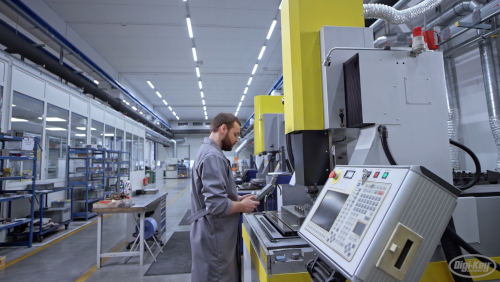
At this point, we've reached a point where, as a society, we're less afraid that robots or automation will "eliminate" human jobs because we've realized the immense benefits that can be gained. It's generally accepted that robots working alongside humans—collaborative robots (cobots)—have great potential to keep workers safe and happy.
Reassigning tedious or repetitive tasks to robots can shift the average manufacturing position to one that is more decision-based than task-oriented, as it was in the past. Humans can then take on projects requiring judgment or creativity, leaving the heavy or less appealing work to robots, thereby improving safety and reducing injuries.
Furthermore, while these robots are highly complex machines, a computer science degree is often not required to learn how to reprogram them to perform more than one task. It is now common to see more "general-purpose" robots with computer vision that can adapt to different environments and be quickly reprogrammed to perform multiple functions.
Currently, many leading companies are automating processes, and we expect this to reach many more companies in the near future. Tesla is an example of a factory that is truly embracing automation and optimizing its processes. Apple contracted with a factory for the recycling of its iPhones, where robots effectively disassemble the retired phones. They can recycle some of the parts and recover some of the precious metals inside, with robots performing reverse assembly and keeping workers safe from heavy metals and repetitive work.
Overall, this is improving morale, reducing stress, and increasing job satisfaction among workers—something that is crucial at a time when labor is extremely scarce: vacancies in the manufacturing industry are more than double what they were last year, according to the U.S. Department of Labor. Human workers assisted by robots are thus safer, with fewer injuries, accidents, and repetitive stress injuries.
 Robotics as a service
Automation is an equalizer, and the rapidly growing trend driving the use of robots in smaller factories is Robotics as a Service (RaaS). In fact, the global RaaS market was valued at $12.6 billion in 2020 and is expected to exceed $41.3 billion by 2028, according to a recent report published by Coherent Market Insights
Similar to Software as a Service (SaaS), manufacturers using RaaS reap the benefits of robotic process automation by leasing robotic devices and accessing a cloud-based subscription service instead of purchasing the equipment. With RaaS, manufacturers can avoid paying for expensive equipment, managing maintenance, and other headaches associated with outright ownership. Manufacturers can simply contact a RaaS provider and request that they set up the entire automation system for a fraction of the cost of purchasing and owning their own robotic devices.
There are very few things that cannot be automated at this point, and it's usually a question of whether the cost of automation will be prohibitive (in most cases, it isn't). As these costs continue to fall, there will be a resurgence of manufacturing in Western Europe and North America; so we expect to see much more regional manufacturing in the next five to ten years. Automation is very much an equalizer: the robotic machine has running costs no matter where it is, but it isn't paying human labor costs for those repetitive processes.
Another current RaaS trend is the "digital twin," in which a factory or production facility is recreated in a virtual environment using exact product specifications, or in some cases, the system dictates which products should be used. Users can simulate manufacturing an item in a digital environment and learn ways to optimize machine placement and improve material flow.
Digital twins can also alert operators and factory managers when an engine is about to start wearing out, or when maintenance is due. Implementing digital twins can resolve many problems before they occur. And at this point, that service is something you can approach with a RaaS provider and say, "This is what I'm trying to do," and the provider will create the digital twin for you and help you discover the processes needed to achieve your goals.
 Edge Computing
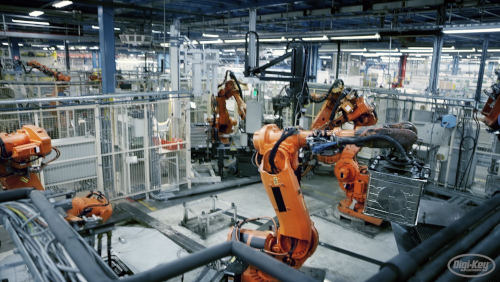
The factory of the future will house a vast number of sensors, which will then collect an immense amount of data. Communicating that data to the cloud is slower and more expensive than processing it closer to the source—at the edge.
For example, a continuous temperature monitoring system at the edge can analyze the data it's processing and send an alert or notification when a temperature level is detected outside the norm. This allows for much faster data analysis and, ultimately, quicker action, because it doesn't have to wait for the data to be sent to the cloud.
New connectivity options, such as long-range wide area networks (LoRaWAN), are enabling edge computing to advance at a much faster pace in the manufacturing industry, making it an effective and efficient connectivity option for data analysis in factories.
Artificial intelligence
Machine-to-machine communication via wireless connectivity can now connect with peripheral computers to provide process analytics. With machine learning, changes can be made with minimal programming, enabling factories to continuously adjust their processes and increase efficiency.
Artificial intelligence (AI) applications can unlock the true potential of IoT and edge applications in manufacturing and the factory floor. With real-time analytics, connected sensors, predictive maintenance, supply chain automation, and other process advancements, the manufacturing industry is rapidly being propelled into a new era.
Digi-Key is also leveraging this technology to equip itself with the world's largest electronic component selection automation and also accelerate its unique shipping speeds.
 Digi-Key's future factory
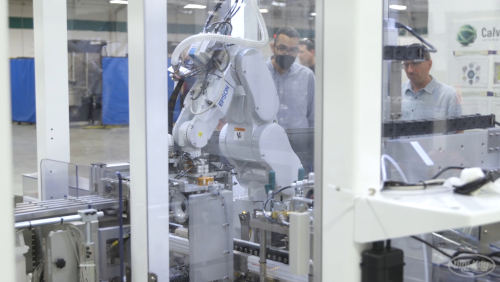
Digi-Key's new state-of-the-art distribution facility, the newly expanded Product Distribution Center (PDCe), is a prime example of a factory of the future. Fully operational by the end of 2021, it is one of the world's largest distribution facilities, spanning 1 million square feet. The PDCe will house all of Digi-Key's order fulfillment operations, including picking, packing, and shipping, as well as receiving and overflow pallet storage.
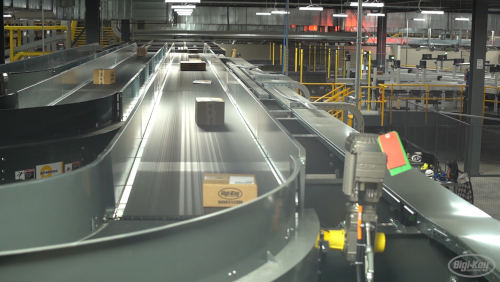
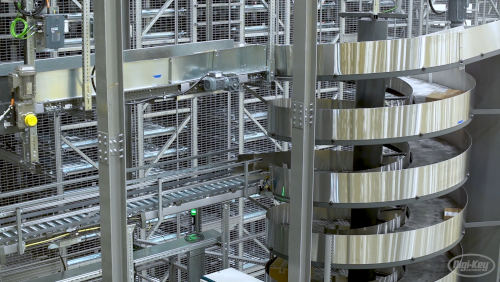
The technology incorporated in this facility will allow Digi-Key to be at the forefront of distribution for years to come. The PDCe will house 27 miles of high-speed automated conveyor belts that will allow the brain of the operation, the Order Storage Retrieval System (OSR), to automatically receive product and prepare orders for packaging. The OSR supports goods-to-person order fulfillment using 1,000 automated shuttles that can move throughout the OSR and store up to 2.7 million unique pieces.
This smart, automated system will allow orders to be picked, packed, and shipped much faster, eliminating packaging waste from orders shipped in multiple boxes. It will also free up warehouse workers to take on new responsibilities, improve their safety, and eliminate a significant amount of manual labor.
The facility will feature many other innovations, including a garbage-collecting robot that will empty more than 400 trash cans located throughout the facility. It's important to note that the robot and automated systems will not eliminate any jobs, but rather provide opportunities for the current workforce to apply or expand their skills in other areas of the warehouse.
What's next?
One area with great potential is the relocation of manufacturing jobs, making it more local and flexible. Over the next 5 to 10 years, the increasing number of robots and other technologies could make mass customization, batch sizes of one, and regionalized manufacturing a reality. Instead of producing a million units of a single item, a factory could focus on creating items that precisely meet a customer's needs.
For example, a customer could upload a photo or 3D model of themselves to a local factory via the cloud, which a robot could then use to manufacture a complete T-shirt that fits their exact measurements. The shirt could then reach the customer in just one or two days because they don't have to travel far—a significant improvement over the current mass production model, where orders are often shipped overseas before reaching the customer.
This would help eliminate some of the wasteful aspects of manufacturing across the supply chain: wasted resources, long shipping routes, and returns, making the entire process more individualized and less resource-intensive. Even giant factory buildings could disappear in the near future as factories become smaller, more flexible, and more localized, with robots learning and adapting as they go.
Our position at the intersection of robotics and artificial intelligence is like reinventing the wheel. What will happen over the next ten years will be very significant: manufacturing, as we know it, will be completely different, thanks in large part to the digital transformation of the industry, which will benefit everyone from employees to customers and the environment.
Author: Robbie Paul, Director, IoT Business Development for Digi-Key Electronics
Robbie Paul is the IoT business development director for Digi-Key Electronics, which recently produced a video series called Factory Tomorrow that you can watch here.