
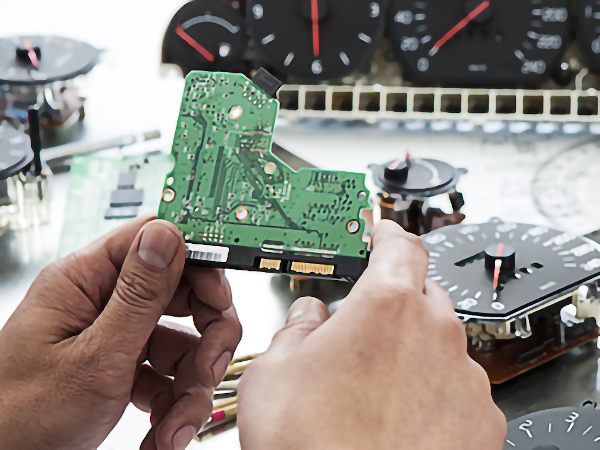
By increasing accuracy, vision can accelerate touch-up time, improve quality, and boost throughput at the end of the production line. On the other hand, integrating a vision system is known to be time-consuming and complex. Specialized technical skills are typically required to handle tasks such as establishing communication between the various subsystems, calibrating the vision system, and accurately recording workpiece data. Engineering challenges like these can sometimes delay the project and ultimately postpone the start of production.
Need for Speed
A manufacturer can lose ground to the competition if a business opportunity suddenly arises and they lack the necessary skills to implement a suitable process. This was the prospect facing a leading automotive parts manufacturer based in Japan, as the company sought to introduce cutting-edge robotic automation to produce its latest products quickly and cost-effectively.
A quick solution was needed to stay ahead of the market. However, the company's most experienced in-house engineer with robotic vision expertise was busy elsewhere with another project. Based on past experience, the production team knew that system integration could take much longer than expected and might require significant engineering resources. They also knew that securing long-term support could be a concern; determining whether the vision system or the robot was the cause of a problem, so they could direct their service calls to the appropriate vendor, could be challenging.
The team had to find a way to move quickly in order to introduce the vision system, ready to begin commercial production as soon as possible.
It was at that moment that the project leader learned of a solution offered by Yamaha Robotics' Factory Automation division. The solution showcased features that made the Yamaha RCXiVY2+ robotic vision system easy to integrate and configure, as well as fast and accurate. He quickly saw the system's potential to help overcome the challenges in the factory.
The Vision Robot simplifies
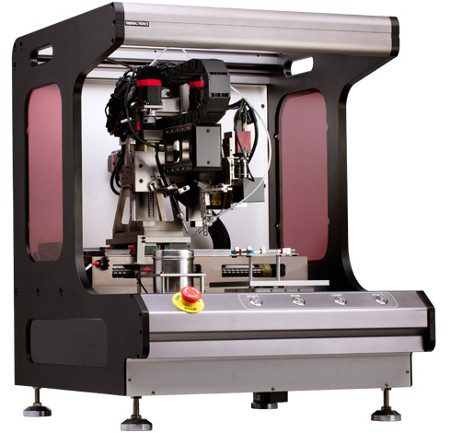
The RCXiVY2+ simplifies tasks that are notoriously complex and time-consuming when integrating conventional machine vision into a robotic system. These include robotic control, image processing, lighting control, and conveyor tracking data processing, all handled within the robot program and by incorporating a vision panel, lighting panel, and tracking panel into the RCX3 series multi-axis robot controller. Interoperability with lighting and other peripherals such as grippers is ensured.
Since vision is managed by the robot's software, there's no need to create a coordinate conversion routine. Furthermore, there's an intuitive wizard for calibrating the camera and a graphical tool that reduces workpiece registration to three simple steps: image capture, contour adjustment, and recording the detection position.
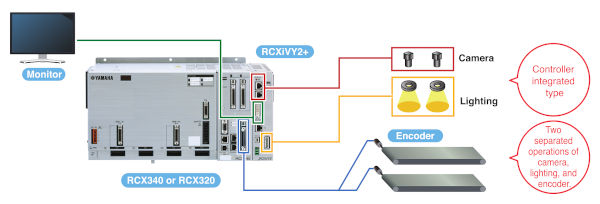 Typical conventional vision systems are complex to set up and require several additional cables that take up space. A separate GUI is also usually used to interact with the vision software. Yamaha's RCXiVY2+ can be integrated directly into the Yamaha robot controller without additional cables and without requiring a minimum footprint. With fully integrated vision programming commands, the RCXiVY2+ enables a simple, compact, yet intelligent robotic solution.
The vision system is integrated directly into the Yamaha robot controller
Flexibility is provided to mount cameras in fixed positions above and/or below the workpiece, or on the robot itself. If mounted on the robot, the system automatically adjusts the coordinates to correct for the effects of camera movement. Finally, a single cable provides power and data connections to the camera, and a standard DVI-I output simplifies connecting a monitor.
Thanks to these features, users no longer need extensive training and experience to build an accurate, fully functioning robot-vision system. After everything is connected and powered-on for the first time, setting up can be completed in under 10 minutes. That's about 80 percent faster than a conventional system. Furthermore, this plug-and-play simplicity comes without compromising performance: the latest-generation image-processing chip powering RCXiVY2 ensures up to 45% faster detection time than Yamaha's preceding model.
The RCXiVY2 system also features an innovative way of recognizing objects that is up to 10 times faster than the edge-detection approach traditionally employed in automated vision systems. This “blob-detection” technique applies threshold criteria to the camera's greyscale images, taking into account variations in light and shade, and applies binary coded processing to convert to black and white gradations. This enhances picking, presence recognition, and high-speed counting of multiple workpieces. Blob detection is especially effective when the objects are irregular shapes such as foodstuffs and clothing, and hence expands the possible range of applications for robot vision.
All-in-one stand
While the RCXiVY2+ is designed for ease of setup, helping users deploy high-performance robotic vision extremely quickly, Yamaha also provides support, including individual project consultation and training for new users. Furthermore, customers have the peace of mind of knowing they only need to make a call if they require additional assistance.
Back at the factory in Japan, having quickly set up the RCXiVY2+ system and leveraging the confidence that comes with knowing how to deal with any issues, Yamaha's new customer was looking forward to achieving its ambitious business growth goals.


 Asparagus picking-1-w.jpg)