They also seek to incorporate some technological obsolescence into their product lifecycles. Some also provide financing, either directly or in conjunction with a financial institution, to help potential customers overcome the initial cost barrier.
Many traditional robot suppliers fit the above description. Integrators often install a robotic or automated solution and provide after-sales technical support. They make it difficult to integrate competing robots with their solutions and offer regular hardware and software updates.
However, new and emerging robotics companies don't fit neatly into this bill. In fact, they are challenging established norms. This is sometimes by choice and sometimes out of necessity. The trend toward alternative models is evident in all sectors that new robotics seeks to impact. This includes retail, agriculture, logistics, delivery, security, cleaning, transportation, and more.
In the new paragraphs, we describe some trends and units in each sector. For the complete picture, see IDTechEx Research New Robotics and Drones 2018-2038: Technologies, Forecasts, and Players. This report is unique in its depth and breadth. It covers both existing and emerging applications. In fact, it provides twenty-year forecasts in value and unit numbers for 46 categories, giving a comprehensive and quantitative picture of this important transformation.
Agriculture
Autonomous robots can provide automated precision pruning. Smart robot deployments can also provide precision spraying or pruning. Initial machine or fleet costs are often high. The technological risk for end users is also high. Users often fear the need for skilled operators and repair technicians. They worry that the technology has not been thoroughly tested, especially in an agricultural environment. They fear that the technology could evolve rapidly, exposing them to serious risks of obsolescence. Crucially, they require seasonal services and are accustomed to paying wages rather than making significant capital investments in machines with low utilization rates.
To address these challenges, many companies are positioning themselves as robotic RaaS (Railway as a Service) providers. Essentially, they become lawn mowing service providers. They operate or monitor their own machines. They charge the customer per acre, a metric they're likely familiar with. They absorb the technological risk. Crucially, they give their robots extensive field practice and will have the opportunity to gather data and feedback. This is important because the design of these products and services is still evolving, with many more iterations anticipated.
This positioning changes the nature of their business. Companies need additional working capital and staff to absorb service costs and offer a sufficiently scaled service network. They can't simply build to balance their cash flow. This is where partnerships are important. This is also where initial capital investments for startups become a necessity, as most will operate at a significant loss during their first few years of operation.
With time and technological maturity, could the model revert to a traditional arrangement, or not? This is an ongoing debate because traditional manufacturers of heavy agricultural machinery will also need to adapt their models. This is inevitable because as vehicles become more autonomous in navigation and tasks, the machine becomes the service provider, blurring the line between equipment sales and service delivery. Will the entire value chain need to adjust, and will even distributors need to find their niche to transform their technical support into fully-fledged remote robot operations? For more information, read the IDTechEx report "New Robotics and Drones 2018-2038: Technologies, Forecasts, Players.".
This report focuses on all aspects of mobile robotics in materials handling and logistics. In particular, we consider the following: automated guided vehicles (AGVs and AGCs); autonomous mobile vehicles and carts/units; mobile picking robots; ground robots (droids) and last-mile delivery drones; and autonomous trucks and light vans (Level 4 and Level 5 automation).
Last mile delivery
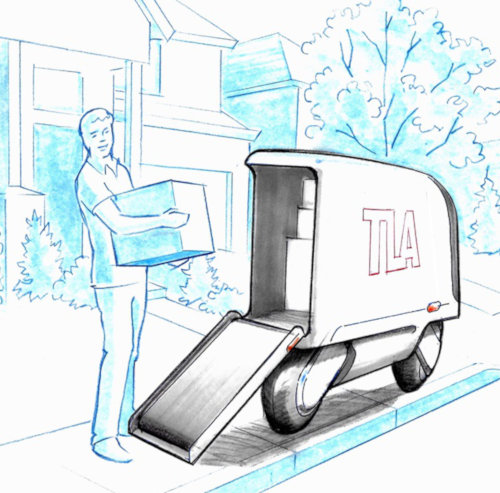
Around the world, numerous small robots are emerging to address the productivity challenges of the final stage of the delivery process: the "last mile." These small, slow robots autonomously deliver small payloads to their final destinations. At the individual machine level, they are highly unproductive. However, at the level of a large fleet, without overload management, they can become productive and commercially viable.
Two business models have emerged here. Some follow the traditional approach of trying to sell their robots. Others position themselves as delivery companies staffed primarily by autonomous robots. This latter model is being adopted for many good reasons. Hardware is expected to become modular, standardized, and highly commercialized in the future—essentially following the same path as consumer drones. Competing in this type of business will not be easy for startups, especially those based in California and similar business hubs.
Crucially, robotics companies also require practice data. This is because they will need to refine their delivery and navigation algorithms so that they can one day operate large fleets in complex environments with high-speed units. The data loop would be broken if they simply sold a machine and left. Data acquisition is a fundamental part of product improvement, without which the company would likely stagnate. It will also open the door to offering high-value-added analytical services.
The technology is still immature. As such, it will require close monitoring and possibly regular manual intervention to troubleshoot issues. Therefore, most players will be forced, at a minimum, to add a robust 24/7 service component to their business.
Logistics
Robotics companies are emerging to enable autonomous robotic picking. These robots combine autonomous mobility with autonomous picking capabilities. Here, too, companies often position themselves as service providers, charging a monthly subscription fee or a dollar-per-pick fee.
In this case, too, robotics companies need data. Their picking algorithms are based on deep learning, and as such, without training data, their product roadmap will likely stall. This would be very dangerous for their business prospects, as today's product generation only manages to slowly pick known objects with regular shapes in simple environments. However, the future lies in the rapid picking of novel items with random shapes in complex environments. To bridge this skills gap, data will be indispensable. Users will also need ongoing support. They, too, will prefer not to absorb the technological risk, especially since the technology—both hardware and software—is evolving rapidly.
Security
Autonomous mobile robots are being developed to perform a variety of security-related tasks. These robots are designed to work indoors, outdoors, and even on rough terrain. They are essentially sensors on a wheel. Some versions can have more than 50 integrated sensors, generating nearly 100 terabytes of data per year per machine. These robots can be deployed wherever security and monitoring are needed.
Here too, companies aren't always adopting a traditional equipment sales model. It's common to seek a subscription model to give customers access to the machine, the interface, the data plan, 24/7 support, and so on. Here, too, such agreements can be mutually beneficial. Suppliers will maintain that crucial data loop in their business models, allowing them to improve their products—for example, by offering specialized algorithms capable of detecting, recognizing, and analyzing specific situations, from license plate recognition to detecting hazardous gas leaks in an industrial area. Customers will also embrace this arrangement because it's closer to a final solution and makes it easier for them to test the technology and the new ways of working it could enable.
particular
, they are essentially offered as automated data acquisition tools, capturing data about items on shelves with greater speed and accuracy than humans.
Here, companies position themselves as providers of complete solutions. This has many advantages. This future tests their business against the commoditization of hardware. They can accumulate knowledge and data that are difficult to obtain and copy, which they can then use to support their value-added data analytics services. Their customers will also be interested in a final solution and not in some other, unrelated technology looking for a problem to solve. At the end of the day, they are only interested in an impact on the bottom line, whether it's increased stock availability, better shelf positioning, or reduced inventory levels. As such, data-centric, service-oriented models can be win-win propositions.
This shift towards non-traditional business models permeates all sectors. It's even happening in the automotive industry, where increased mobility is fueling serious debates about the future of mobility and the role of autonomous taxi fleets and shared facilities. Overall, even if business models aren't radically redrawn, the pool of benefits within the value chain will rebalance. This will change the winners and losers and require all participants to start looking ahead and planning now.
Author: Dr. Khasha Ghaffarzadeh, Director of Research, IDTechEx




 Asparagus picking-1-w.jpg)