


According to an analysis by IDTechEx, around 80% of humanoid robots and prototypes developed so far are designed for industrial applications.
This orientation has direct consequences for the materials used in their manufacture. Robots designed to handle loads and perform repetitive tasks need structures and components capable of withstanding high mechanical stresses, but an excessive increase in weight affects autonomy, energy consumption, and the loads that the joints must bear.
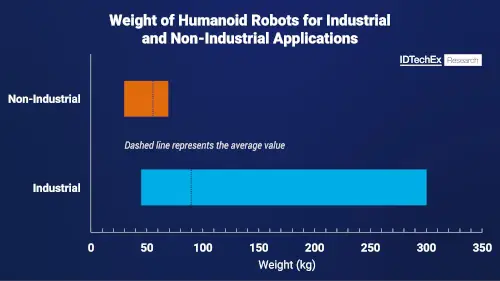
Industrial humanoids reach an average weight of 78 kg
Data collected by IDTechEx indicates that humanoid robots intended for industrial applications have an average weight of approximately 78 kg. Some models equipped with wheels even exceed 100 kg.
Weight is one of the main design parameters because it directly affects joints subjected to significant loads, such as the hips and knees of bipedal robots.
A heavier robot needs actuators capable of generating greater forces and torques. At the same time, it requires a higher-capacity battery if it is to maintain sufficient autonomy to work for extended periods. This creates a trade-off between structural strength, weight, battery capacity, and autonomy.
Wheels versus bipedal robots
Some manufacturers are developing humanoid robots with wheels instead of fully bipedal locomotion systems. This architecture allows for the incorporation of higher-capacity batteries without transferring all the increased weight to the joints responsible for walking.
It also simplifies certain problems related to dynamic balance, especially when the robot needs to transport or manipulate loads. Bipedal robots offer other advantages related to their ability to move through environments designed for people, but they require control systems, actuators, and structures capable of continuously maintaining balance during locomotion.
Actuators can account for more than half the weight
A significant portion of the weight of industrial humanoids comes from metallic materials, especially steel and aluminum alloys. These materials are used in structures and mechanical components that need to withstand heavy loads and repetitive movements.
Actuators are one of the most important components. According to IDTechEx, they can account for more than 50% of a humanoid robot's total weight. They contain components such as gears, bearings, shafts, and screws that must combine mechanical strength, hardness, dimensional accuracy, and wear resistance. The selection of materials for these components is especially important because actuators perform repetitive movements for extended periods and are continuously subjected to mechanical stress.
Precision, wear and fatigue of components
One of the challenges in taking humanoid robots from prototypes to large-scale manufacturing lies in the production of high-precision mechanical components. Elements such as gears or planetary roller screws must be manufactured with tight tolerances and maintain high consistency between units. These parts are also subject to wear and fatigue resulting from the robot's repetitive operation.
The durability of components will have a direct impact on the maintenance and lifespan of robots, especially in industrial applications where equipment is expected to operate for many hours. Therefore, developing materials and manufacturing processes capable of reducing wear without excessively increasing weight is a key area of focus for the industry.
Different materials for non-industrial humanoids
The needs change when robots are intended for non-industrial applications. Future humanoids for customer service, hospitality, other services, or direct user interaction will need to maintain sufficient structural strength, but also incorporate features related to safety and physical contact.
In these cases, flexible materials, soft surfaces, and impact-absorbing structures can become more important. Exterior design will also carry more weight than in certain industrial applications, where factors such as load capacity, strength, and durability may take precedence. Therefore, the combination of materials used in a humanoid robot will depend largely on the tasks and the environment in which it will operate.
From prototype to industrial production
The development of humanoid robots continues to be largely dominated by prototypes, pilot tests, and early commercial implementations. IDTechEx estimates that the market could reach approximately one million units by 2030, although this growth will depend on technological, economic, and regulatory factors. Remaining challenges include robot training and programming, safety, certifications, and the establishment of regulations for their operation in environments shared with workers and users.
There is also a specifically industrial challenge: transferring the materials, components, and assembly methods used in prototypes to processes capable of producing large volumes with adequate cost, quality, and repeatability.
Materials and components will determine the evolution of humanoids
The evolution of humanoid robots will not depend solely on artificial intelligence and control software. Weight reduction, battery energy density, actuator efficiency and durability, gear longevity, and the manufacturing of precision mechanical components will play a significant role in the continued use of these systems.
In industrial applications, the challenge lies especially in combining strength and durability with a sufficiently low weight to limit energy consumption and the loads supported by the joints.
As current projects progress from prototypes to commercial implementations, these needs will largely determine the selection and evolution of materials used in the next generations of humanoid robots.
Author: Dr Shababa Selim, Senior Technology Analyst IDTechex


 Asparagus picking-1-w.jpg)