
Although the pandemic has disrupted overall market trends, demand for robots has continued to rise. One of the driving factors is that companies have identified investment in robotics as a solution to maintain production while ensuring worker protection from infection. This trend is expected to continue. Fortune Business Insights valued the total industrial robot market at $14.6 billion in 2020 and predicts a CAGR of over 10% for the period 2021-2028.
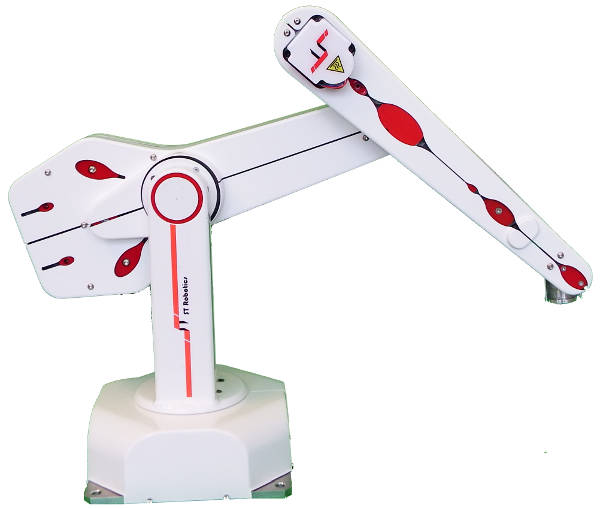
Industrial robots are available in many different forms to tackle a wide variety of tasks. At one end of the spectrum, large machines designed to lift heavy objects and perform high-speed processes work in areas where human access is restricted for safety. At the other end, collaborative desktop robots (cobots) coexist with human workers and handle repetitive, demanding, or time-critical tasks.
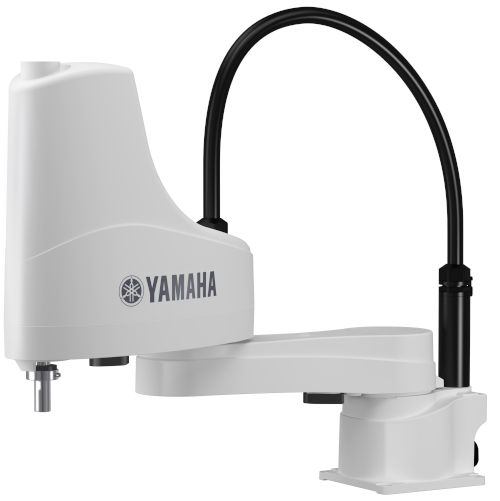
Between these two extremes, robots built to handle loads from a few grams to around 50 kg are automating a wide variety of processes involving the retrieval, movement, and placement of items repeatedly. Typically, users may seek to increase speed, accuracy, and repeatability, or eliminate human contact with items such as food or sterile materials. Among these, the SCARA (Selective Compliance Assembly Robot Arm) robot is widely used in industrial automation projects.
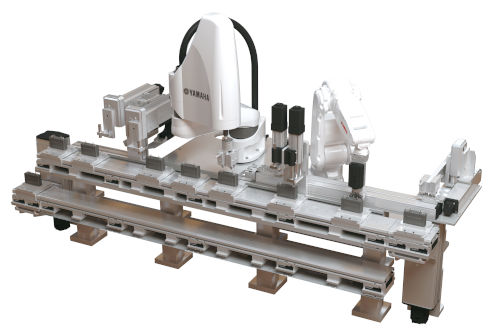
SCARA robots are a mature and affordable technology. They can be installed individually or in groups with other SCARA robots, or with different types such as Cartesian, single-axis, and multi-axis robots (Figure 1). Furthermore, they integrate well with Yamaha's LCMR200 linear transport modules, which provide flexible workpiece transport. Unlike conventional belt and roller conveyors, these modules are programmed and controlled in the same way as other robots to create a fully integrated and coordinated robotic assembly cell.
A closer examination of the latest generations of SCARA robots shows how these machines continue to evolve to meet the demands of modern manufacturing.
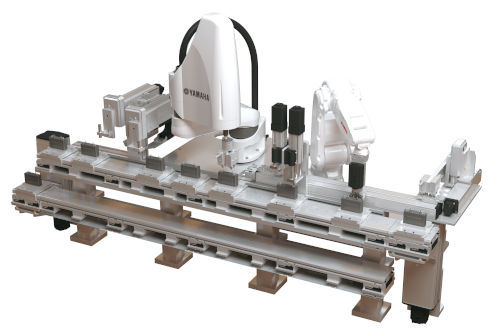
Figure 1. SCARA machine in a mixed robot unit with programmable modular conveyors.
The SCARA Advantage:
At first glance, today's SCARA robots may seem little different from the earliest generations of machines. Like their predecessors, their defining feature is a two-link articulated arm that operates in a single plane. While science fiction and early cobots, such as Baxter, have featured humanoid forms, SCARA has proven its enduring excellence in mimicking the human arm: it can extend and retract, and rotate on the "shoulder" and "elbow" axes, independently and simultaneously. It can move to an infinite number of locations within the area defined by the maximum extension of the two links, and can also reach inside enclosures.
Thanks to this flexibility, SCARA robots can perform a wide range of operations, such as moving objects from one place to another, picking up and placing or positioning components in assemblies, and executing processes such as screwing, dispensing, and engraving.
In addition to this great flexibility, accuracy and precision are other strengths that allow SCARA robots to tackle demanding industrial tasks and offer exceptional repeatability. Yamaha's low-cost, high-performance YK-XE family of SCARA robots, which handles payloads between 4 and 10 kg, includes models with a specified repeatability of just ±0.01 mm on the X, Y, and Z axes, and ±0.01° in rotation. The YK710XE is an exception. With the longest arm in the family, reaching 710 mm, it has a repeatability of ±0.02 mm on the X and Y axes. The accuracy and precision of these robots allow their use in tasks such as placing tiny mechanical components, like small springs or washers, or picking and placing surface-mount electronic components. Their payload capacity also allows them to be used for transferring or assembling heavy parts, such as those used in the automotive industry.
It seems like the perfect robot, ready to transform mundane and repetitive tasks into processes that can help companies that invest in it stand out from their competitors. Robots can work faster, longer, and with fewer errors than human workers, allowing human skills—extreme dexterity, problem-solving, creativity—to be more effectively employed in other areas. But there are always opportunities to improve machines, such as increasing speed, reliability, and ease of use.
Motion Control:
Yamaha's latest generation of YK-XE SCARA robots is designed with a new, lightweight spindle assembly and enhanced motion control, ensuring faster acceleration and reduced vibration. The control strategies Yamaha has developed for its SCARA machines automatically optimize linear and angular acceleration, taking into account arm orientation and payload inertia, to limit peak torque, prevent excessive vibration, and improve controllability. This not only helps minimize cycle time but also reduces mechanical stress, enhancing reliability.
Robot Vision:
With their precision motion control, SCARA robots bring increased productivity to numerous industrial processes. Integrating a vision system further expands the machine's applications, enabling functions such as conveyor belt tracking, position detection, and position compensation to improve the accuracy of processes like applying adhesive or sealant to the edge of an assembly, or placing labels on components that may be irregularly positioned on a substrate.
Yamaha's RCXiVY2+ vision system (Figure 2) is implemented with a vision card, a lighting card, and a tracking card installed in the RCX3 series multi-axis robot controller. This integrates robot control management, image processing, lighting control, and the processing of data required for conveyor tracking within the robot program, significantly reducing equipment setup time.
 Figure 2. SCARA robot equipped with a camera for the iVY2+ vision system.
The RCXiVY2+ system features a new spot detection capability that can recognize workpieces two to ten times faster than the previously used edge detection technique. This allows robots to handle high-speed detection, picking, and counting of multiple items of indeterminate shape and size, such as food and clothing.
Programming Software:
To help configure a single robot or an assembly cell, the vendor's feature-rich software tools can simplify and expedite robot programming and configuration. Yamaha's RCX-Studio 2020 environment provides tools to help manage robots from setup to maintenance and now includes wizards to automatically generate sample applications. These ready-to-use templates help easily program common actions such as pick and place, palletizing, and conveyor tracking, including vision-based processes, without the need to write commands.
There are also tools such as an emulator, a cycle time calculator, and real-time plotting, while another new feature is the 3D simulator for checking, debugging, and optimizing programs offline. Among the tools available in the simulator are trajectory visualization, which allows operators to evaluate robot movements, and interference checking to help avoid collisions with other robots or peripherals. It is possible to simulate up to four robots together and observe them from multiple viewpoints simultaneously. Thanks to the simulator, robot positions, action sequences, and optimal speed settings can be determined quickly before any actual installation work begins. This can save a great deal of costly trial and error, especially when setting up an assembly cell with multiple robots, and allows production to start sooner.
Conclusion:
The SCARA robot has been the primary type deployed in industrial applications, offering high speed, reliability, and exceptional accuracy. The latest generations continue to improve upon these well-known parameters. As the economic case for automation gains strength, companies seeking to integrate robotics into their processes have a wider range of options than ever before. The SCARA continues to improve, delivering new advancements with each successive generation to offer a more cost-effective and accessible option with additional capabilities, faster cycle times, greater accuracy, reliability, and ease of use and programming.


 Asparagus picking-1-w.jpg)