
There are many types of security devices available today. The devices listed below are just a few examples to help you consider the options available to you.
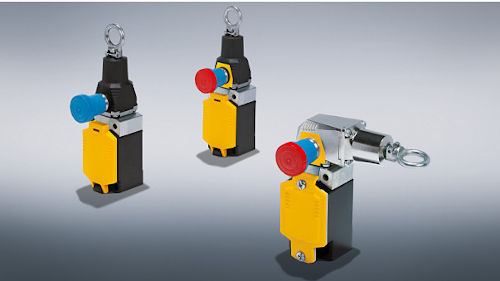
Emergency stops (E-stops) are one of the most recognizable and frequently considered safety devices on the production floor. Think of them as the immediate interface for stopping a machine. The emergency stop is typically in a normally closed position within a circuit that, when pressed, opens the circuit and cuts power to the device. To reactivate the circuit, the emergency stop must be pulled out or rotated to reopen the circuit and restore operation.
According to OSHA, ANSI, NFPA 79, ISO 13850, and IEC 60204-1, emergency stops must be installed in locations easily accessible to the operator, and resetting the emergency stop must not allow operations to resume. A second, redundant action, such as a clear all function via a circuit in the programmable logic controller (PLC), is required.
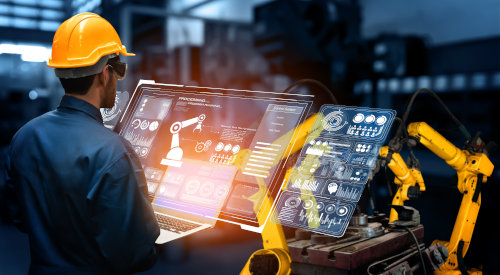
Door interlocks are another physical safety device commonly integrated into production plants. Safety interlocks are used on physical barriers such as gates and doors. Like emergency stops, safety interlocks operate on a normally closed circuit. When the gate or door is opened, the circuit is interrupted, and all work stops. Interlocks must comply with ISO 14119 and ISO 13849 standards.
Operator presence triggers come in many shapes and sizes. For example, a safety mat is activated by someone standing on it. It can cause a machine to stop, reverse, or shut down when their presence is detected. This helps ensure that human workers do not obstruct the machine, allowing it to operate.
Safety laser scanners have become very popular with the rise of cobots. The scanner uses a 360-degree beam that indicates how close a worker or object is to the robot. Typically, with predefined zones, the robot reduces its speed based on the proximity of the person or object. In the orange or yellow zone, the robot slows to a cooperative speed until the object or person has moved away. If the red zone is activated, the robot will then slow down or even stop completely until it is safe.

Photoelectric curtains are especially effective in areas with a risk of crushing or entrapment, such as hydraulic presses. The optical barrier uses photoelectric beams projected from a transmitter to a receiver. If the beam is interrupted, all work stops immediately until the obstruction is removed. Photoelectric curtains are particularly effective when using solid fences or barricades is impractical. They are available in various sizes and sensitivity levels to meet manufacturers' OSHA compliance requirements.
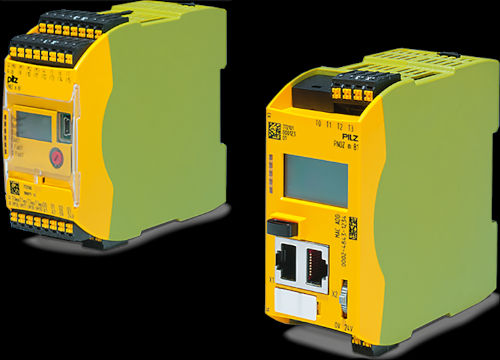
Safety programmable logic controllers (PLCs) are control systems designed to monitor and manage safety-critical functions and are used to program safeguards to monitor the status of a line. Through redundancy, the safety PLC is designed to perform diagnostics to determine if a part of the line or a component is faulty. If an event occurs, such as a cable break or a motor operating out of specification, the safety PLC will immediately disconnect the entire affected system to prevent injury or damage. The safety PLC must adhere to a specific Safety Integrity Level (SIL) and comply with IEC 62061, ISO 13849-1, and IEC 61058 standards.
These are just a few of the many safety devices available to manufacturers and installers today. When automating a process, it's essential to seek the advice of a safety expert and consultant to ensure you've addressed all potential hazards within your facility to protect your workforce and your investment. These experts and consultants can help you navigate OSHA, ANSI, and all other relevant safety regulatory bodies.
 Author: By Eric J. Halvorson, Director of Marketing Technology - Automation and Control at DigiKey