
An interruption of just 100 milliseconds can cause the onboard computer to restart, which could take several minutes and even require manual intervention to resume operation for safety reasons. For example, a robotic arm should not be left in an undesirable state or position.
Power outages can be caused by environmental factors, such as lightning strikes on high-voltage power lines, storms, falling tree branches, or even animals. In rural areas, the risk is greater, as power lines are often exposed above ground. Outages can also be caused by events that introduce disturbances to the electrical grid, such as the starting of motors or the energizing of large transformers in neighboring facilities.
AC-DC power supplies can only withstand the loss of AC power for a few milliseconds before the output voltage drops to zero.
Preventing Equipment Shutdowns:
Backup generators are suitable for long-term power outages that can last from tens of minutes to several hours or even days; however, they can take several minutes to start up.
Computer systems often rely on an uninterruptible power supply (UPS) for backup. These use batteries to store backup power, which requires preventative maintenance and, occasionally, battery replacement. Because they operate continuously, they consume more power, are more expensive to maintain, and add considerable expense. The vast majority of AC power outages and dips occur in less than 0.5 seconds. Since a standard AC-DC power supply can sustain output for only 50 ms (at most), additional energy storage is required.

In the diagram in Figure 1, the impact of an AC interruption without a buffer module is shown, where time T is the power supply hold time (20 to 50 ms).
TDK-Lambda Buffer Modules:
As the name suggests, a buffer module protects the load from brief interruptions in the AC power supply. The load can be a digital process control board, relays, contactors, or motors. Energy is stored in the module in electrolytic capacitors, similar to those found in an AC-DC power supply. DIN rail-mounted buffer modules are the most popular; for example, TDK-Lambda, represented by Mecter SL, offers the DBM20 series, rated at 24 VDC and 20 A (Figure 2).

Figure 2: TDK-Lambda DBM20 buffer modules for DIN rail mounting.
The buffer module is connected in parallel with the DC output of the power supply, as shown in Figure 3.
If the AC supply is briefly interrupted, the DC output of the power supply will begin to decrease as its internal energy is depleted. At that point, the buffer module will take over powering the load. When the AC supply is restored, a controlled amount of current flows from the AC-DC power supply to the module to recharge it. In this way, when a buffer module is connected in parallel with the power supply output (Figure 4), there is always voltage at the load during the AC interruption. During the time interval T, the power supply continues to power the load, and during Tb, the buffer module covers the demand until the AC supply is restored.
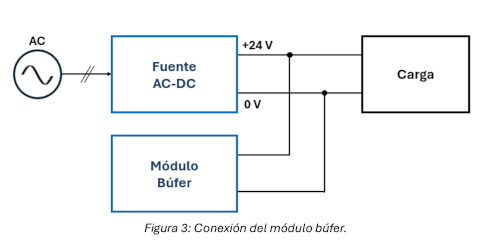
Figure 3: Buffer module connection.

Figure 4: Output of the power supply during a voltage interruption with buffer module.
In the event of a very long AC interruption, the buffer module can be used to power the load for a longer time, allowing the equipment to be shut down safely and in a controlled manner or vital information to be stored (Figure 5).
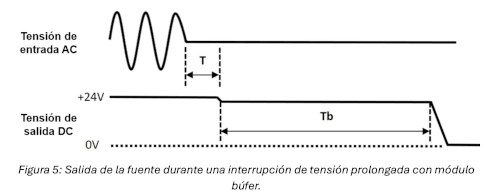
Figure 5: Output of the power supply during a prolonged voltage interruption with buffer module.
The DBM20 can be configured in fixed or variable buffer mode. In fixed mode, it will supply power when the input voltage drops to 22.4V; in variable mode, it will supply power when the input drops by 1V. The buffer hold time (Tb) is specified in the module's datasheet at a given power level. For example, the 20A TDK-Lambda DBM20 provides an additional 250ms at a power level of 448W. When used at lower power/current levels, the buffer hold time increases. For a load current of 5A, the buffer hold time will be approximately 1 second. With a load current of 2.5A, the buffer hold time will be 2 seconds. Buffer modules can be connected in parallel to further extend the buffer hold time.
Because the buffer module operates independently of the power supply and end equipment, it can be added after installation. No AC wiring is required, and no batteries requiring maintenance or replacement are used. If a specific machine location is found to be more prone to brief AC power interruptions, easy on-site retrofitting is possible. Product status can be accessed remotely via a DC OK relay or locally via LED indicators.
For any technical or commercial queries, you can contact Mecter SL, an authorized distributor of TDK-Lambda.