




made up of routes considered a priority for the development of European transport infrastructure.
The project aims to help adapt regulations, traffic control centers, and infrastructure to autonomous driving in order to improve the interoperability of autonomous vehicles, ensure their safe operation on all types of roads across Europe, and guarantee their safe coexistence with other vehicles. To achieve this, intelligent transport services based on cooperative information and technology (C-ITS) systems will be developed. These systems enable secure communication and data exchange between vehicles, users, and infrastructure, utilizing the European ITS-G5 communications standard.
 For the Madrid pilot project, three C-ITS services have been developed that will expand the "vision" of the autonomous vehicle and facilitate decision-making through alerts such as, for example, notifications about road works, congestion situations or adverse weather conditions.
These C-ITS services have been integrated into the Horus traffic and tunnel management solution, developed by Indra, for which a new module has been created that allows both the management of sending information to the autonomous or connected vehicle and taking advantage of all the data that this type of vehicle generates, processing it in real time and offering valuable information for decision-making by managers, the connected vehicles themselves and drivers of conventional vehicles.
The Horus platform, implemented in the cloud, obtains information on incidents through the DGT information channel using the DATEX2 protocol, a European standard for the exchange of information between traffic control centers.
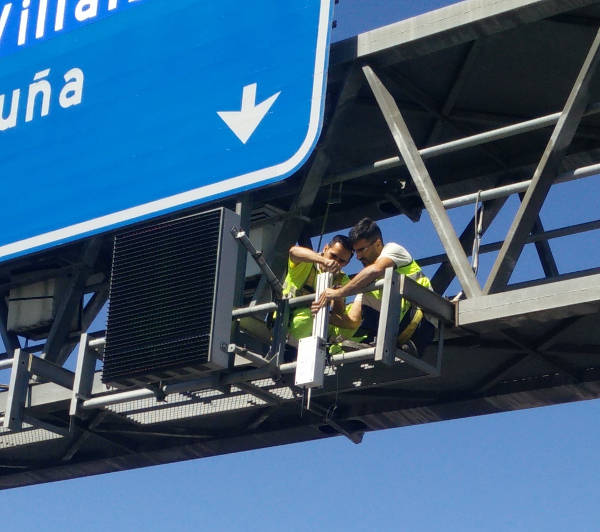
The first Road Side Units (RSUs), equipped with various ITS-G5 and mobile communication technologies, are already being installed at the pilot site, the A-6 bus-HOV lane that connects to the M-30 ring road in Madrid. These units will transmit information to autonomous and connected vehicles when they are traveling in the A-6's reversible high-occupancy vehicle lane.
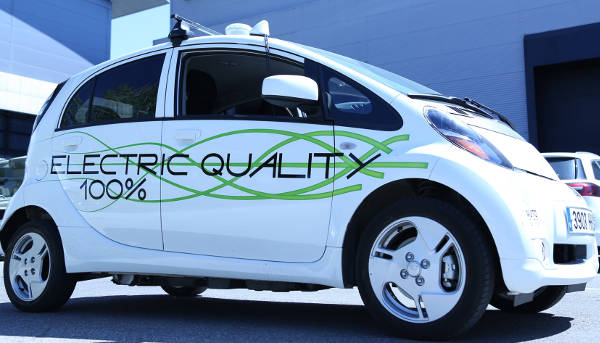
In addition to this initial deployment, the first tests with an autonomous vehicle have already been carried out on a closed circuit at Indra's facilities in San Fernando de Henares to verify the correct transmission and reception of information. Both the tests in this environment and on the HOV lane are being conducted according to the regulations approved by the DGT (Spanish Directorate General of Traffic), which provides companies and research centers with open regulations for conducting tests, as they are not bound by the Vienna Convention.
Exchange of services between pilots
The pilot projects in Madrid, Lisbon, and Paris are pioneering initiatives in the Atlantic Corridor and among the first in Europe to include tests of autonomous vehicles from various providers, both on closed and open roads with conventional traffic, on urban and suburban roads, and on highway interchanges. The services and systems tested in one city are planned to be shared with those in the other two to verify their interoperability and proper functioning.
The Lisbon pilot project will take place on the A-9 motorway, between the A16 and the EN6. The C-ITS services to be deployed will send autonomous vehicles alerts about traffic congestion, notifications about slow or parked vehicles, and warnings of adverse weather. Six Road Side Units (RSUs) will be installed for communication with the vehicles, and at least two autonomous vehicles, from the IPN and the Polytechnic University of Madrid (UPM), will be deployed, along with one instrumented vehicle to carry out validation tests of the services and infrastructure.
In addition, to carry out the tests in the more urban environment, two other low-speed autonomous vehicles will be used as shuttles at the IPN, allowing the transport of passengers on a stretch of approximately 500 meters.
In Paris, in addition to warnings of dangerous situations, traffic jams will be reported and traffic management will be facilitated by providing information on recommended speeds, lanes, alternative routes, etc., using communication from the control center to autonomous vehicles. The trials will take place on the A-13 motorway, on the outskirts of the city.
Collaborative ecosystem
In addition to Indra, the following entities are participating in AUTOCITS: the Spanish Directorate General of Traffic (DGT), the Polytechnic University of Madrid (UPM), the National Road Safety Authority (ANSR), the University of Coimbra (UC), the Pedro Nunes Institute (IPN), and the National Institute for Research and Innovation in Digital World (INRIA). The project has a budget of €2.6 million and is funded by the European CEF (Connecting Europe Facility) program.
AUTOCITS is also collaborating with other existing European R&D initiatives in this field, such as the C-Roads platform and the C-Roads Spain project, as well as with other organizations interested in projects related to connected and autonomous vehicles. To this end, a series of open sessions are being held to bring together organizations interested in this area so they can contribute their perspectives on autonomous vehicles and the work carried out within the project.
The latest workshop was held on October 10th in Lisbon. ANSR President Jorge Jacob closed the event, which also included participation from companies and institutions such as BRISA, ITS Portugal, IMT, and Indra itself.
The open sessions previously held in Madrid and Paris included organizations such as DGT, SACYR, Ferrovial, OHL, Mapfre, the Road Technology Platform (PTC), the PONS Foundation, COMSIGNIA, YOGOKO, Vedecom, AutoKAB and VICI.







