The award was granted by a jury comprised of representatives from business, academic, technological, institutional, and media organizations, including amec itself, CEOE, ESADE, Eurecat, the Polytechnic University of Catalonia, UNE, the Ministry of Industry, La Vanguardia, and 3Cat. Other awards went to Aimsun (Anticipation), Grupo Calaf i Girbau (Collaboration), Inoxpa (Glocalization), and Plásticos Escanero (Sustainability).
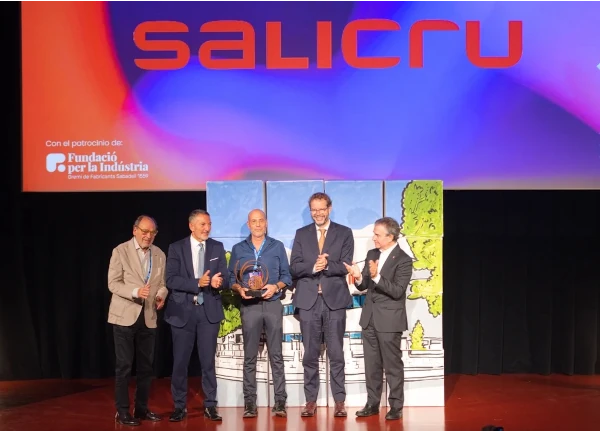
Salicru CEO Eduard Salicrú accepted the award from Miquel Sàmper, Minister of Business and Labor of the Government of Catalonia, and Jordi García Brustenga, Secretary of State for Industry. During his acceptance speech, he emphasized that “adaptability is not an individual quality; it is the capacity of an entire organization to listen, learn, and act.”
“At Salicru, we have been evolving for over sixty years without losing our essence, which is that nothing important ever stops. We have learned that adapting is not about giving up who you are, but about finding a new way to fulfill your values,” he stated.
The award is part of the Positive Industry movement, which advocates for an industry committed to shared progress, people, local communities, and sustainability. Its five principles include anticipating, adapting, collaborating, glocalizing, and focusing on sustainability.
In this regard, Salicru emphasized that each market has different needs and that its international activity goes beyond simply exporting solutions: “It consists of adapting knowledge, technology, and service to each local context. Continued investment in R&D&I allows the company to anticipate changes and transform specific needs into robust and reliable energy solutions.”
The recognition also highlights the collaboration between the engineering, production, sales, quality, and service departments, as well as the contributions of subsidiaries, partners, and clients. “Adaptability only works when information circulates and is transformed into improvement,” says Salicrú, adding that adapting also implies acting responsibly: “designing more efficient, durable, repairable equipment prepared to contribute to a more sustainable future.”





- Details
- Category: Current Affairs
Salicru, recognized by amec for its adaptability
These are two awards given by amec positive industry, the association for the promotion of internationalized industry, which brings together and represents more than 500 industrial companies with an international vocation, forming one of the main internationalized industrial communities in the country.




Print Magazine

Annual subscription price:
You will receive all 10 editions that are published each year.
social networks
Popular News Electronics


Spanish electronics magazine. Printed for over 25 years.
Spain - Madrid - All rights reserved © Convertronic Professional Spanish Electronics Magazine.