




The growth in electric vehicle production is driving demand for materials capable of preventing or delaying the spread of thermal runaway between lithium-ion battery cells and to the outside of the pack.
New materials will reach nearly 40% of the market
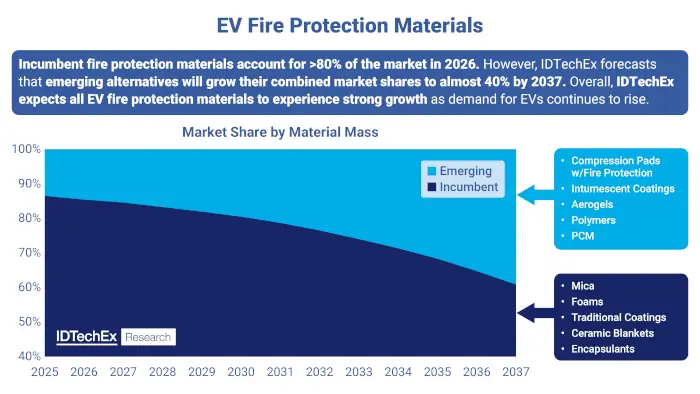
Currently, encapsulating foams and mica sheets together account for more than 80% of the market for fire protection materials for electric vehicle batteries. However, IDTechEx anticipates that their combined share will decline as new technologies are adopted more widely. According to their estimates, emerging materials will reach a market share of nearly 40% by 2037, thanks to their advantages in thermal insulation, weight reduction, and functional integration.
The consulting firm points out that no single solution is completely effective under all conditions. The selection depends on factors such as battery design, cell format, and safety requirements.
Intumescent polymers to reduce components
Intumescent polymers are gaining interest as an alternative to traditional materials. These compounds expand when subjected to high temperatures and form an insulating barrier that helps limit the spread of heat and fire. Their main advantage is the ability to combine several functions in a single component. For example, a cell support or separator made from an intumescent polymer can replace several currently used materials to achieve equivalent protection.
IDTechEx also expects an increase in the use of fire-resistant coatings, especially in applications that require thin, lightweight layers.
Aerogels for lightweight thermal insulation
Aerogels represent another technology with significant growth potential, both for inter-cell protection and for insulating the entire battery pack. These materials combine low density and reduced thermal conductivity, with conductivity values below 0.05 W/m·K, according to data collected by IDTechEx. These properties allow for limiting heat transfer without excessively increasing the system's weight, an important factor for the range and efficiency of electric vehicles. The consulting firm anticipates that aerogels will achieve significant market share, even though the physical quantity of material required is relatively small.
Foams and phase change materials
Foams, encapsulants, and phase-change materials (PCMs) are primarily used in battery systems with cylindrical cells. IDTechEx highlights that the use of protective foams in Tesla batteries has contributed to their increased adoption in the industry. Among these solutions, the consultancy considers foams to offer a particularly attractive combination of thermal insulation and low weight.
Meanwhile, encapsulants and PCMs will continue to have applications in smaller battery systems, especially when active thermal management is not used, although they represent a smaller segment of the market.
Growth driven by electric vehicle production
IDTechEx links the evolution of the flame-resistant materials market to the increase in electric vehicle manufacturing and the need to improve battery safety. The consultancy notes that monthly electric vehicle sales in Europe increased by 40% between February and April 2016, amid high oil prices. As production grows and different cell formats are maintained, the need for specific solutions to prevent or limit the spread of thermal incidents will also increase.







