Hermann Reiter, President of DMASS, states: “The fairly solid numbers compared to a record year (2022) cannot mask the fact that customer orders continue to decline, which will inevitably result in a weaker second half of the year. Inventories are full and need to be processed. At the same time, availability across the market has improved significantly, and instances of component shortages, while still present, for example, in SiC and GaN devices, have greatly decreased. This is a huge relief, and we look forward to a return to some semblance of normality in the market. On a positive note, we are confident that long-term demand is not being hampered, and design activities remain dynamic despite all the challenges.”
Semiconductors (Q2):
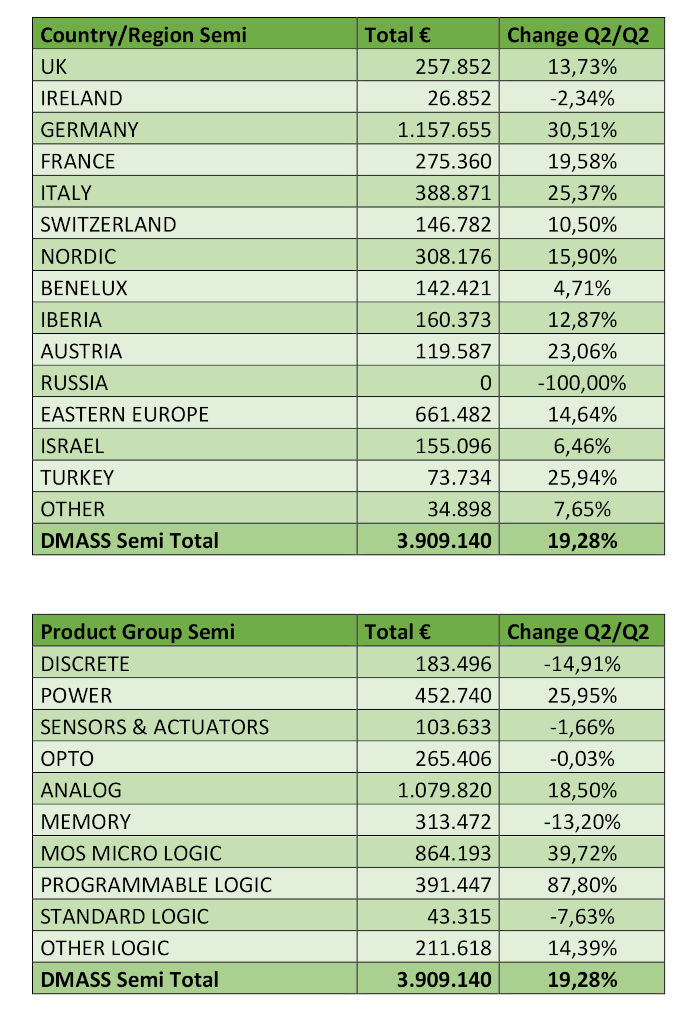
With a total of €3.91 billion, DMASS continued to post strong semiconductor revenues. However, regional differences were quite significant. While Germany, Italy, France, Austria, and Turkey showed oversized growth, and the UK, Switzerland, Iberia, the Nordic countries, and Eastern Europe maintained double-digit growth, Benelux and Israel, along with the rest of Europe, remained barely positive. In terms of products, Microcontrollers, Programmable Logic, and Power Devices actually drove most of the growth in Q2.
Interconnection, Passive and Electromechanical Components (second quarter):
Given that IP&E was ahead of semiconductors in terms of cyclicality, the return to normal market conditions began earlier, and therefore the decline in the second quarter compared to the record year of 2022 was not really a surprise. The 7.3% drop to €1.56 billion was not uniform across all regions and products. The UK and France performed above average, Germany, also the largest market here, was average, while Italy experienced a double-digit decline. Regarding products, Passives declined at an average level and Power Supplies actually grew, while Electromechanical Components (including Interconnect) decreased by almost 9%.

President Hermann Reiter: "The last two years have certainly brought about significant changes in our industry. Awareness of the importance of a stable supply chain has never been greater, even in circles where knowledge of our specific market is limited. Furthermore, trading conditions have shifted from a free market to one characterized by delays and certain conditions that were certainly difficult to accept. Therefore, it is more important than ever to improve cooperation within the supply chain to at least mitigate potential risks and find better solutions. The future of the components industry, while generally appearing positive, hinges on a variety of massive challenges that could shift the market in any direction. We must prepare for this."