
These studies, which are based on responses obtained from a wide and varied number of professionals responsible for the prescription, design and supply of interconnections in Europe and the USA, analyzed the most important applications of connectors, the technologies chosen and the criteria for selecting products and suppliers.
“This new Harwin study builds on the success of the 2025 edition for the connectors industry in North America and covers the European market for the first time,” said Peter Schneid, Vice President of Marketing at Harwin. “It’s clear that connectors, and especially high-reliability connectors, remain absolutely essential for the successful design and manufacture of electronic products in segments such as industrial systems, telecommunications, data, automotive, and electric vehicles.”.
Harwin's report analyzes how European engineers and buyers select electronic connectors and what their main technical and supply concerns are.
Study Objective:
This study is based on surveys of engineers, electronic designers, and purchasing managers in the European industrial and technological sectors. The objective was to understand:
What criteria influence connector selection.
What problems users encounter.
What technological trends are changing the market.
Key findings
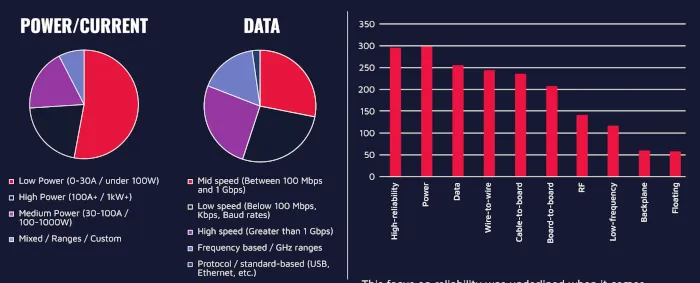
1. Reliability is the most important factor.
Users clearly prioritize:
Reliability,
Durability
, Electrical performance,
and Lifespan
over other aspects such as sustainability, size, weight, or initial cost.
This is especially important in critical sectors such as aerospace, defense, industrial, electric vehicles, telecommunications, and energy. The report highlights that connector failures remain a frequent cause of breakdowns in complex electronic systems.
2. Increased demand for high-power, high-speed connectors.
Modern applications require higher connection density, faster data rates, and greater current capacity.
The fastest-growing areas include electric vehicles (EVs), industrial automation, data centers, drones, telecommunications, and aerospace systems.
The study indicates that combining power and data transmission in confined spaces is a clear trend.
3. Engineers Need Better Digital Tools.
Many participants believe that the tools available for selecting connectors are still lagging behind those in other industries.
Users demand smarter configurators, more accurate CAD models, simulations, integration with PCB design, clear technical documentation, and AI-based tools.
Although AI usage is still relatively low, it is already beginning to be used for component selection, design validation, and the automation of engineering processes.
4. Supply chain issues remain a concern.
Following years of global logistical challenges, customers particularly value stock availability, fast delivery, rapid samples, technical support, and continuity of supply.
Many users prefer suppliers capable of providing complete assemblies, integrated solutions, design support, and long-term compatibility.
Key technical trends: Floating connectors
The report mentions the growing interest in connectors capable of tolerating mechanical misalignments during automated assembly.
Advantages: They reduce mechanical stress, improve service life, facilitate automated manufacturing, and reduce assembly errors.
Especially important in: compact equipment, industrial electronics, automotive, and vibratory systems.
Greater resistance to vibration and harsh environments.
Modern applications demand connectors capable of withstanding vibration, shock, extreme temperatures, repeated connection cycles, and high currents.
Therefore, the demand is growing for gold-plated contacts, locking systems, shielded connectors, and designs with high mechanical retention.
Miniaturization without sacrificing performance:
There is constant pressure to reduce size, increase density, maintain signal integrity, and support more power.
This drives the development of fine-pitch connectors, mezzanine connectors, compact board-to-board connectors, and hybrid power and data solutions.
Frequent problems identified by users
: Respondents point to the following main difficulties:
- insufficient technical documentation,
- complexity of selection,
- mechanical incompatibilities,
- irregular availability,
- long validation times,
- PCB integration errors.
Many engineers feel that projects are becoming increasingly complex and that expectations regarding deadlines and performance have increased considerably.
Overall Conclusion:
The report concludes that the European connector market is evolving towards more robust, compact, automation-ready solutions with greater digital support.
Reliability remains the dominant criterion, while digitalization and AI are beginning to transform how engineers select and validate connectors.