




IDTechEx's latest research report on electric motors predicts that annual demand for rare-earth magnets for EV motors will exceed 1 billion kg by 2031. If so, what impact will this new development have on the electric vehicle market?
Europe relies heavily on other regions for the supply and processing of strategic raw materials; one of the categories highlighted in the law is rare earth elements for magnets, such as Nd, Pr, Tb, Dy, Gd, Sm, and Ce. Much of the law focuses on increasing the EU's extraction (10% compared to the current 3%), processing and refining (40%), and recycling (15%) of these materials. The law acknowledges that the EU cannot be self-sufficient in this area, but sets a target of not depending on any single country for more than 65% of each strategic raw material.
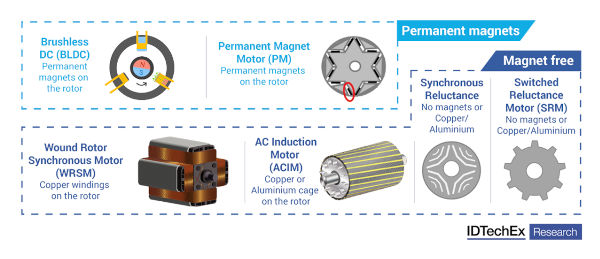
Electric vehicle motors rely heavily on rare-earth magnets. In 2022, 82% of the global electric vehicle market used rare-earth-based permanent magnet (PM) motors. Alternative strategies exist, with European OEMs such as Renault, BMW, Mercedes, and Audi introducing magnet-free technologies, including wound-rotor and induction motors. However, research by IDTechEx revealed that their market share in 2022 was less than 23% in Europe (the region with the greatest OEM focus on magnet-free motors).
Regarding recycling standards and magnet content, the law establishes the responsibility of the entity that markets the motor vehicle or light transport vehicle. They must indicate whether the magnet contains PM, the PM family (NdFeB, SmCo, AlNiCo, Ferrite), and the location of the electric motors within the vehicle, along with the steps for their removal. This should assist recyclers when it comes time to process the motors at the end of their useful life. In cases where the PM content exceeds 0.2 kg (PM motors in electric cars typically weigh between 1 and 3 kg), the proportion of Nd, Dy, Pr, Tb, B, Sm, Ni, and Co recovered from post-consumer waste will be made public. The specific percentages of required recycled content have not yet been established.
Although the law sets targets for reducing the EU's dependence on imported materials, the most important issue is that it doesn't specify how this could be achieved on the demand side. For example, some OEMs might use a magnet-free option that significantly reduces the demand for rare earth elements, while others might not, a fact not addressed in the law. The fact that an OEM not using PM doesn't have to declare or worry about the recycled content of its magnets is unlikely to be a key driver of PM reduction. A reduction in PM content per engine or greater adoption of smaller vehicles would also reduce demand, but this too is not considered.
The LEVA-EU (Light Electric Vehicle Association) has pointed out in its response to the EU Commission that the 0.2 kg magnet weight limit will mean that some vehicle classes, such as electric bicycles, will be excluded, but a series hybrid cycle might not be. This makes it difficult for certain technologies or companies to operate. It also highlights that the supply of components for LEVs (light electric vehicles) is already insufficient, leaving companies (especially SMEs) with fewer options when choosing the origin of their components. This action could discriminate against companies that source parts from the EU compared to those from non-EU regions.
In IDTechEx's opinion, the EU Critical Raw Materials Act, in its current form, will have little impact on the adoption of magnet-free motor designs in most electric vehicle categories, as the initial cost and price volatility of materials are far more significant factors. However, the Act should begin to focus more attention on the recycling of rare earth elements, which is currently only carried out on a very small scale. In a market with a larger supply of motors, higher recycled content or magnet-free designs could become a differentiating factor for motor manufacturers selling in the EU. But in the opposite scenario, with component shortages, this makes it difficult for the end vehicle manufacturer to comply with the proposed new law.
IDTechEx's latest iteration of "Electric Motors for Electric Vehicles 2024-2034" delves into motor technology, market adoption, material utilization, and market forecasts. It draws on a comprehensive database of vehicles and motors across all vehicle segments, including cars, buses, trucks, vans, two-wheelers, three-wheelers, microcars, and aircraft.
Author: Dr. James Edmondson, Principal Technology Analyst at IDTechEx







