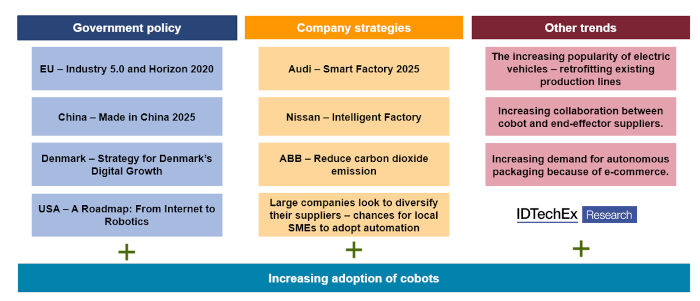
Although historically cobots have not been as popular as industrial robots, in recent years several drivers have been proposed to accelerate the adoption of cobots, such as Industry 5.0, the smart factory proposals of large car manufacturers and the growing demand for offshoring of production.
As one of the pioneers in adopting automation in production, automotive manufacturing is by far the largest market for robots; however, one of the major challenges for large automakers is that if an industrial robot malfunctions, the entire production line must be shut down to ensure the safety of human operators during inspection. This process can result in significant downtime costs. However, cobots may be the ideal solution, as human operators can work efficiently and safely alongside them without affecting other robots. Audi has announced its "Smart Factory 2025," in which one of the key elements is improving human-robot interaction (HRI), and many other global automakers, such as Volkswagen and Nissan, have also proposed similar plans. It is believed that these plans will drive a rapid increase in cobot sales in the automotive manufacturing industry.
Industry 4.0, as a hot topic, has been researched for many years. However, Industry 4.0's focus on digitalization has been shown to cause a number of socioeconomic problems, such as concerns about the replacement of human operators and greenhouse gas emissions. Recently, the European Union (EU) proposed its Horizon 2020 and Industry 5.0 plan, which heavily emphasizes Human Resource Integration (HRI) and reducing carbon dioxide emissions. Given that many robot manufacturers and end users are based in Europe, IDTechEx believes this proposal will increase the demand for collaborative robots. Furthermore, many other countries have also presented their plans, such as Made in China 2025, Strategy for Denmark's Digital Growth, and A Roadmap: From Internet to Robotics, to promote the adoption of cobots.
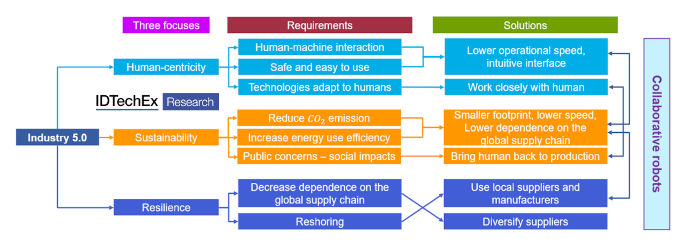
Industry 5.0 focuses on three main areas: human-centered manufacturing, sustainability, and business resilience. As mentioned in the recent EU publication, Industry 5.0 aims to bring human operators back into production and improve the sustainability of manufacturing. The general consensus is that Industry 5.0 requires an increasing deployment of collaborative robots, but how exactly do they relate, and what benefits would cobots bring to Industry 5.0? The following graphic, created by IDTechEx, provides some explanations.
 Source: IDTechEx - "Collaborative Robots (Cobots) 2023-2043: Technologies, Actors and Markets"
Human-centered manufacturing demands a high level of production safety, as machines work closely with human operators. Torque sensors can be used for collision detection and force control. Operators pre-set the torque sensor values. When a collision occurs, the values detected by the sensors exceed the preset range, triggering the emergency stop function. Thanks to their robustness and low cost, torque sensors are the most widely used sensory systems for collaborative robots. However, torque sensors can only detect torque changes after a collision has occurred, meaning they cannot make predictions in advance. Proximity sensors could be an ideal solution. The capacitance of the air gap between the sensors and the humans will change when the human operators are near the cobot arm. However, proximity sensors are relatively expensive, and for the cobot to detect human operators from any direction, many proximity sensors are needed, ultimately leading to high costs and lower affordability.
Sustainability refers to reducing greenhouse gas emissions and mitigating the potential negative social impacts of Industry 4.0. For example, compared to industrial robots, collaborative robots operate at a slower speed and have a smaller footprint, leading to lower carbon dioxide emissions. Meanwhile, because cobots work closely with human operators, there will be fewer socioeconomic concerns about machines replacing humans.
Finally, in terms of resilience, due to the lingering impacts of COVID-19, such as supply chain disruptions and inflation, large global companies have begun to diversify their suppliers. These impacts present significant opportunities and challenges for local small and medium-sized enterprises (SMEs) to increase factory automation and meet the manufacturing capacity needs of these large corporations. Some SMEs have already begun installing cobots on their production lines to boost their manufacturing capacity.
In summary, compared to Industry 4.0, there is no significant technological evolution in automation or manufacturing in the transition to Industry 5.0. IDTechEx believes that Industry 5.0 will bring enormous opportunities for collaborative robots. As a pioneer of Industry 5.0, Europe has seen a rapid increase in the adoption of collaborative robots, and IDTechEx believes that other large regional economies will also promote the adoption of cobots.