
Takahiro Sugihara, Director of THE's Industrial and Social Infrastructure Business Area, commented on the agreement: “KD is a pioneer in high-speed vehicle networks. This agreement perfectly aligns with our commitment to providing cutting-edge technologies, products, and services that support the evolution of automotive electronics and advanced mobility, in line with our corporate vision of 'Changing the world and the future with the power of knowledge'.”
Óscar Ciordia, Marketing and Sales Director at KD, highlighted the strategic importance of the cooperation: “Japan is a highly advanced automotive market with strong technological leadership among OEMs and Tier-1 suppliers. It is an honor for us to collaborate with Hitachi High-Tech as a business partner to better serve this market. This agreement represents a significant milestone and a clear sign that multi-gigabit optical connectivity in vehicles is gaining momentum in Japan. The collaboration is expected to accelerate the adoption of optical networks throughout the Japanese automotive ecosystem.”
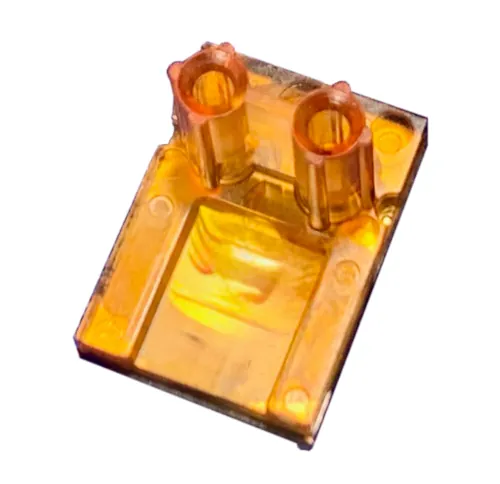
Focus on the KD7251: Integrated Optoelectronics for Automotive Networks. As part of the collaboration, Hitachi High-Tech will support the introduction of KD's KD7251, an integrated optoelectronic device designed for high-speed data transmission in vehicles. Targeting demanding automotive environments, the device supports the transition to scalable, future-proof network platforms for ADAS, infotainment, and emerging software-defined vehicle architectures.
The KD7251 combines optical and electronic functionality in a single device, enabling robust multi-gigabit links and helping automotive system designers address bandwidth growth, electromagnetic interference (EMI) constraints, and packaging efficiency in zonal and centralized vehicle architectures.
The ASIC implements the BASE-AU physical layers and complies with the IEEE Std 802.3cz™ specification for automotive multigigabit optical communication links over multimode glass fiber (OM3). Designed as a single-chip solution with an integrated optical interface, the KD7251 supports data rates of 2.5, 5, and 10 Gb/s. It also includes a bridging function that enables direct connectivity of MIPI-based sensors, such as cameras and radars (CSI-2®), displays (DSI-2℠), and AI processors via PCIe®, simplifying system integration within the vehicle.