Meanwhile, LMFP represents an intermediate point between the two and is expected to be deployed in the coming years.
Behind each cell chemistry lies a specific material demand profile, including cathode materials such as nickel, manganese, cobalt, iron, and phosphate, as well as anode materials such as graphite and silicon. The new IDTechEx report, titled “Materials for Electric Vehicle Battery Cells and Packs 2026-2036: Technologies, Markets, Forecasts,” analyzes these fundamental materials and forecasts that the global market will reach $154 billion by 2036.
Overview of Cell Chemistry:
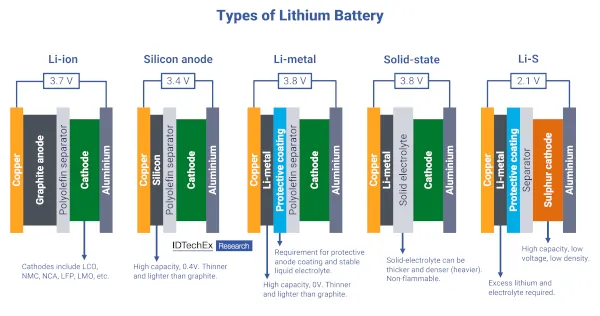
The term lithium-ion batteries encompasses various chemistries, such as LCO for consumer electronics or LTO for high-power applications. However, nickel-based chemistries (such as NMC and NCA) and LFP predominate in electric vehicles.
LFP dominates in China and is gaining market share in Europe and North America thanks to its lower cost per kWh. Although its energy density is lower, optimized vehicle design allows for sufficient range.
Nickel-based chemistries offer higher energy density, albeit at a higher cost, making them ideal for premium vehicles. NMC has been dominant in the West, although it is losing market share to LFP. There is also a trend toward higher nickel content (such as NMC 811) to improve performance and reduce cobalt usage.
Volatility in Battery Materials:
Critical materials such as lithium, nickel, and cobalt have limited supply and long extraction times, leading to high price volatility.
Lithium experienced a sharp increase in 2022-2023, reaching $80,000 per ton, compared to $13,000 in 2025. In 2026, prices are expected to rise again due to high demand and mine closures in China.
Cobalt has also shown volatility, especially following export restrictions in the Democratic Republic of Congo, the world's main supplier. This instability directly impacts battery costs, which are particularly sensitive to the price of lithium.
Material Costs: NMC vs LFP
According to IDTechEx, material costs reached historic lows in 2025:
LFP: $34/kWh
NMC 811: $39/kWh
Although LFP remains cheaper, the difference has narrowed. It is important to note that these values do not include processing or assembly costs, which are key factors in the final cost.
Future Trends in Materials:
The development of new battery technologies will significantly change the demand for materials:
Silicon anodes: already present in Tesla vehicles, they will increase energy density and could gradually replace graphite.
Solid state: use of solid electrolytes to improve performance, although with scalability challenges.
New cathodes: chemistries such as LMFP, LMO, or LNMO will reduce dependence on cobalt.
Metallic lithium: offers high energy density, but with degradation problems.
Lithium-sulfur: high potential for specific energy, although with limited adoption in automotive applications.
Market Outlook:
The lithium-ion battery materials market is diverse and experiencing strong growth. Demand for electric vehicle materials is expected to exceed 17.9 million tons by 2036, driven by global electrification.
Author: Daniel Parr, Technology Analyst at IDtech