“Perovskite Photovoltaics 2027-2037: Technologies, Markets, and Trends,” and thanks to the support of government initiatives and growing private investment, perovskite photovoltaics (PV) remains one of the most closely watched sectors in the energy transition.
Initially, perovskite solar cells captured global attention for three distinct reasons: their rapid and unprecedented increases in energy conversion efficiency, their ability to be seamlessly combined with traditional silicon in perovskite-silicon tandem architectures, and their exceptionally simple, low-temperature manufacturing processes, which allow for thin-film deposition using processes compatible with sheet-to-sheet or roll-to-roll solutions. However, as the industry matures, the discourse surrounding this revolutionary technology has changed radically.
Beyond efficiency: the real obstacles to commercialization
For years, the development of perovskite PV was seen as a race to achieve higher laboratory efficiencies and benchmark stability. While industry players and research institutes continue to push the boundaries of performance, the debate has evolved. Today, commercializing perovskite PV is no longer just about improving efficiency or combating moisture degradation.
To bridge the gap between the lab and the factory, a new set of critical metrics has come to the forefront. This report provides an in-depth analysis of the maturity of perovskite PV, exploring factors that are now as important as, if not more important than, raw efficiency. These include:
Fabricability and scalability: moving from small-area laboratory cells to large-scale, high-throughput manufacturing without sacrificing performance.
Performance and cost analysis: ensuring that production profitability can truly compete with, or complement, traditional, now deeply commoditized solar technologies.
Supply chain resilience: Identifying and ensuring the supply of specialized materials needed for global-scale production, from substrates and transparent conductive films to active layers.
Sustainability: Addressing environmental concerns, including end-of-life recycling and lead content management in perovskite structures.
A divergent global market: Regional preferences
As manufacturers scale up, it is becoming clear that the perovskite photovoltaic market is not monolithic. Different regions are exhibiting distinct technological and commercial preferences based on their national energy policies, existing manufacturing infrastructure and supply chains, and geographical constraints. While some regions are prioritizing perovskite-silicon tandem photovoltaic systems to maximize grid-scale power density, others are focusing their investments on flexible perovskite and single-junction perovskite modules to drive localized, building-integrated manufacturing.
Application-specific success: no longer a binary issue.
Due to these changing regional and technological dynamics, the commercial viability of perovskite photovoltaics is no longer a simple "will the technology work?" question. The answer also depends on the application.
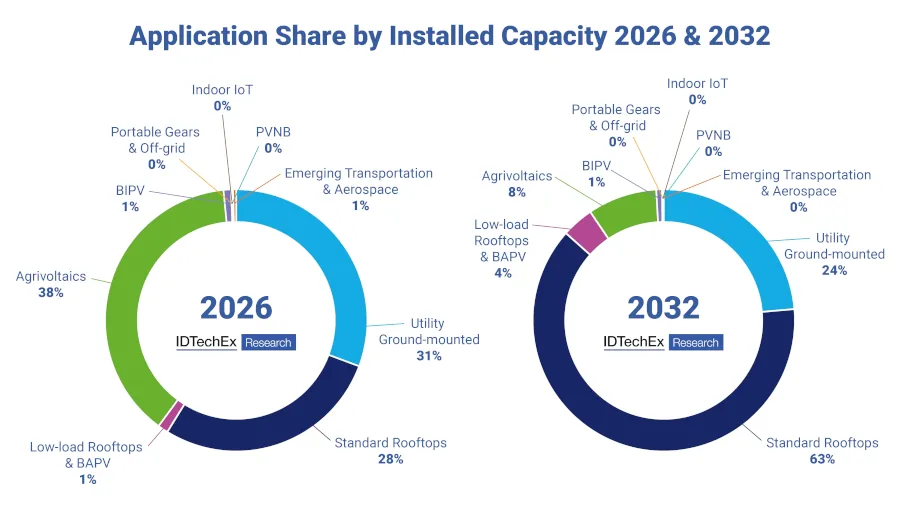
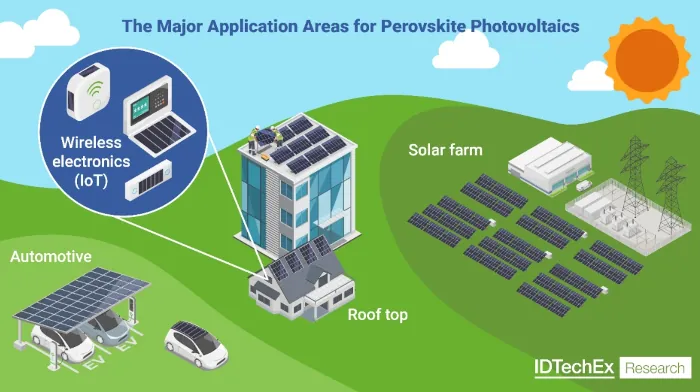
The unique properties of perovskites, such as their light weight, adjustable transparency, and flexibility, allow for their deployment in environments where rigid silicon panels cannot be used. To reflect this, the IDTechEx report "Perovskite Photovoltaics 2027-2037: Technologies, Markets, and Trends" provides a detailed and comprehensive analysis of the specific use cases driving the market:
Building-integrated and building-applied photovoltaics (BIPV and BAPV),
low-load-capacity rooftops
, vehicle-integrated photovoltaics (VIPV) and emerging transportation
, indoor IoT, consumer electronics, and wearables
, agrivoltaics,
noise barrier and road fence integration (PVNB),
space and aerospace,
and large-scale utilities and energy.
Author: Dr Xiaoxi He, Principal Research Associate IDTech