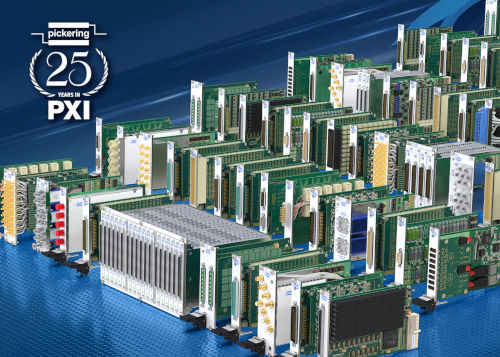
It's incredible to think that the three original modules we developed for PXI 25 years ago are still available and being sold today, while the breadth and depth of the modules we offer now are among the broadest available from any PXI vendor. By working closely with customers and investing heavily in R&D, we continually design new PXI modules to meet their diverse switching and simulation needs
Developed as an open standard by NI (formerly National Instruments), an innovative company in computerized testing and measurement, PXI is defined and managed by the PXI Systems Alliance (pxisa.org), an industry consortium of more than 60 companies worldwide that promotes and maintains the PXI standard, ensuring interoperability. Pickering joined PXISA in 1998 and has been a sponsoring member ever since, actively participating in the ongoing development of the PXI platform.
“PXI is now the de facto standard for automated testing in almost every relevant industry,” says Mark Wetzel, NI Fellow and Chair of the Technical Committee and a member of the PXISA board. “And continued innovation and collaboration with companies like Pickering Interfaces will keep PXI as the dominant open standard for automated electronic testing for another 25 years.”
Pickering Interfaces has been designing and manufacturing modular signal switches for electronic testing and verification since 1988. In 1998, driven by customer requests, Pickering introduced its first three PXI modules. Since then, PXI has become the dominant standard worldwide for automated testing, transforming the test lab and the production floor with systems that reduce cost and form factors while increasing throughput and sustaining performance. Currently, with over 200 PXI product families and more than 3,500 PXI and PXIe variants available on request, Pickering products are specified in test systems installed around the world.
Pickering Interfaces' PXI products range from RF/microwave, fault insertion, and optical switching to sensor simulation, including programmable resistors, strain gauge simulators, batteries, and thermocouples. Module production takes place on flexible manufacturing lines at Pickering's two factories in the UK and the Czech Republic, enabling them to meet the ever-changing requirements of the T&M industry.
Pickering Interfaces also recently announced the release of the sixth edition of its reference book, "PXImate: A Practical Guide to Using PXI." The 6th edition of PXImate, the first major update to this popular guide in nearly a decade, is designed to be a valuable resource for T&M engineers looking to learn about building PXI-based test, measurement, and automation systems.