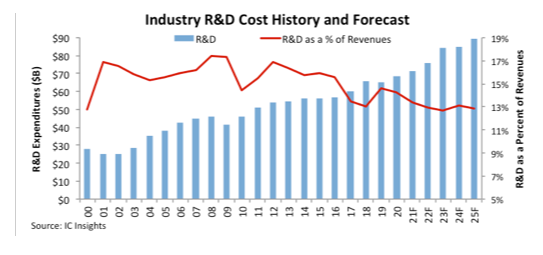
Semiconductor companies' total R&D spending is expected to increase at a compound annual growth rate (CAGR) of 5.8% between 2021 and 2025, reaching $89.3 billion.
When the world was hit by the Covid-19 pandemic in 2020, semiconductor suppliers cautiously maintained their R&D spending increases, even though total semiconductor industry revenue grew by a remarkable 8% that year, despite the economic fallout from the deadly pandemic. Semiconductor R&D spending as a percentage of global industry sales slipped to 14.2% in 2020, compared to 14.6% in 2019, when research and development spending declined by 1% and total semiconductor revenue fell by 12%. Figure 1 shows semiconductor R&D spending levels and the ratio of spending to sales over the past two decades, along with IC Insights' forecast to 2025.
Total semiconductor R&D spending has declined in only four years since the late 1970s (-1% in 2019 during an economic downturn, -10% in 2009 after the industry was hit by a major global recession, and consecutive declines of -1% in 2002 and -10% in 2001, when the economic downturn coincided with the implosion of the dot-com bubble at the beginning of the century). Following the global recession of 2008-2009, R&D spending rebounded strongly in 2010 and 2011, but then outlays slowed for the remainder of the past decade for a variety of reasons, including continued uncertainty about the global economy and a historic wave of acquisitions in the chip sector.
Since 2000, total semiconductor R&D expenditure as a percentage of global sales has exceeded the four-decade historical average of 14.6% in all but five years (2000, 2010, 2017, 2018, and 2020). In these five years, the lower R&D-to-sales ratios were more related to strong overall revenue growth than to weak research and development spending by semiconductor suppliers.
Intel continued to lead all other semiconductor vendors in R&D spending in 2020, accounting for about 19% of the industry total. However, cost-cutting, the elimination of some product categories, and a push to maximize efficiencies resulted in a 4% decrease in Intel's R&D outlays in 2020, to an estimated $12.9 billion, after its spending declined by 1% in 2019, when its share was 22% of the industry total. Intel's R&D spending declines from 2019 to 2020 were the company's first consecutive annual drops since 2008 and 2009. The 4% decrease in 2020 was Intel's largest R&D decline since the mid-1990s. Second-ranked Samsung increased its R&D spending by 19% in 2020 to $5.6 billion, partly as the South Korean memory giant ramped up development of cutting-edge logic processes (5nm and smaller) to compete in the advanced integrated circuit foundry business with market leader Taiwan Semiconductor Manufacturing Co., which increased its research and development spending by 24% to nearly $3.7 billion last year.
The McClean report shows that the top 10 R&D spenders (Intel, Samsung, Broadcom, Qualcomm, Nvidia, TSMC, MediaTek, Micron, SK Hynix, and AMD) collectively increased their research and development spending by 11% in 2020, reaching $43.5 billion, which represents 64% of the industry total. Climbing in the 2020 R&D rankings were Nvidia (up one spot to fifth), MediaTek (up two spots to seventh), and Advanced Micro Devices (up to tenth from eleventh in 2019). The R&D investment ratio for the top 10 was 14.5% in 2020, down from 15.0% in 2019, according to the new IC Insight report