

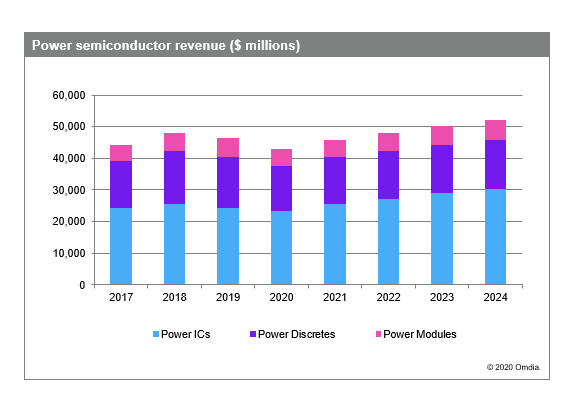
Omdia now forecasts that the overall power semiconductor market will decline by 6.9 percent in 2020, with revenue falling to $43.1 billion in 2020, down from $46.3 billion in 2019. The power semiconductor market consists of three segments: power integrated circuits (ICs), discrete power, and power modules.
Revenues in the discrete and module power market are expected to decline by 10.6 percent in 2020, according to the Interim Power Discrete and Module Market Tracker released this month. The previous forecast, issued in March, predicted the market would remain stable in 2020, with a negligible decline of 0.1 percent.
Furthermore, Omdia's power CI revenues in 2020 are projected to decline by 3.9 percent compared to 2019, a rare two-year variation in this market. This current forecast places power CI revenues for 2020 at 23.4 billion, erasing most of the market's gains since 2016.
In terms of revenue, the largest consumer of power integrated circuits is the wireless market, a segment that includes mobile phones. Before the coronavirus outbreak, Omdia forecast a 3.4 percent increase in wireless market revenue due to increased smartphone sales. However, as the impact of the coronavirus has worsened, Omdia has lowered its forecast and now expects a 9.6 percent decrease in wireless revenue.
“Supply chain disruptions, store closures, unfulfilled orders, job losses, and potential delays in new models have combined to impact the wireless market,” says Kevin Anderson, senior power semiconductor analyst at Omdia. “This is partly due to a decline in mobile phone orders. But mobile phone manufacturers are also offering more mid-range products that have less power IC content.”.
Another severely affected sector is the automotive market, where vehicle sales have plummeted due to dealership closures and vehicle production line shutdowns. Vehicle sales are likely to decline by double digits in 2020. On the other hand, the increased use of electronics in some automotive systems, such as advanced driver assistance and vehicle electrification, will moderate the decline in power IC revenues to just 6 percent.
Market Declines:
Taking a closer look at the discrete power module market outlook, discrete power semiconductor revenues are expected to decline by 10.7 percent this year, while power semiconductor module revenues are projected to fall by 10.3 percent. Overall, the discrete power module market is expected to generate $2.4 billion in revenue compared to 2019.
Regarding discrete power semiconductors in detail, the revenue decline in 2020 is expected to stem primarily from standard MOSFET power transistors. MOSFET revenue is projected to decrease by approximately $1.4 billion in 2020, a 16.5 percent year-over-year decline, before recovering in 2021. However, MOSFET revenue is not expected to return to 2018 levels until after 2024.
Revenue from bipolar power transistors is forecast to decline by approximately $170 million in 2020, a 15% decrease year-over-year, while revenue from IGBT power transistors is expected to decline by approximately $110 million in 2020, a 6.8% year-over-year decrease. Unlike discrete power transistors, rectifiers and thyristors are projected to see declines of less than 1% in 2020.
"Most of the reductions for discrete power semiconductors are coming from the computing and data storage segment, where the trend is moving away from discrete point-of-load and toward more integrated solutions," says Richard Eden, senior principal power semiconductor analyst at Omdia. "This, along with the decline in equipment units in some personal computer devices, is causing the forecast in that segment to be drastically reduced, falling 48.1 percent and losing more than $1 billion in revenue from 2019 to 2020.".
Power module market revenue declines due to IGBT weakness.
Regarding power modules in detail, the 2020 revenue decline is expected to stem primarily from standard IGBT and IGBT-IPM power modules. Standard IGBT power module revenue is projected to decrease by approximately 300 million in 2020, a year-over-year decline of 11.1 percent. IGBT-IPM revenue is forecast to decrease by approximately 270 million in 2020, a year-over-year decline of 15.6 percent, and MOSFET module revenue is expected to decrease by approximately 33 million in 2020, a year-over-year decline of 11.9 percent. Unlike discrete power semiconductors, power modules will not generate a significant revenue recovery in 2021. Instead, Omdia predicts that the market will continue to decline, a phenomenon that will continue in 2022 and 2023, before recovering in 2024.
The computing segment provides a glimmer of hope.
"Unlike power discrete chips, the data storage and computing segment is the bright spot in the power integrated circuit market," says Kevin Anderson, senior research analyst at Omdia. "The stay-at-home, work-from-home, and learn-from-home environment is driving increased demand for data center equipment, laptops, and accessories such as external monitors and webcams."
Omdia forecasts overall growth of 2.6 percent in 2020 for the use of power integrated circuits in this segment.
Expected Market Rebound: Omdia anticipates a robust recovery for power semiconductors in 2021, driven by strong demand for vehicles as pent-up demand is unleashed after two years of weak vehicle sales. We also anticipate that consumers will want to spend again on televisions, mobile device upgrades, and other consumer goods once they return to work. This recovery scenario depends on a gradual easing of restrictions in the developed world by mid-year, a manageable recurrence of the virus as we move into the next cold and flu season, and a successful vaccine rollout within 12 months.