

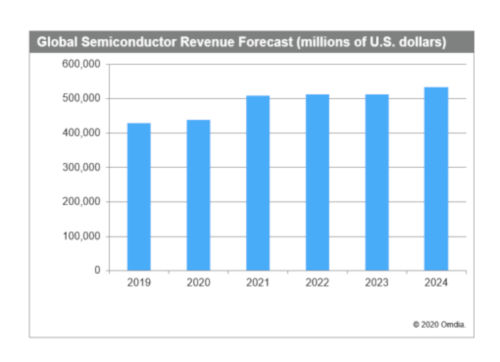
The global semiconductor market is expected to decline by 5 percent in 2020, excluding memory integrated circuits, according to the Omnia Application Market Forecast Tool (AMFT). Including memory, global revenue for the total market is projected to reach $439.3 billion in 2020, a 2.5 percent increase from $428.5 billion in 2019. This represents a significant reduction from Omnia's previous forecast of 5.5 percent growth for this year.
“Omdia has substantially lowered its semiconductor forecast as the impact of the coronavirus on the global economy has increased,” says Myson Robles-Bruce, research analyst, semiconductor value chain, at Omdia. “With Japan already in recession and economists expecting the US and Europe to enter recession in the second quarter, demand is weak across all regions and in almost every market. The pandemic has negatively impacted supply chains and market demand across all component categories.”.
The wireless segment is a major factor behind this year's weak market conditions, with market revenue for wireless equipment expected to decline by 4.7 percent compared to 2019. This has led Omdia to reduce its growth forecast for wireless chips to 2 percent, down from the previous 4.8 percent.
"The coronavirus outbreak will have a negative impact on the smartphone market in 2020," says Robles-Bruce. "The modest 2.4 percent growth forecast at the beginning of the year has turned negative. As of March 2020, Omdia expects mobile phone shipments to reach 1.2 billion units in total for this year.".
The automotive industry also represents a significant drag on the semiconductor market, with motor vehicle production expected to decline by 12.4 percent this year. This will result in a 7.5 percent decrease in semiconductor revenue in the automotive market in 2020.
 Industrial/Healthcare Market Receives Boost from Coronavirus:
The industrial semiconductor market is expected to grow by 2.5 percent in 2020. This increase will be driven by the healthcare sector, where demand for chips will rise by 5.9 percent during the year.
"COVID-19 is causing a rapid reallocation of priorities and funding in the medical sector," says Robles-Bruce. "The consequences are both direct, with an increased demand for medical ventilators and surgical supplies, and indirect, with an increase in telemedicine caused by the postponement or cancellation of routine appointments.".
The market for semiconductors in healthcare electronics will reach $6 billion in 2020, up from $5.6 billion in 2019.
A major growth driver for medical semiconductors will be the respiratory equipment used to treat coronavirus patients. Global orders for ventilators are projected to reach 691,840 units this year, up 60 percent from 430,843 units in 2019. In terms of revenue, the ventilator market this year is expected to be worth $4.6 billion, a sharp 71 percent increase from $2.7 billion in 2019.
Semiconductors are an integral component for many medical devices used in hospitals today, including ventilators. Omdia expects the medical end-use market to account for approximately $5.8 billion in total semiconductor sales in 2020, roughly 11 percent of the global industrial semiconductor market and an 8.1 percent increase from 2019.
Revenue from medical ventilator semiconductors received a short-term boost in 2020 due to the COVID-19 pandemic. Omdia has doubled its forecast for ventilator chip revenue in 2020, and growth is expected to continue into 2021.
"Medical ventilators have been in use for more than 70 years, and in that time, they have evolved from simple electromechanical designs to complex, electronically controlled systems with multiple microcontrollers, brushless DC motor drivers, touchscreen interfaces, and USB or wireless connectivity," says Paul Pickering, senior analyst, industrial semiconductors, Omdia. "As a result, these devices are driving significant semiconductor consumption as orders surge to meet the challenge of the coronavirus in 2020.".
The medical semiconductor segment will continue to grow faster than the overall industrial semiconductor market in 2021 and beyond, driven by long-term trends such as an aging population, the increasing use of telemedicine, the shift to wearable devices, and the rise of artificial intelligence (AI).