
According to IDTechEx's analysis of sustainable electronics and semiconductor manufacturing for the period 2027-2037, the industry's energy and water consumption will continue to increase over the next few years, as manufacturers and governments seek to introduce more efficient processes and diversify certain stages of production.
The expansion of artificial intelligence and data centers adds pressure to this supply chain due to the growing demand for chips, memory, and other electronic components.
A geographically concentrated production
A significant portion of global semiconductor and electronics manufacturing is currently concentrated in Asia. Taiwan maintains a particularly high level of production in the manufacture of chips for the most advanced technological nodes. At the same time, certain technologies required to produce these devices exhibit a high concentration of suppliers.
One of the most representative examples is extreme ultraviolet (EUV) lithography. ASML, based in the Netherlands, is currently the sole manufacturer of the EUV lithography systems used to produce some of the most advanced semiconductors. This concentration has led various governments and manufacturers to pursue strategies of regionalization, supplier diversification, and the establishment of new production capabilities within their own territories.
However, relocating or duplicating manufacturing capacity involves significant investments and may encounter limitations related to available infrastructure and a lack of skilled workers.
Energy and water consumption will continue to increase
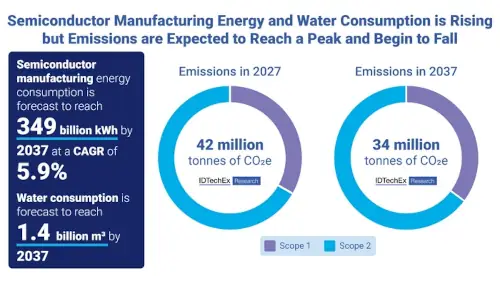
Semiconductor manufacturing requires significant amounts of electricity and water, especially in plants dedicated to advanced process technologies. IDTechEx estimates that energy consumption in this industry will grow at a compound annual growth rate of approximately 6%, while water consumption will increase by around 4% annually.
According to data collected by the analysis firm, the semiconductor industry consumed more than 850 billion liters of water in 2025. Ultrapure water is used extensively during chip manufacturing to clean wafers and remove contaminants between different stages of the process. Increased production capacity makes water reuse, equipment efficiency, and the supply of low-emission electricity crucial factors for reducing the environmental impact of new factories.
Emissions could peak around 2030
IDTechEx anticipates that Scope 1 and 2 emissions associated with semiconductor manufacturing will continue to grow over the next few years. The firm estimates they could peak around 2030, due in part to increased manufacturing using advanced technology nodes. Subsequently, their forecasts anticipate a gradual decline related to efficiency improvements and greater use of electricity from renewable sources.
Scope 1 emissions are those generated directly by a company's operations, while Scope 2 emissions are related to the energy purchased to carry out its activity.
Climate and geopolitics increase supply risks
The concentration of raw materials and production capacity means that the electronics industry can be affected by disruptions at specific points in the supply chain. In addition to geopolitical factors, extreme weather events can also impact mineral extraction and processing. IDTechEx cites as an example a storm that disrupted copper mining operations in Chile in July 2016.
Copper is a widely used raw material in electronics, from printed circuit boards and interconnects to wiring and electrical infrastructure. The prices of metals used by the sector, including copper, silver, and gold, have also experienced significant fluctuations.
According to IDTechEx analysis, the price of silver reached approximately three times the level recorded in 2025 during 2026. The evolution of these markets responds to multiple factors, including industrial demand and the use of some metals as financial assets.
AI adds pressure to memory and components
The construction of infrastructure for artificial intelligence and data centers is another factor changing the demand for electronic components. Systems used for training and inferring models require large quantities of accelerators, memory, storage systems, and network and power components.
IDTechEx specifically highlights the memory market, where growing demand is putting pressure on supply and prices. This situation introduces a new risk factor for electronics manufacturers competing for certain components with data center infrastructure providers.
Reduce materials and processes during manufacturing
The conventional manufacturing of integrated circuits and printed circuit boards uses numerous materials, chemicals, and processing steps. One way to reduce its environmental impact is to lower the temperature required during certain operations, eliminate unnecessary steps, and recover materials used during production.
Alternative processes are also being developed, including dry phase patterning techniques, which could replace certain conventional operations. The viability of these technologies will depend, among other factors, on their ability to meet the industry's technical, economic, and large-scale production requirements.
Alternatives to FR4 for printed circuit boards
Another area of research lies in the substrates used to manufacture printed circuit boards. FR4 continues to be one of the predominant materials due to its electrical, mechanical, and thermal properties, as well as the industrial infrastructure developed around it.
However, recyclable or biodegradable materials that could replace it in certain applications are being investigated. IDTechEx mentions materials and technologies based on polylactic acid (PLA), Pure Additive, Soluboard, Recyclad1G, and ReUSE as alternatives. Their use will depend on whether they can meet the durability, temperature, electrical insulation, manufacturing, and cost requirements of each application.
Manufacturers develop efficiency strategies
Manufacturers such as Samsung, TSMC, GlobalFoundries, and Intel have implemented various initiatives to reduce resource consumption and emissions at their factories. Water management is a key area of focus due to the volume required during wafer processing. Available measures include water recovery and reuse, optimization of cleaning processes, and improved efficiency of auxiliary facilities.
Energy consumption represents another area of focus, both through efficiency improvements and through changes in the sources used to supply the plants.
Costs and specialized personnel hinder regionalization
Increasing supply chain resilience does not necessarily imply improving its economic efficiency. Building new semiconductor factories requires significant investment, specialized infrastructure, and a skilled workforce. Onshoring, regionalization, and multi-supplier strategies can also introduce redundancies and increase certain operating costs.
In some segments, there are also not enough alternative suppliers to easily diversify supply. For this reason, the industry must evaluate the trade-offs between costs, efficiency, production capacity, and reducing dependence on certain suppliers or regions.
European regulation will drive changes in electronics
Legislation will be another factor influencing the evolution of electronics manufacturing. In Europe, the Ecodesign Regulation for Sustainable Products (ESPR) introduces requirements aimed at improving aspects such as durability, repairability, resource efficiency, and recyclability of different product categories. Complementing this framework is the Digital Product Passport (DPP), designed to provide structured information on product characteristics and life cycle.
IDTechEx predicts that requirements related to digital passports will begin to affect the electronics sector from 2028 onwards.
Although approximately 90% of printed circuit boards are manufactured and exported from the Asia-Pacific region, the international nature of the supply chain means that requirements introduced in large markets can also affect manufacturers located outside of them.
The evolution towards more resource-efficient electronics will thus depend on a combination of regulation, industrial investment, new manufacturing technologies and improvements in energy and material efficiency, while the industry tries to reduce its exposure to disruptions in still highly concentrated supply chains.