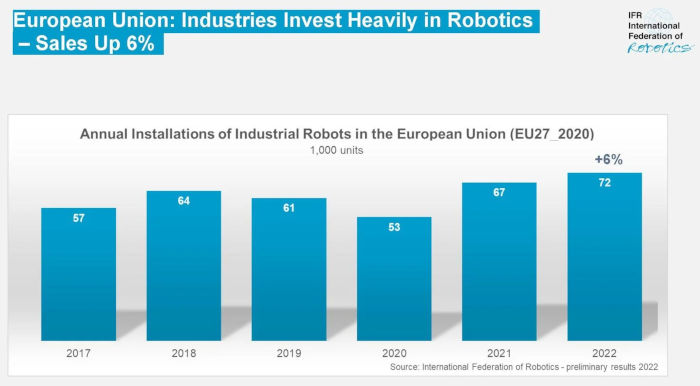
Germany is by far the largest robot market in Europe: some 26,000 units were installed in 2022 (+3%). This represented a 37% share of all EU installations. Globally, the country had the fourth highest robot density, after Japan, Singapore, and South Korea.
The automotive industry is traditionally the largest customer for industrial robots in Germany. In 2022, 27% of newly installed robots were in this sector, totaling 7,100 units, a 22% decrease compared to the previous year—a well-known cyclical pattern in investment within this segment. Within general industry, the metalworking industry was the largest customer, installing 4,200 units (+20%) in 2022. This is above the pre-pandemic level, which fluctuated around 3,500 units per year, peaking at 3,700 units in 2019. Installations in the plastics and chemical industries returned to pre-pandemic levels, increasing by 7% to 2,200 units in 2022.
Italy is the second largest robot market in Europe after Germany. In 2022, a record high of almost 12,000 units were installed (+10%). This represented a 16% share of all EU installations.
The country has a strong metalworking and machinery industry: Sales reached 3,700 units in 2022, an 18% increase over the previous year. Robot sales in the plastics and chemical industry grew by 42%, with 1,400 units installed. The country also boasts a robust food and beverage industry. Installations rose by 9% to 1,400 units in 2022. Demand from the automotive industry fell by 22% to 900 units. This segment is dominated by the Stellantis Group, formed by the merger of FIAT-Chrysler and France's PSA.
The French robot market ranked third in Europe in 2022. Annual installations increased by 15%, totaling 7,400 units. This figure is less than a third of that of neighboring Germany. The main customer is the metalworking industry, with a 22% market share. 1,600 units were installed in this segment, a 23% increase. The automotive industry grew by 19%, reaching 1,600 units. This represents a 21% market share. The French government's €100 billion stimulus package for investment in smart factory equipment, which came into effect in mid-2021, will create new demand for industrial robots in the coming years.
Annual robot installations in Spain grew by 12%, totaling 3,800 units. Robot installations are traditionally driven by the automotive industry. According to the International Organization of Motor Vehicle Manufacturers (OICA), Spain is the second largest car producer in Europe, after Germany. The automotive industry installed 900 units in Spain, a 5% increase. Sales in the metal industry grew by 20%, reaching 900 units. The automotive and metal industries accounted for almost 50% of robot installations in 2022.
Robot installations in Poland have followed a strong upward trajectory for nine years.
Annual installations reached a total of 3,100 units in 2022, the second-best result after the new record of 3,500 units in 2021. Demand from the metalworking and machinery industry increased by 17% to reach 600 units in 2022. The automotive industry showed cyclical demand with 500 units installed, down 37%. The war in neighboring Ukraine hampered manufacturing industries. However, investments in digitalization and automation technologies will benefit from a total of €160 billion in EU investment aid between 2021 and 2027.
Robot installations in European countries, including non-EU countries, reached a total of 84,000 units, up 3% in 2022.