
In this context, the Technological Institute of Plastics (AIMPLAS) is leading the MAT3D-XL project, an initiative that seeks to address these limitations through the development of sustainable composite materials and the integration of auxiliary technologies in the printing process.
The project, funded by the Valencian Institute of Competitiveness and Innovation (IVACE+i) and the European Regional Development Fund (ERDF), seeks to improve large format 3D printing with more sustainable materials and technologies that make the process more precise and reliable.
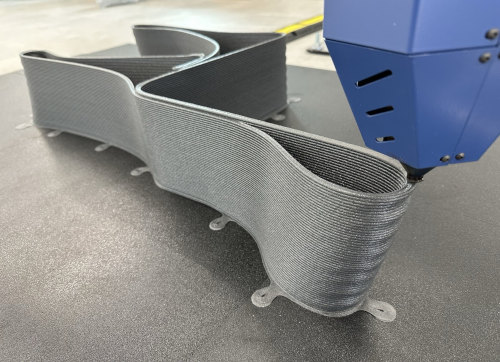
MAT3D-XL focuses on developing new recycled or bio-based thermoplastic materials reinforced with carbon, glass, or natural fibers. These composites not only improve the strength and rigidity of parts but also promote a circular economy by reducing the use of non-renewable resources. Furthermore, the project incorporates auxiliary technologies such as infrared (IR) heating systems, which allow for precise temperature control during printing. This improves layer adhesion and reduces structural defects, increasing the reliability and final quality of the manufactured parts.
As highlighted by Daniel Rodríguez, an engineering researcher at AIMPLAS, “sustainability in 3D printing cannot be addressed solely through plastic recycling: it also involves redesigning materials to be more stable during the manufacturing process and reducing waste resulting from structural failures. Therefore, MAT3D-XL is committed to developing composite materials that, through the addition of fibers (carbon, glass, or natural), not only improve mechanical properties but also reduce thermal contraction, minimizing defects during the printing process.”.
Thanks to these innovations, he continued, “we can achieve more reliable prints, more dependable parts, and less material waste. Moving towards these types of solutions allows the industry to maintain high standards of technical performance, while promoting a realistic and efficient circular economy in large-format industrial applications.”.
The ability to manufacture parts larger than one cubic meter without assembly opens up new opportunities in sectors such as automotive, urban planning, and interior design. AIMPLAS has developed several functional demonstrators that showcase the potential of these new materials and applied technologies. In collaboration with Plàstic Preciós La Safor, they have manufactured parts for urban furniture benches, where the large-format 3D-printed legs are complemented by recycled shelves produced by the company itself from plastic waste. In the field of interior design, they have developed a table with a tabletop manufactured by Plàstic Preciós and a single-piece, slender, and over one-meter-high base produced using large-scale additive manufacturing. Furthermore, AIMPLAS has independently designed and manufactured an automotive spoiler, demonstrating the viability of using these materials in demanding applications.
All these demonstrators have been produced from the new compounds developed in the project, formulated with recycled or bio-based pellets, and reinforced with natural fibers, rice husk or recycled polymers, achieving more sustainable pieces with better structural performance.
The MAT3D-XL project is part of the call for aid aimed at technology centers in the Valencian Community for R&D projects in collaboration with companies for the year 2024 by the Valencian Institute of Competitiveness and Innovation (IVACE+i), with funding from the FEDER funds.