Hermann Reiter, president of DMASS Europe, states: “Forecasting has rarely been so difficult. Geopolitical tensions, tariffs, and uncertainties in the global supply chain have made predictions almost impossible. Regardless of whether tensions increase or decrease, a return to the ‘old normal’ is out of the question. Instead, adaptability becomes key: optimizing processes and increasing resilience are essential.”
As external pressures mount, the EU is showing signs of a strengthening core. A Deloitte survey highlights unexpected results, with increased investment in the EU, which continues to be considered the most predictable market. While stronger consolidation from the second quarter of 2024 onward will improve year-on-year comparisons, real growth remains uncertain and is likely to take time to materialize. This year is projected to end at a similar level to last year, which would still be a remarkable result given the 14.3% decline recorded after the first quarter.
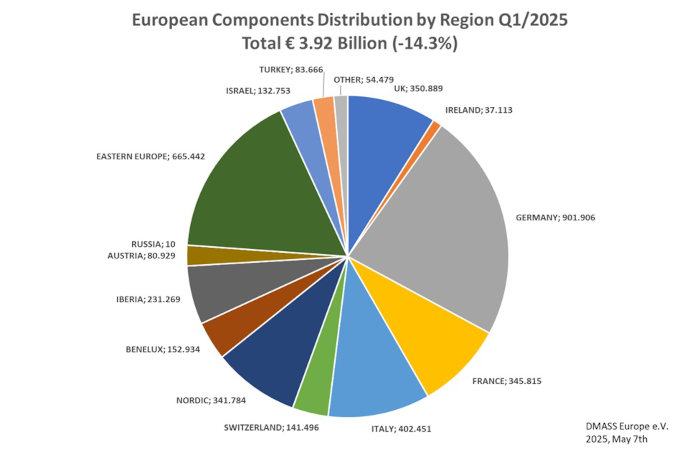
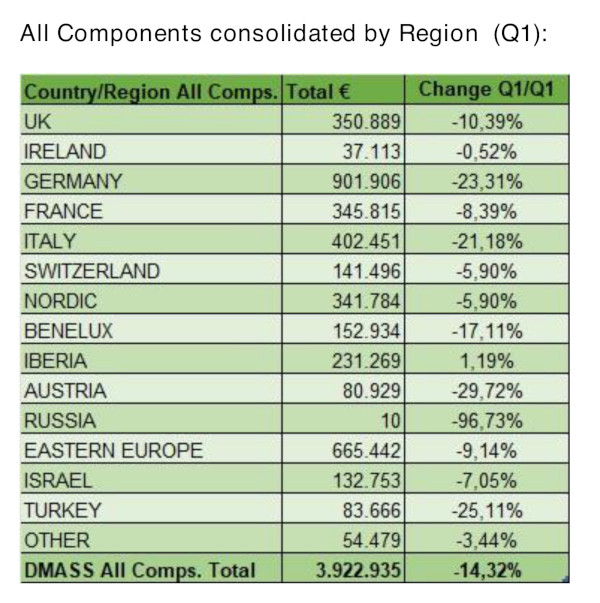
"The downturn in European component markets persisted into the first quarter of 2025. The distribution sector, which had previously thrived, is now facing disproportionate declines. According to DMASS Europe eV, the European component distribution market contracted by 14.3%, with consolidated sales reaching €3.92 billion.
Once again, IP&E components (interconnect, passive, and electromechanical) demonstrated relative resilience, declining by only 4.63% to €1.55 billion. In contrast, semiconductors continued their sharp downward trend, falling by 19.59% to €2.37 billion."
Hermann Reiter, Chairman of DMASS:
“The great corporate restructuring? First-quarter results show mature economies losing momentum and smaller markets gaining ground, with Germany, Italy, Austria, and Turkey facing steeper losses in the first quarter. The first quarter of 2025 saw a decline compared to the still-robust first quarter of 2024, continuing the trend. However, Europe is experiencing mixed signals. Eurozone GDP increased by 0.4%, suggesting a slight recovery. Despite this, uncertainty remains high due to geopolitical tensions and new tariffs impacting markets. Overall, the economic situation remains challenging, but there are signs of long-term stability and adaptation. In this turbulent economic climate, strong distribution networks are more important than ever.”
Semiconductors (first quarter):
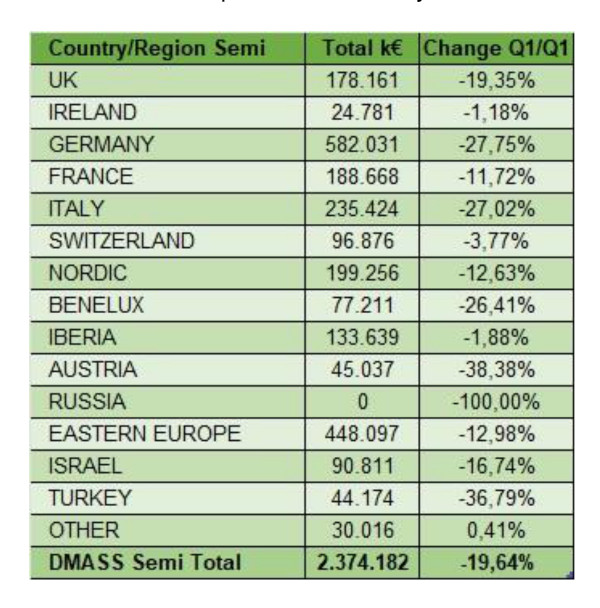
Semiconductor distribution sales in Europe experienced a significant decline of almost 19.59%, amounting to €2.37 billion. Among the major countries, Austria suffered the steepest drop, with a decrease of almost 39%, closely followed by Turkey, with a reduction of almost 37%. In contrast, Ireland, Switzerland, Spain, Portugal, and the smaller EMEA countries as a whole performed notably better.
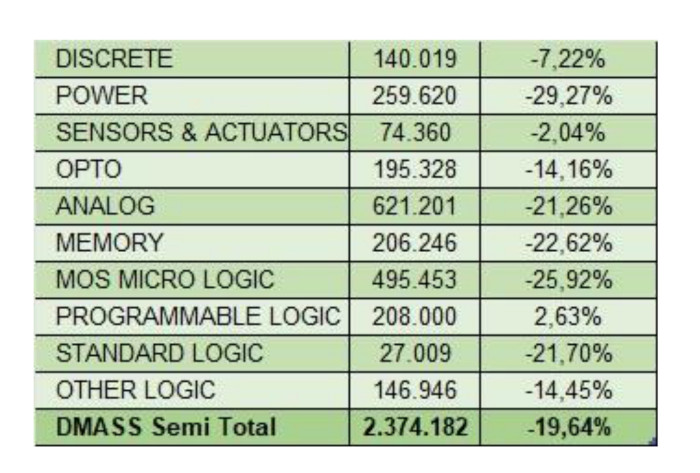
Regarding products, the weakest sales were recorded in the power and MOS micro logic segments, with a decline exceeding 25%. Only programmable logic registered a slight increase, of around 2.63%, and performed well above average, with a decline of almost 20%. See the table below.
Interconnection, passive and electromechanical components (first quarter):
In IP&E, the worst appears to be over for the distribution market. The slowdown continued at a much slower pace, with a decline of only 4.63% to €1.55 billion.
Only Austria and Germany registered a disproportionately steep drop.
Regarding products, passive components (-7.62%) registered a greater decline than electromechanical components (-2.82%) and power supplies (-3.75%). The largest drops were observed in capacitors (-12.6%), frequency control devices (-11.1%), and relays (-14.8%), while circular connectors (+12.8%) registered a significant increase.
(See tables.)


All components consolidated by region (first quarter):
President Hermann Reiter concluded: “Looking at the big picture, a nuanced view emerges in different parts of the world. The enormous disruptions to global trade are reflected in financial markets and the economy. New structures will emerge to address these disruptions, with a tendency to value proximity and security more than in the past.
Our industry, with its enormous potential for innovation, will face significant challenges, but in return, it will offer many solutions and perspectives. The real challenges lie in transforming familiar structures and responding to this rapid pace of change with resilient processes. We will respond to many changes positively through innovation. The old adage still holds true: great challenges always bring great solutions. The era of administration is over; now is the time for innovation.”