




One of the most innovative and commercially promising technologies is event-based vision, a biologically inspired method of visual data acquisition that promises numerous advantages, such as reduced data transfer/processing and increased dynamic range. In fact, these merits are so significant that IDTechEx forecasts the market for event-based vision sensor chips alone will grow from its current status of virtually no revenue to $20 million annually within the next 10 years. Furthermore, much of the value is likely to be captured by the software that enables event-based vision hardware, resulting in a much larger overall market.
What is event-based viewing?
Event-based vision, also known as dynamic vision sensing (DVS), is a scene acquisition method that mirrors how the human retina/brain processes information, recording changes as they occur rather than the entire frame at specific intervals. This method is entirely geared toward machine vision applications and is not intended to replace conventional cameras/image sensors.
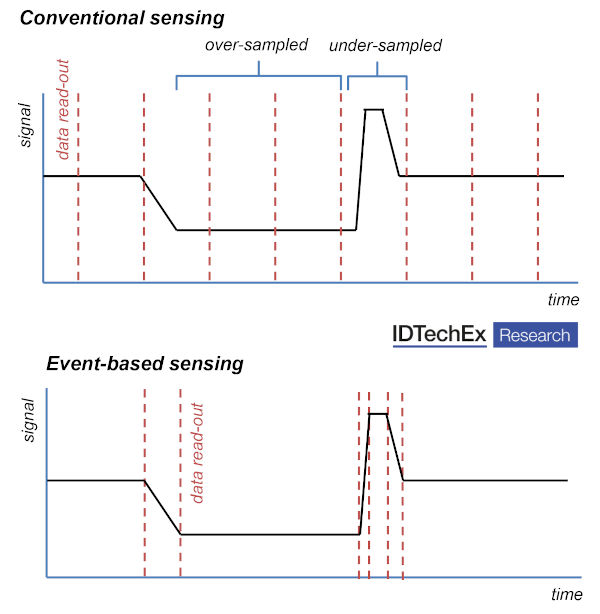
In conventional video, an entire image is recorded at a predetermined interval, known as the frame rate. For machine vision applications, this means acquiring a lot of unnecessary data, while the most dynamic part of the image is often undersampled. Event-based vision sensors solve this problem by detecting relative intensity changes instead of capturing frames. Pixels report asynchronously, providing a timestamp each time the light intensity exceeds a certain threshold. Figure 1 illustrates the difference between conventional frame-based detection and event-based detection for a single pixel.
Motivation
Event-based vision offers several significant advantages over conventional frame-based imaging. The most important is that, by detecting only changes, subsequent data processing can be much simpler. This is because irrelevant static areas of the image are ignored, meaning that far less data needs to be transmitted and processed.
Furthermore, event-based vision offers a greater dynamic range, as individual pixels report a percentage change in intensity rather than an absolute measurement of light intensity. This significantly reduces the risk of saturation. The final advantage is higher temporal resolution, with time signals from each pixel.
Applications of the objectives
Event-based vision is highly relevant for recording rapidly changing situations that require immediate data processing (since the volume of data produced is much smaller). Applications requiring high temporal resolution or high dynamic range are especially relevant.
Therefore, IDTechEx believes the most promising applications are collision avoidance and navigation for autonomous vehicles/ADAS and unmanned aerial vehicles (drones). These markets have enormous potential, but will require significant software development and data collection to fully interpret event-based vision data. For this reason, IDTechEx believes that smaller markets with much more predictable input data, such as iris tracking for AR/VR glasses and laser beam profiling, will be the first to adopt event-based vision.
A global vision
The new IDTechEx report, "Emerging Imaging Sensor Technologies 2021-2031: Applications and Markets," describes the current state and future applications of a wide range of emerging imaging sensor technologies. These include the event-based vision sensors described here, as well as emerging short-wave infrared (SWIR) imaging technologies likely to replace InGaAs, hybrid quantum dot, or organic semiconductor-on-silicon sensors; thin-film photodetectors; flexible X-ray detectors; and hyperspectral imaging, among others. The report also includes highly detailed 10-year market forecasts by revenue and volume (broken down by technology and application), along with numerous application case studies and technology/market readiness assessments.







