How VRE Penetration Will Influence LDES Demand:
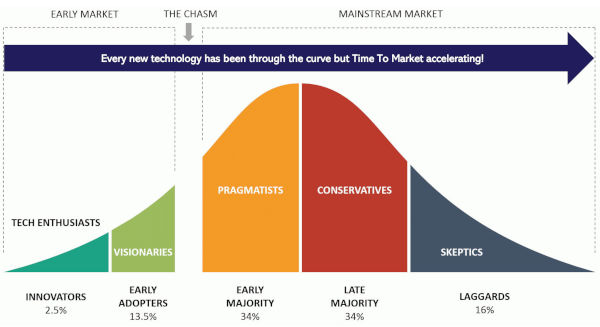
ERV penetration is expected to increase sooner in some key regions, given that governments have announced ambitious and aggressive ERV deployment targets. For example, if California's ERV deployment targets are met by 2035, this could represent an approximately 280% increase in ERV-generated electricity capacity in terms of GWh compared to its 2023 baseline. Other key countries and US states expected to see rapid growth in VRE deployments include Germany, the UK, Italy, Australia, India, and Texas. Higher ERV penetration will result in longer periods when energy is unavailable from these sources, thus requiring LDES technologies to dispatch power during these extended periods. According to IDTechEx analysis, once a country or state's electricity generated from renewable energy sources (RES) reaches approximately 45%, an average storage duration of more than 6 hours will be the most cost-effective for the electricity system. On average, globally, this is not expected to occur until the late 2030s, although the other key countries and states mentioned are expected to reach those percentages of electricity generated from RES in terms of GWh before then. As such, some initial deployments of commercial-scale LDES projects can be expected before 2030 and beyond in some of these key regions.
Why Solutions Other Than Lithium-Ion Batteries Are Needed:
Aside from pumped hydro, while lithium-ion batteries currently dominate the global stationary energy storage market, the capital cost of lithium-ion is unlikely to be low enough for LDES (Local Energy Storage Systems). Instead, alternative energy storage (ES) technologies aim to offer lower costs (on a $/kWh basis). One way to achieve this is through designs that allow for the decoupling of energy and power. This could apply, for example, to some redox flow batteries (RFBs) and liquid-air energy storage (LAES). To increase system capacity for RFBs, the electrolyte volume and the size of the electrolyte storage tanks can be increased, while changes to the cell stack are only needed to increase energy output. For LAES, the size of the liquid-air storage tanks can be increased, while the turbomachinery only needs to be scaled up to accommodate the power output. This results in faster, non-linear decreases in CAPEX (on a $/kWh basis) for many of these LDES technologies depending on the storage duration. While there is no strict definition for LDES, IDTechEx defines it as a storage duration starting at 6 hours. This is when many of the other competing energy storage (ES) technologies begin to be, or are, cheaper than Li-ion in terms of $/kWh.

Decoupling of energy capacity and power in redox flow batteries. Source: IDTechEx
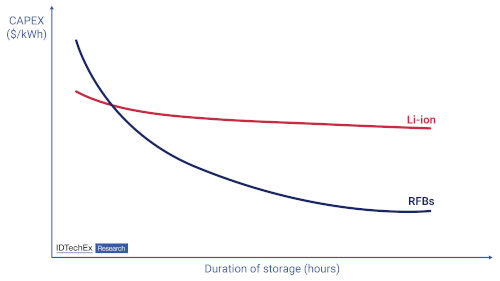
Reductions in CAPEX (US$/kWh). Source: IDTechEx
As the penetration of renewable energy sources (RES) increases, the average storage duration in a given country or state will need to increase to support this. Therefore, with greater VRE penetration, reduced system costs can be expected for many low-energy storage (LDES) technologies, highlighting their advantage over lithium-ion. Furthermore, anticipated limitations on lithium-ion materials toward the end of the decade and the safety risks associated with flammable electrolytes in lithium-ion batteries are expected to be other key factors driving demand for other energy storage (ES) technologies in general. A variety of LDES technologies are currently being developed and commercialized in key regions, including electrochemical, mechanical, thermal, and hydrogen storage. However, ultimately, depending on the penetration of RES, it will not be until the mid-2030s that demand for LDES technologies will begin to accelerate in key regions, with broader global demand only occurring after approximately 2040.
Author: Conrad Nichols, technology analyst at IDTechEx