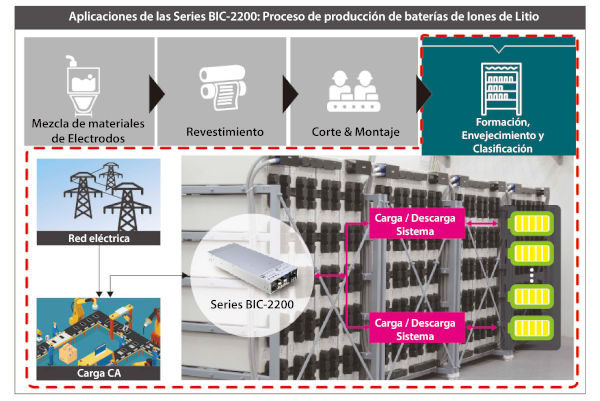
Regarding forming, it's a crucial process that directly impacts battery quality. In the past, battery manufacturers had to use an AC-to-DC converter for forming and a separate DC-to-AC inverter for forming and sorting. Using two separate devices not only takes up a lot of space, but also prevents effective cost reduction. Furthermore, more components lead to higher maintenance costs and reduced reliability.
In this regard, MEAN WELL (products distributed by Electrónica OLFER) announces the new BIC-2200 series. This is the first bidirectional power supply with energy recycling functionality, designed to replace the two units typically used in the battery manufacturing process with a single unit. The BIC-2200 can not only supply AC to DC power, but when the DC needs to be discharged, it also converts it back to AC for use by the system's equipment. Furthermore, the discharge timing can be programmed to reduce peak loads and fill valley loads, thus lowering charging costs.
The BIC-2200 series meets global safety requirements with CE, UL, TUV, and CB 62368-1 certifications. Most importantly, its energy recycling function is designed in accordance with IEC 62477-1. This device features a fully digital design, optimizing operation through digital control, resulting in a 93% bidirectional conversion efficiency and reduced energy conversion losses. A CAN Bus version is also available.
In addition to these advantages, the BIC-2200 series can switch between AC and DC in less than 1 ms during bidirectional conversion to accommodate process changes. Furthermore, to allow customers to flexibly increase or decrease the load, up to five devices can operate in parallel, reaching up to 11,000W.
Choosing the BIC-2200 series not only reduces construction, production, and maintenance costs but also lowers carbon emissions from power plants. In the future, production facilities using the BIC-2200 series can fulfill the mission of providing environmentally friendly products and improved sustainability.