This evolution raises a question that goes beyond simply having enough power: how to ensure that each unit of energy used by the data center delivers the maximum possible value without compromising availability?
Energy that is not measured can hardly be optimized
Knowing the overall consumption of a data center provides a first reference, but truly managing efficiency requires analyzing what happens at different levels of the electrical distribution.
An installation may present an apparently stable overall consumption while a certain line registers a deviation, a set of racks shows a lower utilization than expected, or part of the electrical infrastructure suffers losses that go unnoticed in a general measurement.
Granular monitoring allows you to convert overall consumption into useful information for operations. Measuring different points in the distribution system, from lines and panels to rack-connected systems, provides a much more accurate picture of the installation's energy performance.
This granularity is especially relevant when the infrastructure grows in phases. Each new room, power upgrade, or addition of high-density loads modifies the data center's energy profile. Measuring by circuit allows us to understand what is actually happening and compare the performance of different areas.
The information also helps to link consumption and capacity. If an operator knows the actual demand on each line and how it evolves, they can better plan future expansions and reduce their reliance on theoretical estimates.
Energy that isn't measured is difficult to optimize. However, knowing how much is consumed is only part of the problem. It's also necessary to know what happens to that energy as it circulates through the system.

Efficiency also means energy quality
Energy consumption is one part of the equation. The other part is related to the conditions under which that energy reaches the loads.
Data centers concentrate a large amount of power electronics: UPS systems, power supplies, air conditioning equipment, variable frequency drives, converters, and servers. This configuration makes parameters such as harmonics, imbalances, and certain electrical disturbances particularly relevant.
An installation can maintain controlled consumption and show good overall efficiency indicators while certain power quality problems generate additional losses, heating, stress on equipment, or abnormal behavior.
For this reason, a comprehensive energy strategy must analyze both the amount of energy consumed and the conditions under which it circulates through the infrastructure.
Power quality analysis systems allow for the monitoring of electrical parameters, the identification of disturbances, and the establishment of detection and alarm mechanisms. Their usefulness lies, among other aspects, in facilitating the transition from a reactive to a preventative strategy.
A gradual increase in harmonics, a localized imbalance in a part of the distribution system, or a recurring disturbance can be signs of a problem that has not yet caused a critical incident. Detecting it early provides time to investigate its origin and take action before it affects the operation of the loads.
From this perspective, power quality is also part of efficiency. Electrical losses, unnecessary heating of conductors and equipment, or operation outside of expected conditions have economic and operational consequences.
Being efficient without compromising availability
Servers that support digital services, business applications, cloud platforms, or artificial intelligence processes require a continuous power supply. Electrical redundancy is therefore an integral part of a data center's architecture and cannot be considered a dispensable variable for improving efficiency indicators.
The challenge is to design that redundancy in an efficient and adaptable way.
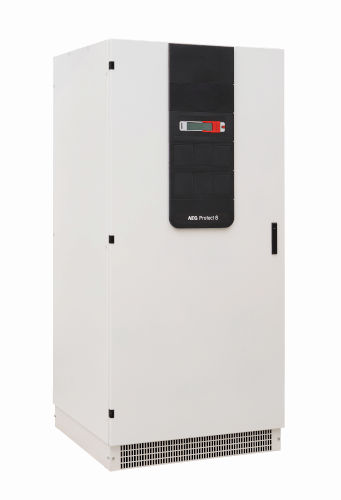
Uninterruptible power supply (UPS) systems are of particular importance here. Their main function is to guarantee the continuity of critical loads in the event of power disturbances or interruptions, although their energy consumption also directly influences the overall energy consumption of the installation.
The efficiency of a UPS should be analyzed in relation to the actual load it supports. An oversized system can operate for extended periods far from its optimal operating point. An adaptable architecture allows for better adjustment of available capacity to the actual needs of the installation.
This approach becomes even more important when the growth of the data center occurs gradually.
Modularity to grow when really needed
The initial sizing of a data center always incorporates projections of its future growth. The problem arises when these estimates require installing, from the outset, a capacity that may take years to fully utilize.
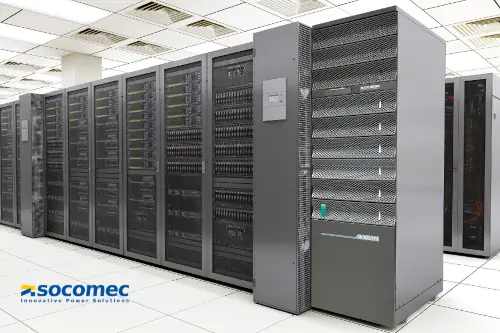
Modular architectures offer an alternative. Instead of deploying the full planned capacity from the outset, they allow for gradual expansion as demand increases.
The energy advantage of this approach lies in the ability to better adapt the installed infrastructure to the actual load. From an economic standpoint, it allows investments to be aligned with growth. Operationally, it facilitates having an architecture ready to evolve without having to completely replace existing systems.
This adaptability is especially relevant in projects related to artificial intelligence and high-performance computing (HPC), where power requirements can change rapidly.
Efficiency is no longer solely about consuming fewer kilowatt-hours. It also involves using available electrical capacity intelligently, reducing underutilized infrastructure, and maintaining sufficient capacity for growth.
In a critical infrastructure, all of this must be done while maintaining the necessary levels of redundancy.
When a source fails, continuity must be maintained
The electrical architecture of a data center is designed around continuity of service. Critical loads can have multiple power sources to maintain operation in the event of a failure in one of them.
Static transfer systems play an important role in this scenario. Their function is to automatically transfer loads between alternative sources when the main power supply falls outside of established parameters.
This capability allows for the use of dual-feed architectures and provides redundancy for workloads requiring high levels of availability. The goal is to perform the transfer quickly enough to maintain the continuity of critical systems.
Redundancy thus ceases to be a simple duplication of equipment and becomes a coordinated architecture of protection, power supply and availability.
Energy efficiency faces one of its fundamental constraints here: a reduction in consumption loses its value if the risk of interruption increases. For this reason, efficiency must be designed around availability, not in opposition to it.
From energy consumed to available capacity
The evolution of data centers is changing how we understand efficiency. The relevant indicator is no longer just how much electricity a facility consumes, but what performance it gets from each unit of energy and what service capacity it can maintain with it.
The first step is to identify where energy is consumed using sufficiently granular monitoring systems. Next, it is necessary to analyze the conditions under which the energy flows and detect anomalies that could cause losses or compromise equipment operation.
From there, the power infrastructure must be prepared to provide both efficiency and continuity. Efficient, modular UPS systems allow for better adaptation of capacity to demand, while redundant architectures and source transfer systems help preserve availability in the event of failures.
The result is a broader view of energy efficiency in data centers: consuming the necessary energy, knowing where it is used, reducing losses, maintaining power quality, and sizing the infrastructure according to actual demand.
In a scenario marked by the growth of artificial intelligence, HPC and high-density loads, optimizing energy infrastructure is not simply about consuming less, but about obtaining more usable capacity from the available energy without compromising the continuity of service.