To increase competitiveness, there is no alternative but to invest in improving our infrastructure, and in recent years we have seen how users are paying more attention to ensuring their own electrical quality in the face of a power outage or other alterations in the electrical supply, adding UPS (Uninterruptible Power Supply) equipment to alleviate these shortcomings.
Static UPSs
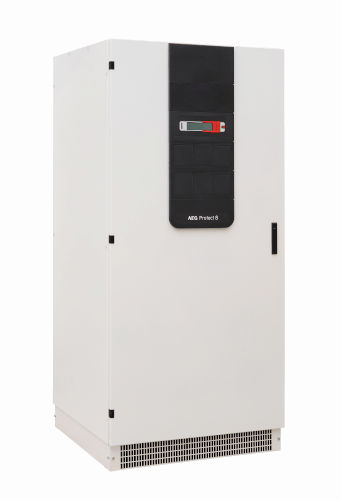
For low-power environments, static "on-line" double-conversion UPS systems are commonly used, generally with a capacity below 500 kVA.
These units condition the incoming power supply and provide high-quality power at their output through electronic energy conversion. If uninterruptible power supply is also required, batteries are installed as energy storage elements to absorb power outages.
In small installations, these systems cover the needs, mitigating the effects of poor power quality.
But what happens when
we need to guarantee the continuity of an industrial plant, comprised of large energy consumers such as electric motors, welding robots, etc., and facing
the same power quality problems? And what happens to these processes?
Dynamic Technology UPS Systems
: To solve power supply problems in large industrial environments, Piller offers its range of dynamic technology UPS systems, capable of providing protection
and continuity to entire factories. A single unit can protect up to 2,500 kVA of power consumption.
Dynamic technology UPS systems are also power conditioners, like those described previously, but they use a mechanical system to ensure a reliable power supply.
These units essentially function like an electric motor driving an alternator. All the electrical energy they receive is converted into motion, which then generates clean, pure, and perfectly conditioned energy.
Dynamic UPS systems, also called rotary UPS systems, can handle overloads of up to 14 times their nominal output current. Thanks to their robust construction, they can maintain the continuity of an industrial process without being affected by power surges caused by
the input and output of different loads. They offer excellent performance in installations with extensive cable runs and are the best way to guarantee uninterrupted production.
The Piller dynamic UPS integrates energy storage systems, using a flywheel or batteries, and can also be coupled to a diesel generator, allowing for indefinitely extended runtime without zero-crossing.
These units help improve environmental conditions because they always consume active energy with a power factor (PF) of 1 and act as harmonic filters between the input and output, achieving 99% attenuation.
High performance.
Another important factor of this technology is its very high performance (or its low heat generation losses), which makes it a key element in cost savings during operation. They also do not require special conditioning, as they can operate in environments with ambient temperatures up to 40°C.
In the long run, and to justify an investment in this type of equipment, a loss study must be conducted, considering at least the following:
- Product losses.
- Downtime and restart time.
- Damage to components.
- Opportunity losses.
- Damage to reputation.
- Increased maintenance cycles, etc.
With all this data in hand, we can assess the impact of downtime and compare it to the investment in a dynamic UPS.
Depending on each user's needs, a specific type of dynamic UPS solution is required, but as an example, the installation of a 1,670 kVA unit with a storage system and diesel generator occupies an area of 14 m (length) x 3 m (width) x 3 m (height), the space required by a shipping container.
It should be noted that this "dynamic" technology is designed to last for over 20 years. Piller currently has operational UPS systems that were installed 30 years ago and has references in the automotive, cable, laminate, newspaper printing, construction materials, and electronics manufacturing sectors, among many others.
Author: PILLER Ibérica SLU