This expansion allows us to offer a homogeneous lithium-ion battery-based solution for a wider range of applications, from small communications infrastructures and servers to more critical enterprise environments such as data centers, virtualization systems, high-density racks, and IT infrastructures requiring high levels of availability.
The SLC TWIN RT3 LION series combines double-conversion online technology with state-of-the-art lithium-ion batteries, providing continuous power protection against interruptions, micro-outages, voltage fluctuations, harmonics, and other power grid disturbances. Furthermore, all models feature a power factor of 1 (PF=1), enabling them to deliver the maximum available active power to connected loads.
The advantages of lithium extend to higher-power applications.
Lithium-ion batteries offer significant advantages over traditional lead-acid batteries, including longer lifespan, reduced maintenance requirements, faster recharge times, and higher energy density. Thanks to this, users can reduce system lifecycle costs and optimize available space in facilities where service continuity is critical.
Maximum flexibility for IT environments and data centers.
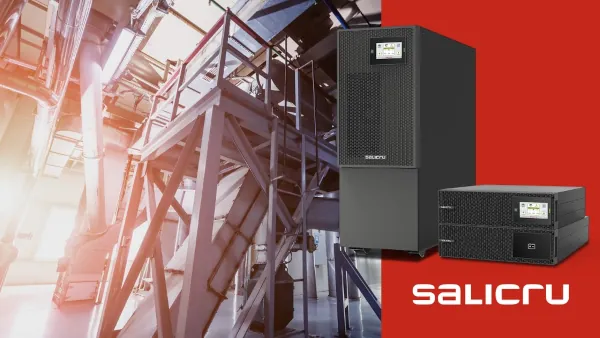
The entire SLC TWIN RT3 LION range maintains its convertible rack/tower design, facilitating integration into both standard rack cabinets and floor-standing installations. It also incorporates advanced monitoring and remote management capabilities through Salicru's connectivity solutions, allowing for system status monitoring and proactive maintenance of the protected infrastructure.
The new 6 and 10 kVA models also include an adaptable PDU for rack or vertical mounting, simplifying power distribution and equipment connection in high-density environments.
With this expansion, Salicru offers the market one of the most comprehensive lithium UPS ranges in its catalog, covering power outputs from 1, 1.5, 2, and 3 kVA up to the new 6 and 10 kVA, maintaining a common technological architecture and performance designed to maximize the availability of critical infrastructure.





- Details
- Category: UPS and Rectifiers
Salicru launches new MULTI online UPS systems up to 20 kVA for critical environments
Salicru expands its family of SLC TWIN RT3 LION lithium Uninterruptible Power Supply (UPS) systems with the addition of new 6 and 10 kVA models, thus extending the series' coverage from the current 1 kVA to 10 kVA.


Print Magazine

Annual subscription price:
You will receive all 10 editions that are published each year.
social networks
Popular News Electronics






Spanish electronics magazine. Printed for over 25 years.
Spain - Madrid - All rights reserved © Convertronic Professional Spanish Electronics Magazine.