
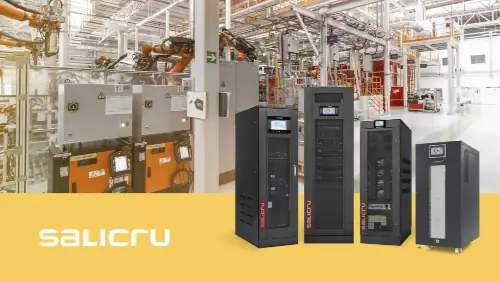
Ensuring the continuity and quality of the electricity supply in industry relies on various equipment, among which Uninterruptible Power Supply (UPS) systems stand out. These systems are capable of protecting assets against numerous electrical disturbances and continuing to power facilities in the event of an outage. The significance of such disturbances is comparable to their economic consequences: the Spanish Association of the Electrical Industry estimated several years ago that the annual cost of power supply interruptions to the country's economy exceeds €6 billion.
A particular characteristic of the industrial sector is its heterogeneity, encompassing everything from heavy machinery, furnaces, and other very high loads to equipment much more sensitive to voltage variations, such as control systems, sensors, and drives. This variability places additional demands on UPS specifications, requiring versatility and scalability.
We must also consider recent trends such as Industry 4.0, which integrates data analytics, advanced automation, and IoT connectivity into the production environment. This combination of disparate elements means that an unexpected power fluctuation can generate cascading inefficiencies and disruptions that jeopardize uptime, and therefore the profitability and reputation of the industrial plant.
Given these risks, it is essential to implement UPS systems based on online double-conversion technology capable of protecting all types of industrial processes, such as manual automation and control systems, continuous manufacturing systems, instruments, and measuring devices, among many others. Monolithic options are available, such as the SLC CUBE3+, which boasts the lowest THDi on the market, the SLC X-PERT, and the SLC X-TRA. Modular alternatives include the SLC ADAPT2, which allows for scalability according to plant needs. Its protection mitigates disturbances such as undervoltages and voltage dips, overvoltages (transient or permanent), power outages and micro-outages, harmonics, frequency fluctuations, and transient bursts.
The effects of these electrical disturbances are highly varied: overheating of devices, intermittent operation, and even process shutdown, as well as accelerated deterioration, unexpected restarts, and irreversible physical damage. Some of these transient phenomena are, in fact, caused by industrial installations, specifically by the starting of high-power motors or switching operations on the medium-voltage network.
For example, starting a high-power induction motor can cause it to draw a current five to eight times its nominal value. This sharp and rapid increase in current causes voltage drops and system fluctuations. To mitigate this, it is advisable to install soft starters, variable frequency drives, and, in general, appropriate starting configurations.
This is just one example of a malfunction that can particularly affect equipment frequently found in all kinds of industrial sectors, such as PLCs (programmable logic controllers) and HMIs (human-machine interfaces). An interruption of just a few milliseconds is enough to destabilize software execution and cause communication errors that jeopardize operations to the point of halting the process.
Poor power quality causes cumulative damage that often goes unnoticed until its effects become apparent. This occurs with voltage drops, as explained earlier, and also with harmonics, which originate from the distortion of the voltage and current waveform due to the presence of nonlinear loads. Excessive overheating of conductors and transformers shortens their lifespan, impairs motor insulation, and degrades other passive components.
Installing appropriate UPS systems, properly connected to the control systems, is the best way to prevent all of this. UPS systems provide an ideal solution when safety, economic viability, and reputation are at stake in the industrial environment.
Risks and costs of not installing an industrial UPS
Industrial environments have a number of specific requirements regarding their electricity supply. Its continuity, reliability, and efficiency are non-negotiable and must be achieved at a reasonable cost that contributes to the profitability of companies and organizations.