

To avoid serious damage to the company and its reputation, battery reliability and performance are essential. Li-ion batteries are ideal for this critical function, demonstrating a clear advantage over VRLA (valve-regulated lead-acid) batteries.
An important point to emphasize above all is that "Li-ion" is an umbrella term for an entire family of batteries whose electrochemistry varies considerably. Specifying the most appropriate chemistry, design, and configuration is key to achieving optimal battery characteristics for each application. For data centers, this includes maximizing security.
Why is Li-ion better?
Li-ion technology is more reliable and offers significantly higher performance. Its total cost of ownership (TCO) is lower, thanks to a combination of long lifespan, minimal maintenance, high energy efficiency, and tolerance to higher temperatures. In comparison, the reliability and lifespan of VRLA batteries are drastically reduced at elevated temperatures, which in turn means more cooling, higher energy consumption, and increased CO2 emissions . The high energy density also allows for greater savings in assets and infrastructure. Being smaller in size and six times lighter, they occupy less space and require less structural support. When needed, they discharge energy quickly to meet UPS demands. Between outages, they recharge rapidly, ready for the next emergency. Because their electronic monitoring and management systems are easily integrated into the building, operators are fully aware of their status and availability. At all times, you can be confident in their state of charge (SOC) and remaining lifespan, also known as state of health (SOH). Its electronics also allow for easy scalability and optimization for the application, in terms of voltage, power, and energy.
What could possibly go wrong?
Damage or misuse can cause a short circuit in a Li-ion cell, which can trigger a chain reaction known as thermal runaway. This produces a large heat discharge that, if it spreads to neighboring cells, can initiate their decomposition and release hot, flammable gases. Widely reported thermal runaway incidents include a 2019 fire in Arizona's battery energy storage system and television presenter Richard Hammond's escape from a burning car in 2017 while filming The Gran Tour for Amazon. Importantly, the Li-ion battery specification in both cases differed from the recommended specifications for data centers.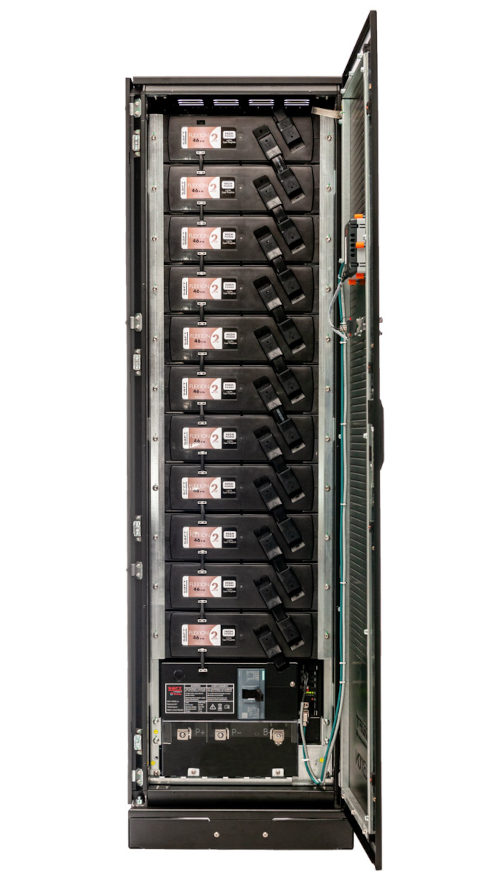
Which chemicals are safer?
When we talk about lithium-ion batteries, the term actually encompasses a whole family of chemicals with different characteristics, such as lifespan, energy and power density, and the ability to operate over a wide temperature range. These chemicals can be selected and even blended to fine-tune the balance of these properties. A battery's ability to manage performance and dissipate heat is also significantly influenced by its mechanical, electrical, and electronic design. There are two main types of lithium-ion batteries, named according to their cathode material: metal oxides and iron phosphate. Another group, with titanate anode material, is used in high-power applications with frequent charge and discharge cycles, such as railway traction or underground mining vehicles. Metal oxides, including aluminum nickel-lithium-cobalt oxide (NCA), lithium nickel-cobalt manganese oxide (NMC), and lithium manganese oxide (LMO), offer the highest energy density. They are ideal in electric vehicles, for example, because their chemistry is very active, but the drawback is that if thermal runaway occurs, they release oxygen. This can fuel the fire, potentially allowing temperatures to reach 800 or even 1,000°C. And because they release oxygen, oxygen-reducing fire suppression systems and advanced extinguishing agents like fluoroketones are ineffective in this situation. Iron phosphates, such as lithium iron phosphate (LFP) and Saft's own patented SLFP (Lithium Iron Super Phosphate) technology, are inherently much safer. The oxygen in their phosphate molecules is tightly bound and is not released during combustion. This limits potential temperatures in the event of thermal runaway to around 200 to 250°C, making spread between cells unlikely. The disadvantage is a lower energy density (approximately 30% less) and a lower cell voltage compared to metal oxides, but they are ideal when safety is critical. They also offer a long lifespan, even at high temperatures, and good discharge/recharge cycle capacity.
What UL and IEC safety certifications apply?
The international standards IFC 2018 and NFPA 855 for building fire safety aim to reduce risk by limiting the energy content of Li-ion batteries to 20 kWh per system, or 600 kWh per installation. They also require an air gap of approximately one meter between cabinets. However, many data center operators need larger systems. Approval for unlimited energy content, without air gaps, can be obtained by passing the rigorous UL 9540A thermal runaway potential test. Tests of some metal oxide systems have been reported in UL 9540A test records to show cell-to-cell and module-to-module heat propagation, flames, thermal runaway, and even ejection of small internal cell components. In contrast, Saft's Flex'ion system passed the UL 9540A test with no cell-to-cell heat propagation or ignition under similar conditions. During an incident, phosphate-based systems vent significantly lower quantities of combustible and other harmful gases, and these gases remain cooler, allowing for easier and safer removal by gas extraction systems. For added safety, the Li-ion battery system is UL 1973 certified, has passed the IEC 62619 test, and fully complies with IEC 62485-5.
What role does battery management play in safety?
Aside from their electrochemistry, there are physical differences between Li-ion battery systems that affect their properties. Each Li-ion battery consists of a series of cells, along with an electrical circuit to the battery management system (BMS), all within a protective casing.
The BMS is vitally important for optimizing security, reliability, and total cost of ownership
A good BMS will monitor both the voltage at each individual cell and its state of charge, health, and safe operating conditions. By controlling charging and discharging at the cell level, battery temperatures are balanced to maximize longevity, as temperature is closely related to battery aging. It should also monitor and manage the temperature of the power connections, which can be higher than the cell temperature during discharge. Each cabinet has a battery management module (BMM) to monitor multiple battery modules. However, during scale-up, the BMS can combine several BMMs across multiple cabinets to establish a master battery management module (MBMM), which regulates the entire system.
How do UPS batteries differ from those used in other applications?
Another point is that, ideally, Li-ion battery systems used for data center UPS applications should be specifically designed for that purpose. Their primary objective is very different from that of a battery energy storage system (BESS), for example. BESS batteries are revenue-generating assets that must be protected, so their BMS will prevent them from being fully discharged—a state from which Li-ion batteries cannot recover. However, data center UPS batteries are there to protect the business by ensuring power continuity. If necessary, the BMS will allow a full discharge to gain a few vital extra seconds of power in an emergency, even if this means sacrificing battery life. Backup power and security should not be compromised.
Article written by Gareth Hackett, Li-ion technology expert at Saft.