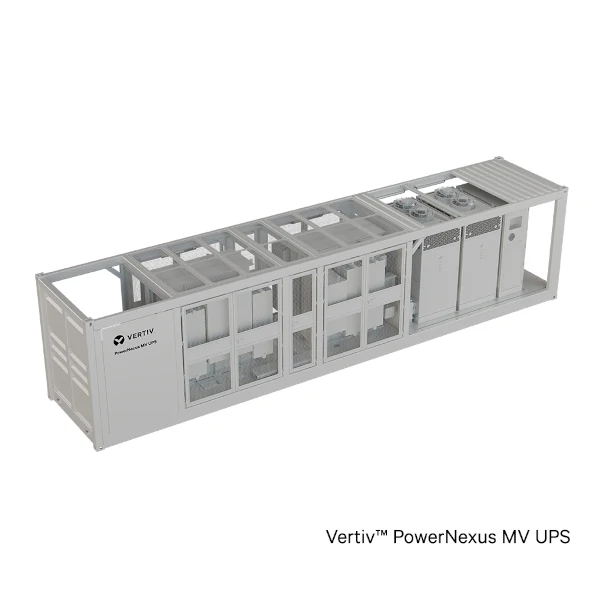
The solution is designed for outdoor installation, close to the point of connection with the electrical network, providing continuous power protection and freeing up interior space for computing infrastructure.
The system offers a maximum operating efficiency of 98.5% and, combined with long-life battery energy storage systems, can provide up to four hours of autonomy, reducing dependence on diesel generators.
The PowerNexus MV UPS addresses these needs by moving power protection and management to the point of connection to the grid. Its architecture combines medium-voltage protection, operational continuity in the face of power disturbances, and stabilization of the rapid power fluctuations of artificial intelligence systems.
Kyle Keeper, senior vice president of Vertiv's power management business unit, highlights that this platform allows operators to focus on deploying computing capacity, reducing the complexity associated with coordinating electrical infrastructures.
Key features of the Vertiv PowerNexus MV UPS include:
Class 1 critical load protection: output voltage quality in accordance with IEC 62040-3, even in the face of network disturbances and upstream faults.
Outdoor installation: architecture mounted on a skid-type structure that allows freeing up interior space in data centers.
Continuity in the event of network failures: ability to contribute to the stability of the supply during electrical disturbances.
AI load stabilization: absorbing rapid power fluctuations before they reach the electrical grid.
High energy efficiency: performance up to 98.5% at full load through a network-interactive topology.
Up to four hours of autonomy: through integration with long-life battery systems.
Simplified deployment: integration of UPS, batteries and other power chain elements through a single-vendor architecture.
Vertiv also provides a PSCAD (Power Systems Computer Aided Design) simulation model that allows you to evaluate the electrical behavior of the system, validate its integration, and analyze its dynamic interactions with the grid before installation.
Validation against voltage drops and dynamic load variations
Vertiv has conducted proof-of-concept demonstrations with QTS, SoftBank, and Rosendin at its Global Power R&D and Customer Experience Center in Bologna, Italy. According to the company, the tests, performed under steady-state and dynamic conditions, demonstrated:
Stable operation with loads from 0 to 100%.
Class 1 voltage accuracy during rapid load changes.
Operational continuity in the event of a 100% voltage drop for 150 ms.
Operation under a 25% overvoltage for five seconds.
Ryan Kuithe, senior vice president of facilities operations at QTS, highlights that the tests validated the system's ability to maintain a stable power supply in the face of dynamic load changes and voltage disturbances.
New laboratory for medium voltage and 800 VDC power supply architectures
Vertiv is also expanding its research, development and validation capabilities for electrical systems through a dedicated medium-voltage laboratory in Bologna, which is scheduled to become operational in 2027.
The facilities will allow for full voltage testing, customer demonstrations, technical training, and system-level validations.
Among the technologies that can be evaluated are medium voltage UPS systems, battery energy storage systems, and medium voltage to 800 VDC conversion architectures, designed to meet the power needs of AI data centers.
Giovanni Zanei, Vertiv's vice president of large power system conversion, notes that these facilities will help operators evaluate new electrical architectures before their deployment.
The first shipments of the Vertiv PowerNexus MV UPS are scheduled for mid-2027.