Creating a motor control system requires accurate current detection and measurement of motor winding currents. A commonly used approach is to infer winding currents by taking measurements to ground or supply in the bridge circuit. Measuring the direct winding current is a simpler and more accurate method, but implementation is challenging due to the high common-mode oscillation of the PWM signal. Adoption of this approach has been limited by poor PWM rejection and the slow resolution speed of existing solutions.
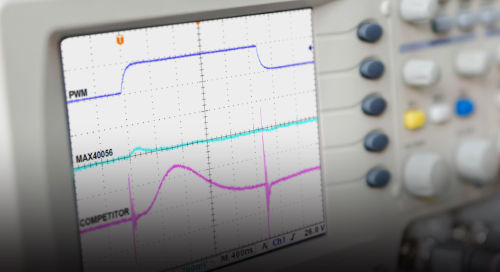
The MAX40056 rejects PWM slew rates above 500 V/µs and sets to 500 ns to provide full-scale winding current measurement with an accuracy of 0.3 percent. Its patented PWM rejection scheme achieves a settling time four times faster than competing offerings, allowing motor control designers to increase the drive frequency or decrease the minimum duty cycle without sacrificing measurement accuracy. A higher PWM frequency smooths current flow and reduces torque ripple, resulting in more efficient motor operation. Accurate winding current measurement at low duty cycles helps reduce or virtually eliminate vibration when the motor is running at low speeds. The MAX40056 has a wide common-mode voltage range of -0.1V to +65V and a protection range of -5V to 70V to ensure that inductive backfeed does not damage the IC. With bidirectional sensing capability, it is ideal for DC motor control, base stations, data centers, battery banks, and many other applications that require accurate current measurements in noisy environments.