





Product samples and development tools will be introduced gradually starting in June 2023, with mass production planned for the fourth quarter of 2023.
Featuring an advanced manufacturing process, attractive cost, and outstanding application potential, the GD32H7 MCU series is ideal for signal processing, high-precision motor control, digital power supplies, energy storage, audio/speech recognition, and graphics/image applications. Thanks to the CPU's ultra-high clock speed and large memory capacity, the product also supports applications requiring intensive processing capabilities, such as machine learning (ML) and artificial intelligence (AI).
Powerful On-Chip Integration:
The GD32H7 MCU series adopts a high-performance Arm® Cortex®-M7 core based on the Armv7E-M architecture, with a clock speed of up to 600 MHz. Its performance is further enhanced by the high-bandwidth AXI+AHB bus and the six-pipeline architecture with branch prediction capabilities. The integrated advanced hardware digital signal processing (DSP) accelerator and double-precision floating-point unit (FPU), along with the hardware trigonometric math unit (TMU) and filter accelerator (FAC), significantly reduce the CPU load and increase computational and processing efficiency. The GD32H7 MCU series can operate at up to 1552 DMIPS at its highest frequency and achieve an outstanding performance score of 2888 points in CoreMark® benchmark tests, improving code execution efficiency by approximately 10% compared to similar products on the market operating at the same frequency. The product's performance is over 40% higher than that of Cortex®-M4 products.
The integrated memories in the GD32H7 MCU series range from 1024KB to 3840KB of Flash memory and 1024KB of SRAM, including 512KB of Tightly Coupled Memory (TCM) configurable for zero-wait execution of critical instructions and data. The high-speed 64KB L1 cache (I-Cache, D-Cache) further enhances CPU processing efficiency and real-time performance. Its External Memory Controller (EXMC) allows access to various types of external memory, such as SDRAM, SRAM, ROM, NOR Flash, and NAND Flash. The built-in Embedded Trace Macrocell (ETM) can trace instructions and data in real time, providing advanced debugging capabilities without interfering with normal CPU operations. The large internal memory space of the GD32H7 MCU series can support rich operating systems, embedded ML/AI and other advanced algorithms, enabling high-performance, low-latency real-time control.
Significantly Expanded System Resources:
The GD32H7 MCU series integrates various peripherals, including 8 U(S)ART, 4 I2C, 6 SPI, 4 I2S, 2 SDIO, and 2 Octal SPI (OSPI, backward compatible with QSPI) with real-time decryption compatible with Real-Time Detection (RTDEC) modules. The GD32H7 has two USB 2.0 OTG interfaces, supporting full-speed and high-speed operation modes. It also integrates three CAN-FD modules and two Ethernet interfaces to meet high-speed communication demands.
The GD32H7 microcontroller series offers excellent graphics display and audio/video connectivity solutions. It features a TFT-LCD controller and an Image Processing Accelerator (IPA) for 2D image processing operations such as overlay, rotation, zoom in/out, and conversion between multiple color modes. The product also integrates a serial audio interface (SAI), an SPDIF audio interface, and an 8- to 14-bit digital camera interface for capturing and transmitting video and images.
The GD32H7 MCU series adopts a supply voltage range of 1.71 Vdc to 3.6 Vdc, with advanced power management capabilities. It features three power supply modes (LDO/SMPS/direct power supply) and five low-power modes for a flexible power supply scheme with balanced system power consumption. The GD32H7 MCU has four general-purpose 32-bit timers, twelve general-purpose 16-bit timers, four basic 64-bit/32-bit timers, and two advanced PWM timers, offering greater quantity and higher resolution than competing products, providing designers with more precise options. The sampling rate of the two internal 14-bit ADCs can reach 4 MSPS, and the sampling rate of the 12-bit ADC reaches 5.3 MSPS. It also integrates a fast comparator, DAC, and other high-precision analog peripherals to support various motor control applications.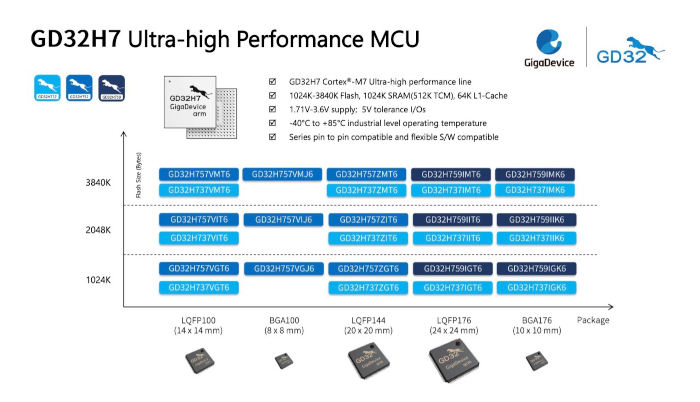 This new MCU family supports several security features. It has built-in hardware encryption using DES, 3DES, or AES algorithms, as well as Hash algorithms for different security applications, to ensure data integrity and protect transmitted information. The SRAM in the GD32H7 MCU series supports ECC verification, effectively improving system reliability. The integrated RTDEC module can decrypt data on the AXI or AHB bus in real time, ensuring the confidentiality of read-only firmware stored in external SPI NOR Flash memory.
product
family is backward compatible with existing GD32 MCU products and offers three product types with different system resource configurations: the GD32H737 supports three CAN 2.0B channels, while the GD32H757 and GD32H759 support three CAN-FD channels. In terms of packaging, the GD32H757 is available in BGA100 and LQFP144/100 packages, while the GD32H759 is available in BGA176 and LQFP176 packages.
The GD32 development ecosystem is now gaining traction. GigaDevice provides a free development environment for the new GD32H7 MCU series, the Eclipse GD32 IDE, and the GD32 all-in-one programmer. The product supports direct programming via GD-LINK's SWD/JTAG mode or through the host's UART, USB, and I2C interfaces. Other popular embedded tools, such as Arm® KEIL, IAR, and SEGGER, also provide full support for this GD32H7 MCU family, including their integrated development environment (IDE) and debugging/traceable functions. GigaDevice will also partner with leading real-time operating systems (RTOS), middleware such as graphical user interfaces (GUIs), and embedded artificial intelligence algorithms to accelerate customer project design and shorten time to market.
GigaDevice unveiled its latest full-featured development board, the GD32H759l-EVAL, earlier this year at Embedded World 2023 in Nuremberg, Germany. Other planned starter kits include GD32H759I-START, GD32H757Z-START, GD32H757J-START, and GD32H757V-START, and will be available in various packaging options, enabling designers to develop and debug applications faster. The above development tools are available from your distributor; please contact Mecter.
For any technical or commercial inquiries, please contact Mecter SL.





