





IoT development kits are a viable and practical solution for creating prototypes on which to base your design. However, there is a wide variety of kits available, so you need to carefully consider the application requirements, the kit's features, and the capabilities involved.
In this article, we'll discuss some of the factors to consider when choosing an IoT development kit for a new design.
The Age of Online Connection
There is no doubt about it: we are in the age of online connection. Connected devices are everywhere: we wear them, they help us precisely control our electricity consumption, or they notify us if someone is coming to visit. In industrial manufacturing processes, the Industrial Internet of Things (IIoT) is revolutionizing factory operations and contributing to improved overall equipment efficiency. In just a decade, we have changed the way we interact with and control the world. We couldn't imagine life without our mobile phones, and now we have become accustomed to obtaining instant information about every aspect of life and work.
Cars are also undergoing radical changes. For example, we now receive alerts and up-to-date traffic information that warns us of potential traffic jams. In the healthcare field, monitoring equipment allows us to stay home with the peace of mind of knowing that professionals are monitoring aspects of our health and will be available if intervention is necessary.
Industry quickly adopted the IoT, thanks to public initiatives—such as Industry 4.0—that spurred the need to simplify operations, increase automation, and improve process efficiency. Currently, numerous sensors monitor the status of all stages, generate reports, and send data to the automation's analysis and control system.
IoT/IIdC systems offer many advantages, but for electronics engineers, most of the challenges are related to developing an IoT device.
IoT Device Requirements:
IoT applications come in all shapes and sizes, but they all share the same basic set of functions, whether designing a pressure sensor for an industrial process or manufacturing an occupancy detector for an office.
During the preliminary study phase of a new IoT device, when the main technical specifications are established, the following factors should be considered, as they will determine the design and functional architecture.
Detection: Sensors detect what is happening in the outside world, from temperature and atmospheric pressure to the movement of people. For example, a camera might send data to a machine learning application designed to detect objects in order to confirm whether a label has been correctly affixed to a bottle. Several technical decisions depend on what is being detected and the frequency of detection. The cost, size, and complexity of the sensors must also be considered. A thermistor used to measure temperature will require additional components for the analog environment and some type of software to process the data before conversion to digital format. Another important factor is the number of sensors required and how frequently their data will be queried.
Connectivity is also crucial: How will the IoT device interact with the main control system? Is a wireless communication system available for all use cases, or is a wired method preferable? The sensor type will also determine how much data needs to be transferred and how often. Wireless mesh technology can offer a more stable communication link in a large installation, but it requires all IoT devices to operate wirelessly. For wireless communication, one of the decisions to be made is whether to create a discrete design or opt for a certified module.
Power Supply: What kind of power consumption profile might the IoT device have? Some applications, communication frequencies, and wireless protocols impose a considerable power load that a battery cannot handle. In some installations, a power line may be available. A current trend in IoT sensors is to use energy harvesting technologies to eliminate the battery altogether: power is obtained from ambient energy sources—such as solar energy, vibrations, and heat—and used to charge a supercapacitor.
User Interface: Will the IoT device require any user interaction? What will happen during installation and when connecting to the main system if it is not operational? Is a display or some type of status or indicator LED required?
Cloud-Based Control and Analytics Applications: In IoT, devices always connect to a central control system. The connectivity method and protocols will determine the sensor's software requirements and how it interacts with the system. Is a constant data link necessary to transmit data, or can it be sent in batches at regular intervals?
Tips for Selecting an IoT Development Kit
: Development kits offer embedded systems engineers a quick and practical way to prototype a design. In this section, we'll highlight some factors engineers should consider when choosing the right kit. Major microcontroller vendors offer a wide variety of IoT development and evaluation kits, so it's best to research thoroughly and make your decision based on the application requirements discussed earlier. Below, you'll find a list of features to consider when selecting a development kit.
Power Supply:
• How will the board be powered? Will it use a USB connection from a host computer? A battery? Can it be powered from the intended power supply? Does it have a PMIC that can be accessed to use other power inputs?
• Is it possible to add a current probe to measure power consumption in real time to generate power profiles? If so, is everything included on the board, along with any additional modules, sensors, etc.?
Sensors:
• Does the board have the type of sensors you will be using in your application?
• Is it possible to add additional sensors, either using a peripheral connection or a standard add-on format, such as mikroBUS Click?
• Which peripheral interfaces are accessible (I2C, UART, SPI, GPIO)?
• Does the board or microcontroller have an ADC? Are additional components required for signal conditioning?
Connectivity:
• What connectivity options does the board have (Wi-Fi, LoRa, BLE, ISM, etc.)?
• If connectivity is not integrated into the board, can it be easily added? Does the manufacturer offer any recommendations or support for wireless modules? Is there a third-party interface (MikroBUS Click, etc.)?
• Can the board's firmware be updated wirelessly?
Computing Resources:
• Does the board have the microcontroller you want to use? Have you used it before? Do you have the necessary development toolchains?
• Regarding the board's computing resources, are they adequate to run the IoT application, the core system protocols, and any other connectivity protocol stack?
• If the microcontroller has an integrated wireless transceiver, can its standby mode be controlled independently to save power?
• What built-in security features does the microcontroller have? Are they suitable for your application?
User controls:
• Is the board equipped with user buttons, touch sliders, or other hardware options for user control?
• Is there any type of display? Is one required in the final application?
• Can user LEDs be accessed from your code? Are there enough LEDs available? Can you quickly add more as needed to an unused GPIO port?
Software support:
• What is the recommended toolchain for this board? Is it available?
• Does it include a comprehensive board support package (BSP)?
• What additional firmware, libraries, and drivers are required? Are they free?
• Consult the board manufacturer for firmware and middleware licensing requirements.
• Does the board have any pre-loaded tests to demonstrate its features? Does it include communication with popular service providers such as Microsoft Azure or Amazon AWS?
• Are there any other sample code or tests available on the board? Is there an ecosystem of libraries and development partners?
Examples of IoT Development Boards
Microchip WFI32-IoT Development Board
The Microchip WFI32 (part number EV36W50A) is a standalone, all-in-one, fully integrated IoT development board (image 1).
 Image 2 shows the block diagram of the WFI32-IoT board, and some integrated Microchip components can be seen.
Image 2: Block diagram of the Micro WFI32-IoT EV36W50A development board (source: Microchip).
EV36W50A (source: Microchip).
The WFI32-IoT integrates a Microchip WFI32E01PC 802.11 Wi-Fi wireless module that utilizes the PIC family of microcontrollers. Some of the integrated sensors include a Microchip digital I2C temperature circuit and a digital ambient light circuit. Developers can connect additional sensors or peripherals via a mikroBUS input. The wireless microcontroller also features an integrated antenna. The board can be powered by a host computer or a lithium-polymer battery. There is an integrated PMIC for charging the battery via USB from the host computer.
The board comes pre-loaded with a test image that reads information from the integrated sensors and sends the data to the Amazon AWS cloud. Sample code and a complete instruction set are available in a GitHub repository.
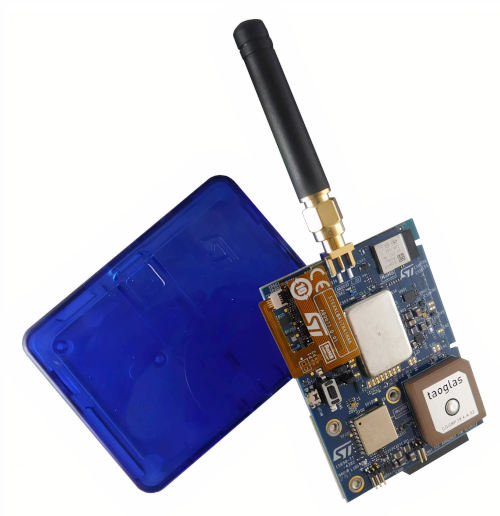 Reference design for multi-connectivity asset tracking STMicroelectronics STEVAL ASTRA1B
image 3 shows the reference design and development kit
The STEVAL ASTRA1B is specifically designed for prototyping and evaluating asset tracking applications. It integrates two wireless connectivity modules: the STM32WB5MMG (a 2.4 GHz, short-range, low-power, wireless BLE/ZigBee microcontroller module) and the STM32WL55JC (a long-range, sub-GHz wireless microcontroller module for LPWAN communication, such as LoRa).
Figure 3: The STEVAL-ASTRA1B asset tracking development kit (source: ST).
The STEVAL ASTRA1B includes a comprehensive set of sensors capable of measuring a multitude of environmental and motion parameters. A GNSS module provides outdoor positioning data. The board also features an STSAFE safety element, a 480 mAh battery, and a pre-configured test with a control panel for asset tracking and a mobile application.
The Silicon Labs xG24-RB4188A is an antenna diversity add-on for prototyping 2.4 GHz wireless applications (Figure 4). It connects to the Silicon Labs BRD4001 wireless starter board. The module contains a Silicon Labs EFR32 Wireless Gecko system-on-a-chip, an RF switch, an adaptive network, and two SMA antenna connectors. The RF output from the EFR32 is +20 dBm.
 Image4: The Silicon Labs xG24-RB4188A antenna diversity module mounted on a Silicon Labs Wireless Kit Pro main board (source: Silicon Labs).
SEMTECH LR1120 Development Kits
To create prototypes of LoRa LPWAN applications based on the SEMTECH LR1120 wireless microcontroller, SEMTECH offers a range of LR1120 development kits, such as the one shown in Figure 5.
Figure 5: Example of a SEMTECH LR1120 development kit (source: SEMTECH)
The kits are available in regional variants according to the sub-GHz spectrum of the band for industrial, scientific and medical (ICM) applications.
The LR1120 kit can be used in many multi-regional applications for theft prevention, inventory management, and asset tracking.
We previously discussed the possibility of adding additional sensors or peripherals to a development board. As already explained, the Microchip board features a mikroBUS connector. This connector, developed by Mikroe, has quickly become an industry standard, and many semiconductor vendors have incorporated it into their evaluation and development boards. The mikroBUS input provides SPI, UART, and I2C serial connectivity, as well as power, analog, and PWM signals, all in a compact connector. Mikroe has developed hundreds of Click that utilize this practical form factor.
One example is the Mikroe Ultra-Low Press Click, designed for low-pressure pneumatic measurements, which features a TE Connectivity SM8436 pressure sensor communicating via the I2C interface (Figure 6).
 Image 6: The Mikroe Ultra-Low Press Click plate (source: Mikroe)
IoT Development Kits Facilitate Progress.
Thanks to development boards, it's much easier to create prototypes for IoT applications. In this short article, we've raised some questions that embedded systems engineers should ask themselves when selecting a suitable development board. However, the factors we've discussed aren't the only ones to consider. The specific application will have demands and requirements that must also be taken into account.
What is he going to design?





