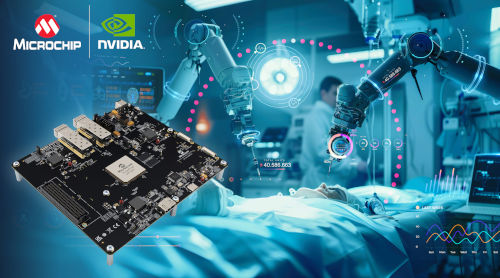
Future solutions will support a wide variety of sensors with different interfaces, including SLVS-EC™ 2.0, 12G SDI, CoaXPress® 2.0, and JESD204B. The platform allows designers to leverage the power of the NVIDIA Holoscan ecosystem and the power-efficient technology of PolarFire FPGAs with low-latency communication and multi-protocol support.
NVIDIA Holoscan helps accelerate the development and deployment of AI and high-performance computing (HPC) applications at the edge for real-time insights. It provides the necessary hardware and software systems on a single platform for low-latency sensor streaming and network connectivity. The platform includes optimized libraries for data processing, sample AI models to accelerate the development of AI inference pipelines, template applications to facilitate rapid prototyping, and core microservices to run streaming and image processing applications, among others.
Thanks to its ability to interconnect sensor data in real time to NVIDIA Holoscan and NVIDIA IGX and NVIDIA Jetson for AI and robotics at the edge, the PolarFire FPGA Ethernet sensor bridge opens up new edge-to-cloud applications, enables AI/ML inference, and facilitates the adoption of AI in the medical, industrial, and automotive markets.
“The sensor bridge over Ethernet is based on Microchip’s PolarFire FPGA platform, which is known for its power efficiency, security, and reliability,” said Bruce Weyer, vice president of Microchip’s FPGA business unit. “By combining our flexible FPGA fabric and NVIDIA’s advanced, multi-protocol-compatible AI platform, we are enabling developers to create innovative, real-time solutions that will revolutionize sensor interfaces in a wide range of powerful AI-powered edge applications.”
Thanks to the low power consumption of Microchip's PolarFire FPGA technology, the NVIDIA Holoscan sensor bridge efficiently manages high-bandwidth data from multiple sensors over Ethernet, enabling high-performance, real-time AI processing at the edge on NVIDIA AI platforms. The power-efficient design is also well-suited for space-constrained, energy-sensitive, or cost-sensitive applications.
PolarFire FPGAs eliminate security concerns in sensor applications by providing embedded security features to protect against potential cyber threats and ensure the physical integrity of the device, design, and data. Their design also incorporates single event upset (SEU) immunity, making them highly reliable in radiation-laden environments such as space applications, high-altitude settings, and medical environments. SEU immunity also helps reduce the risk of data corruption and system failures.