

 Applications such as industrial automation and control products, measuring instruments, and manufacturing equipment require exceptional levels of reliability, all while operating in often harsh and hazardous environments. Performance improvements are also highly valued; for example, a small increase in communication speed can translate into greater efficiency in factory setup. At the same time, compliance with standards and safety are of paramount importance.
More recently, these well-known industrial design requirements have been joined by demands typically associated with consumer products. Designers face increasing pressure to reduce system size and energy consumption, partly because smaller, more closely spaced components present a challenge for thermal management, but also due to considerations such as environmental awareness and fluctuating global energy prices.
The rise of the optical coupler
Isolation components play a key role in addressing this growing industrial market. They provide three key functions in electrical and electronic equipment: first, they are used in situations requiring galvanic isolation, whether for safety or circuit protection; second, they can be used to eliminate impedance mismatches; and third, they can be used to reduce circuit noise. This last function can be especially important in industrial environments when it is necessary to combine electrically noisy motors and drives with sensitive electronic control circuitry.
Optical couplers, or optocouplers, have become the solution of choice for numerous industrial isolation applications. These devices convert electrical signals into light using input circuitry that controls an LED (usually a GaAlAs type). A high-gain photodetector, located in the same package, detects the resulting light signals and converts them back into the appropriate electrical format via an output circuit.
 The type of component and its application are defined primarily not by the LED/detector combination, but by the nature of the input and output circuitry, which can vary enormously. For example, an optical coupler could be used to provide a simple on-off rocker function that in the past would have been performed by a switch or relay. In contrast, other types of components use a logic-level input to generate a high-current output suitable for driving power MOSFETs or IGBTs—a task that has more in common with signal conditioning than relay switching.
Nevertheless, in all applications, optical couplers are rapidly replacing electromechanical solutions and offer the well-known advantages of solid-state technology: long operating life; high reliability; low power consumption; fast switching speed; and a smaller board footprint.
Optical coupler options
Optical couplers with output transistors are used in applications such as PLC switches, power supplies, and inverters. The main selection criteria for the designer are the collector-emitter voltage, the current transfer ratio, the number of channels, and the package type.
A second major category of optical couplers consists of higher-performance coupler ICs.
For example, a device like the TLP2404 from Toshiba Electronics Europe (TEE) combines a wide input voltage range (4.5V to 30V) with an open-collector inverse logic output, making it an ideal solution for designers who need to implement an isolation interface between intelligent power modules (IPMs) and the IC's control circuitry (Figure 1). Space constraints and other design considerations may also necessitate the use of multiple channels.
 Toshiba's TLP2468 and TLP2168 devices, for example, offer single- or dual-channel output options with very high input-to-output noise impedance for high-speed (20 Mbit/s) communication interfaces in applications such as industrial automation equipment and instrumentation. While the outputs are typically configured with open collectors, it is sometimes necessary to conduct current in both directions.
In this case, a device like the TLP2366, with a totem-pole output, can be used for both consumption and supply control. For other consumption/supply applications, such as controlling an AC load, a solid-state relay, or a motor, a triac coupler can be used.
Optical relays (also called MOSFET output couplers) are being used to replace mechanical relays in a growing variety of switching applications. Again, the required characteristics will depend on the application; for example, industrial instrumentation typically requires low capacitance and low resistance.
The general-purpose optical coupler, designed for engineers who need to control power circuits containing IGBTs (insulated gate bipolar transistors) or power MOSFETs, integrates a complete gate control subsystem into a single package. A device like the Toshiba TLP352 does precisely this and fully complies with international safety standards such as EN 60747-5-2 (and others).
Optical coupler applications
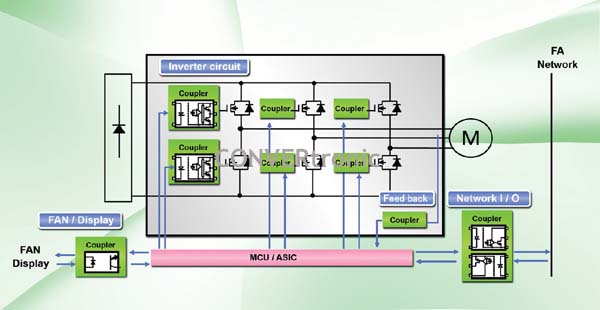
In practice, real-world applications often require more than one type of optical coupler. Thus, in a typical IGBT- or MOSFET-based AC servo amplifier application (see Figure 2), the couplers providing gate control must also offer high isolation (up to 3750V) since current spikes of 1A or higher are not uncommon.
In contrast, speed is especially important at the interface between the servo circuitry and the host microcontroller or ASIC, so a coupler capable of operating at speeds in the megabit (or tens of megabits) range is required. Finally, the network interfaces, display, and cooling system may not need to offer the highest speed specifications, but they must provide appropriate logic voltage levels and noise immunity.
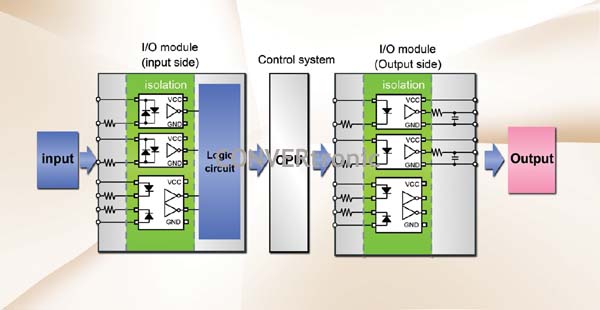
A typical PLC controller application will also require various types of optical couplers, as illustrated in Figure 3.
As with the AC servo example, data transmission speeds can be high: up to 25 Mbit/s. PLCs typically handle a wide variety of input and output types, as well as simple logic signals, and as noted earlier, this necessitates the use of AC inputs (visible in the upper left of Figure 3) in both single-channel and multi-channel configurations. The ability to handle supply voltages from 3.0 V to 20 V further expands the designer's options.
 Trends in optical couplers
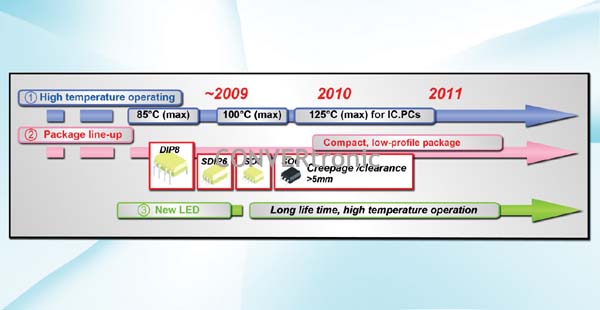
Given such a wide variety of applications, the pace of evolution in optical coupler design is rapid. As mentioned, board space is a major factor driving component miniaturization across the board. Dual in-line packages (DIPs) have seen a significant reduction in size: a current six-pin Shrink DIP has a 50% smaller footprint than the eight-pin DIP it replaces, and many DIPs are being replaced by surface-mount devices (SMDs).
Although packages are becoming smaller, IEC/EN requirements for creeppage (the shortest distance along the surface of the internal insulating material between conductive parts in an insulating component) and clearance (the shortest distance through the air between two conductive parts) remain the same or are even more stringent, posing a considerable challenge for optical coupler manufacturers. Devices recently introduced to the market exhibit creeppage and clearance values exceeding 5 mm despite being supplied in compact, low-profile packages.
Operation over a wide temperature range is also an increasingly important requirement, so optical couplers typically offer operation within a range of [insert temperature range here].
-40°C to 125°C. Developments in processes and packaging—along with the introduction of new LLTL (long-life LED) technologies—allow companies like Toshiba to meet requirements with devices that guarantee performance across the wide temperature range and improve reliability throughout their operational life.
Figure 4 illustrates some of the latest trends in optical couplers, using the evolution of Toshiba's product line as a reference.
At the same time, and due to the particular importance of industrial safety, voltage isolation requirements are also becoming increasingly stringent. Thus, due to the requirement for compliance with international safety standards, even miniature optical couplers are now required to offer up to 5000Vrms.
 Although specifications are becoming increasingly stringent, the most important point is to reduce power consumption as much as possible. Thus, while currently available IGBT control couplers can supply peak currents of up to 6A, the optical couplers themselves consume only a few milliamperes of current and have been designed with very fast switching times (less than 200ns) and low skew (80ns or less). These technologies help engineers design tightly controlled power circuits to reduce the overall system power consumption.
Finally, some of the latest advancements in optical couplers have focused on increasing data communication speeds to handle the growing volume of data in applications such as IPM control and digital interfaces.
Certainly, in addition to improving data transmission speeds, maintaining signal integrity is crucial; therefore, most Toshiba optical couplers offer high levels of noise immunity between input and output and incorporate internal Faraday shielding. This shielding ensures that the optical couplers guarantee minimum immunity to common-mode transients, typically between ±15kV/µs and ±20kV/µs, thus further improving signal quality at these high data transmission speeds.