In recent years, the rapid growth of generative AI and big data processing has accelerated the deployment of high-performance servers in the industrial equipment sector. The resulting increase in power density is placing greater pressure on electrical infrastructure, to the point where localized supply shortages are feared. While smart grids that combine renewable energy sources (e.g., solar power) with conventional power grids are emerging as a potential solution, minimizing losses during energy conversion and storage remains a key challenge.
In the automotive sector, the latest generation of electric vehicles requires greater cruising range and faster charging, generating a demand for inverters with lower losses and higher-performance on-board chargers (OBCs). In response, the adoption of SiC devices capable of achieving both low losses and high efficiency is increasing in high-power applications ranging from a few kilowatts to hundreds of kilowatts.

As a leading global semiconductor company, ROHM was the first in the world to begin mass production of SiC MOSFETs in 2010, contributing to reduced power losses by implementing SiC devices in a wide range of high-power applications. This included offering an initial product line that met automotive reliability standards such as AEC-Q101. Furthermore, 4th generation SiC MOSFETs, with sample deliveries beginning in June 2020, have been adopted worldwide in industrial and automotive applications. They are available in a broad product portfolio, including both discrete devices and modules, facilitating rapid market adoption of SiC technology.
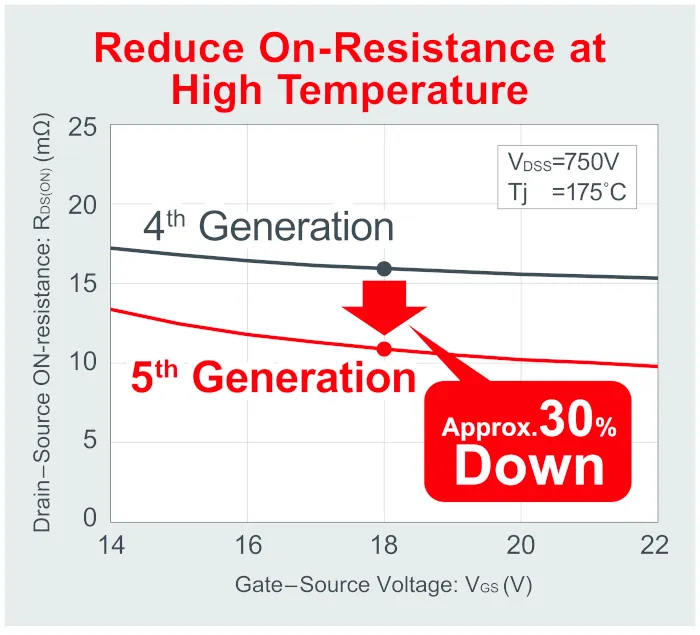
The newly developed 5th generation SiC MOSFETs achieve industry-leading ultra-low losses, driving the increasingly widespread adoption of SiC technology. Thanks to structural improvements and optimized manufacturing processes, on-resistance is reduced by approximately 30% during high-temperature operation (Tj=175°C) compared to conventional 4th generation products (under the same breakdown voltage and chip size conditions). This improvement contributes to smaller unit sizes while increasing power output in high-temperature applications such as xEV traction inverters.
ROHM began supporting the bare chip business with 5th generation SiC MOSFETs in 2025 and completed development in March 2026. In addition, starting in July 2026, ROHM will supply samples of discrete devices and modules incorporating 5th generation SiC MOSFETs.
In the future, ROHM plans to expand its 5th generation SiC MOSFET range with additional breakdown voltage and package options. ROHM will also continue to improve its design tools and strengthen application support. By continuing to promote the deployment of SiC technology—which is now entering a phase of widespread adoption—ROHM is contributing to more efficient energy use in a wide variety of high-power applications.
Application examples
: Automotive systems: xEV traction inverters, on-board chargers (OBCs), DC-DC converters, electric compressors.
Industrial equipment: power supplies for AI servers and data centers, photovoltaic power inverters, ESS (energy storage systems), UPS (uninterruptible power supply systems), eVTOL (electric vertical takeoff and landing vehicles), and AC servos.
EcoSiC
™ is a brand of silicon carbide (SiC) devices that is gaining attention in the power device field by demonstrating performance even higher than that of silicon (Si). ROHM independently develops the core technologies necessary for the advancement of SiC devices entirely in-house, from wafer fabrication and process development to encapsulation and quality control. At the same time, we have implemented a fully integrated production system that covers the entire manufacturing process, solidifying our position as a leading SiC supplier.
*EcoSiC™ is a trademark or registered trademark of ROHM Co., Ltd.